I’m the owner of LONATARP. Here’s what I’ve learned after 12 years in this business: the biggest mistake B-end buyers make when sourcing PVC tarpaulins is focusing entirely on the coating while ignoring the base fabric. I’ve seen procurement managers spend weeks comparing PVC thickness quotes, only to end up with products that delaminate within months. The base fabric—the “skeleton” nobody talks about—is usually where the real quality differences hide.
I. What Is PVC Tarpaulin Substrate?
If you’ve sourced PVC tarpaulins before, you’ve probably heard the term “substrate or base fabric.” But what exactly is it? Why do some PVC-coated fabrics crack after just a few years while others last a decade?
The answer almost always comes down to the base fabric.
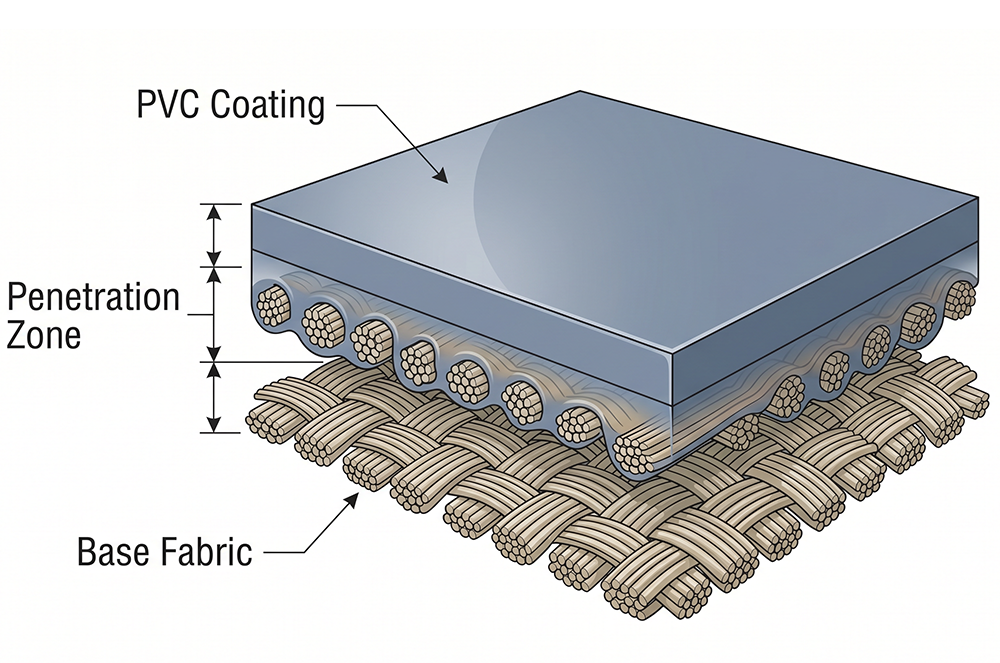
The base fabric (also called scrim fabric or backing fabric) is the structural core layer of PVC tarpaulin. It provides tensile strength, dimensional stability, and abrasion resistance. The PVC coating is just the outer “skin”—the base fabric is what actually bears the load, resists tearing, and keeps the whole structure intact.
During my 12 years dealing with international buyers, I’ve noticed something: most procurement teams focus entirely on PVC coating thickness and surface treatment. They overlook base fabric selection. This is a critical mistake. Choose the wrong substrate, and no matter how thick the coating, the structure will fail first.
What Does the Base Fabric Actually Do?
The base fabric isn’t a supporting player in PVC tarpaulin—it’s the load-bearing core. More specifically, it handles three essential jobs:
1. Provides Tensile Strength In daily use, tarpaulins endure wind loads, snow weight, foot traffic, and other forces. All of these ultimately stress the base fabric layer. Without high-strength base fabric, tarpaulins tear easily at seams and edges.
I once witnessed a case where a cargo cover was damaged during transit because the buyer chose a low-price option with poor-quality base fabric. A small puncture caused the cover to expand rapidly, eventually tearing the entire piece of fabric. The loss from the damaged cargo ended up being higher than the cost saved on the cover.
2. Maintains Dimensional Stability Quality base fabric has extremely low stretch under load and temperature changes. This means the tarp won’t gradually loosen after installation, or warp badly under high heat.
3. Supports the PVC Coating The base fabric’s fiber structure determines how well the coating adheres and penetrates. High-density base fabric allows better PVC penetration, stronger interlaminar bond, and longer service life.
Think about it this way: poor base fabric quality means the surface coating—even if thick—will delaminate, bubble, or peel off. This is why tarpaulins of the same weight can vary 30%+ in price. The difference is usually in the base fabric.
Base Fabric and PVC Coating Relationship
Many clients ask me: “Can’t we just use thicker coating? Doesn’t thicker mean more durable?”
This thinking is understandable but imprecise. The coating and base fabric relationship isn’t “thicker is better”—it’s about proper matching and strong bonding.
Coating Penetration Depth
When PVC coating is applied to base fabric, the compound penetrates into gaps between fibers. Higher-density base fabric creates greater penetration resistance—the coating tends to stay on the surface, forming a “fake coating” that cracks and peels under bending or folding.
Quality base fabric: PVC coating penetration depth should be 30-50% of fiber diameter. This creates a “mortise-and-tenon” bond between coating and base fabric, maximizing interlaminar shear strength.
Base Fabric Surface Treatment
Reputable manufacturers treat base fabric before coating. Two common methods:
- Singeing: Removes surface fuzz for smoother surface, more uniform coating
- Heat setting: Eliminates internal fiber stress for better stability during processing and use
Quality-unstable base fabric has excessive fuzz, insufficient heat setting—after coating, you’ll see surface roughness, color variation, even local thin spots from uneven coating. Inspect these during acceptance.
Coating Weight Selection
The industry uses “coating GSM” to measure PVC coating thickness. Common ranges:
- 260-300 gsm: Light coating, for temporary, low-intensity applications
- 400-550 gsm: Medium coating, commercial and general industrial use
- 550-750 gsm: Heavy coating, high-strength, long-term outdoor use
- Above 800 gsm: Extra-heavy coating, extreme environments, military grade
Base fabric GSM and coating GSM must match. I once worked with a buyer who purchased 300gsm base fabric with 260gsm coating. The coating was too thin to penetrate the base fabric properly. Three months later, the surface delaminated. Classic “mismatched base fabric and coating” problem.
The base fabric determines the tarpaulin’s strength ceiling. The coating determines weather resistance and surface performance. Both are essential.
II. Polyester vs. Nylon Base Fabric: How to Choose?
This is the question I get asked most often. Both are synthetic fibers, but their performance profiles differ significantly.
Polyester Base Fabric
Polyester is the dominant choice for PVC tarpaulin base fabrics. In China, I’d estimate over 80% of industrial tarpaulin manufacturers use polyester. Why? Better value—balanced performance at a reasonable cost.
Polyester advantages:
- Strong UV resistance: Outperforms nylon in long-term outdoor exposure, won’t embrittle as quickly
- Hydrolysis resistant: Stable in humid environments, won’t lose strength from water absorption
- Stable pricing: Ample raw material supply, controllable costs
Polyester disadvantages:
- Lower elastic recovery: Doesn’t bounce back as well after sustained stretching compared to nylon
- Higher initial modulus: Flexibility decreases somewhat in extreme cold (below -20°C)
Nylon Base Fabric
Nylon has the highest strength-to-weight ratio of almost any fiber. So for applications requiring lightweight + high strength, nylon base fabric has a clear advantage.
Nylon advantages:
- Higher strength: At the same denier, nylon fiber is approximately 20-30% stronger in tensile
- Better elastic recovery: Springs back after stretching, resists permanent deformation
- Superior abrasion resistance: Better for applications involving frequent friction (protective clothing, conveyor belts)
Nylon disadvantages:
- Poor UV resistance: Extended sun exposure causes yellowing and strength loss; requires additional UV inhibitors
- Weak hydrolysis resistance: Strength degrades faster in high humidity or immersion environments
- Higher cost: Raw material is typically 1.5-2x the price of polyester
My Recommendation
For standard industrial applications (warehouse covers, cargo yard covers, construction protection): polyester base fabric is sufficient—durable and economical.
For long-term outdoor use with weight requirements (large outdoor tents, inflatable structures, retractable awnings): consider polyester + thicker coating + UV treatment rather than jumping straight to nylon.
Nylon base fabric suits short-term high-intensity use cases: military supplies packaging, emergency disaster relief tarpaulins, or products requiring frequent folding and storage.
III. Base Fabric Specifications: Denier, Thread Count, GSM
When sourcing, you often see labels like “1000D,” “20×20,” “200gsm.” What do these numbers actually mean?
Denier — Fiber Thickness
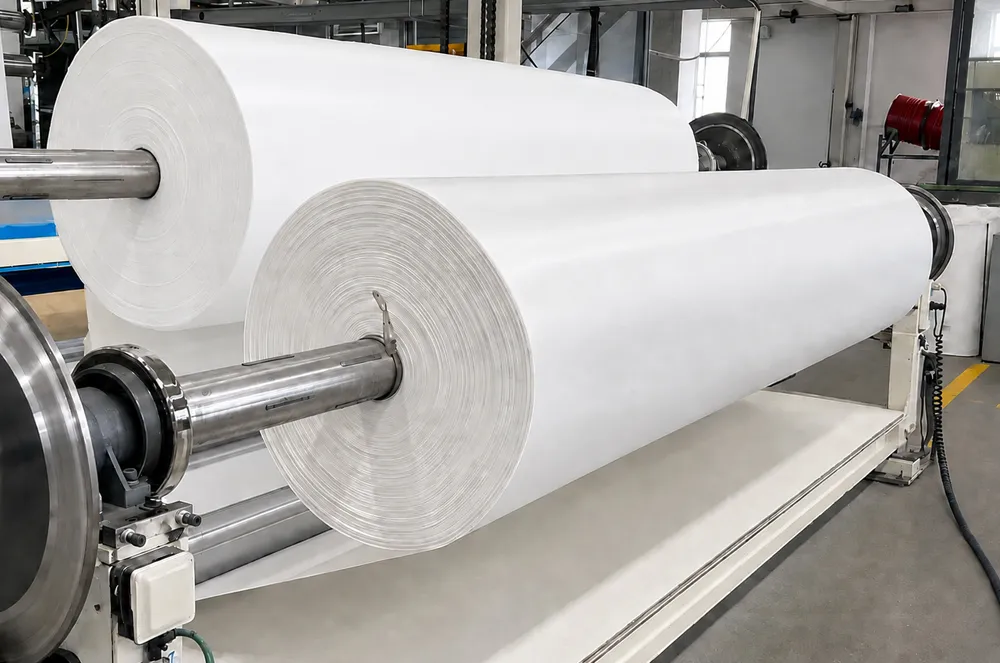
Denier is a weight unit for yarn, defined as “grams per 9,000 meters of yarn.” Higher denier means thicker yarn, heavier fabric.
Common base fabric denier specifications:
- Below 500D: Lightweight base fabric, for light-duty tarpaulins or advertising banners
- 500D – 1000D: Medium specifications, the mainstream choice for commercial and industrial use
- 1000D – 1500D: Heavy-duty base fabric, for large-scale engineering and agricultural storage
- Above 1500D: Extra-heavy-duty base fabric, for mining, military, and specialized applications
I’ve seen buyers chasing high denier numbers, assuming higher is always better. This isn’t accurate. Denier only indicates yarn thickness—it doesn’t directly equal base fabric strength. For the same 1000D base fabric, different twisting methods and fiber density can result in strength variations exceeding 30%.
Thread Count (Warp and Weft Density)
Base fabric is woven from warp (vertical) and weft (horizontal) yarns. Thread count refers to how many yarns per inch (or centimeter).
Common density notations:
- 18×12 (warp x weft): 18 warp yarns and 12 weft yarns per inch—this is common for 1000D polyester tarpaulins
- 20×20: 20 yarns each direction, a tighter weave
- 23×23: High-density base fabric, better coating penetration, used for high-strength products
Thread count directly impacts tear resistance. Higher-density base fabric creates greater resistance to tear propagation. This matters especially in outdoor environments with wind, sand, and temperature swings—low-density base fabric, once punctured, tears rapidly.
GSM (Grams per Square Meter)
GSM is the weight per unit area, directly reflecting base fabric thickness.
- Lightweight base fabric: 100-200 GSM, for advertising banners, linings, packaging
- Medium-weight base fabric: 200-400 GSM, the commercial tarpaulin mainstream range
- Heavyweight base fabric: 400-600+ GSM, engineering and industrial grade
For identical PVC tarpaulin specifications, GSM can differ by 50-100gsm, creating 10-20% price gaps. Whether that difference is worth it depends on whether the weight difference translates to corresponding strength improvement—request the manufacturer’s tensile strength test report to verify.
IV. Warp Knitted vs Woven: How Base Fabric Is Made
When manufacturers talk about base fabric construction, the most important distinction is how the fibers are held together. This affects everything from strength to cost.
Woven Base Fabric
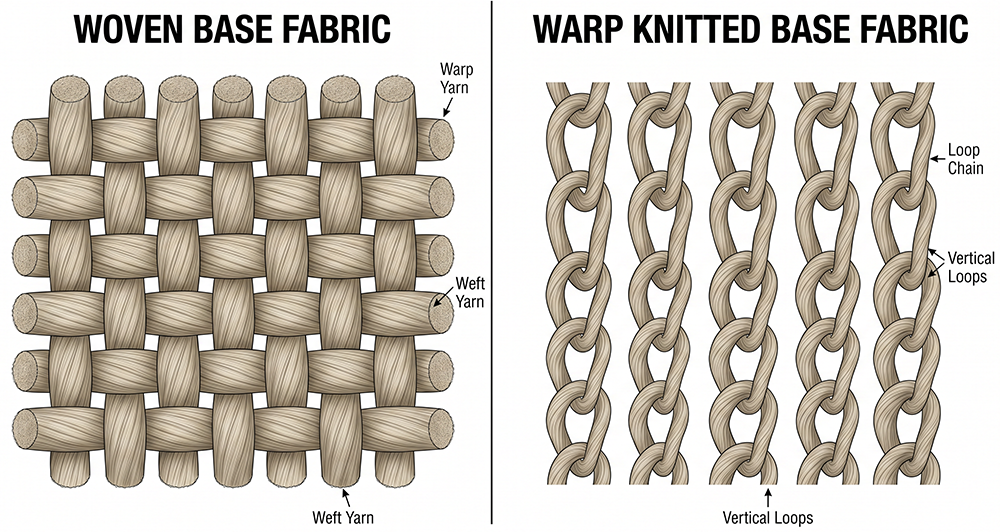
Most PVC tarpaulin base fabric—I’d estimate over 95%—is woven. Warp and weft yarns interlace at right angles.
Characteristics:
- Strong dimensional stability in both directions
- Cost-effective for high-volume production
- Excellent for standard industrial applications
This is what you get with most commercial and industrial tarpaulins.
Warp Knitted Base Fabric
Warp knitted fabric uses a different process—yarns loop vertically (warp direction) without cross-weaving. You’ll see this in specialized applications.
Characteristics:
- Better tear resistance in the warp direction
- Often used for mesh tarpaulins and lightweight covers
- Slightly higher cost than woven equivalents
For most B-end procurement needs—warehouse covers, truck tarpaulins, construction protection—woven base fabric is the standard choice. Warp knitted comes into play when you need specific performance characteristics.
My recommendation: Don’t overthink this. If your supplier asks “woven or warp knitted?”, 9 times out of 10 woven is what you want for standard applications.
Plain Weave: The Industry Standard
Plain weave is the dominant weaving method for PVC tarpaulin base fabric. Over 95% of all industrial tarpaulins use this construction.
Why plain weave dominates:
- Most interlacings = most stable structure
- Even coating penetration
- Cost-effective for volume production
- Proven reliability across decades of use
Twill and satin weaves exist but represent a tiny fraction of PVC tarpaulin production—typically only for specialized applications requiring exceptional flexibility or premium products. For practical B-end sourcing, plain weave is what you’ll encounter 95%+ of the time.
V. How to Select Base Fabric for Different Applications
This section addresses what most procurement teams want to know—I’ve organized recommended solutions for common scenarios:
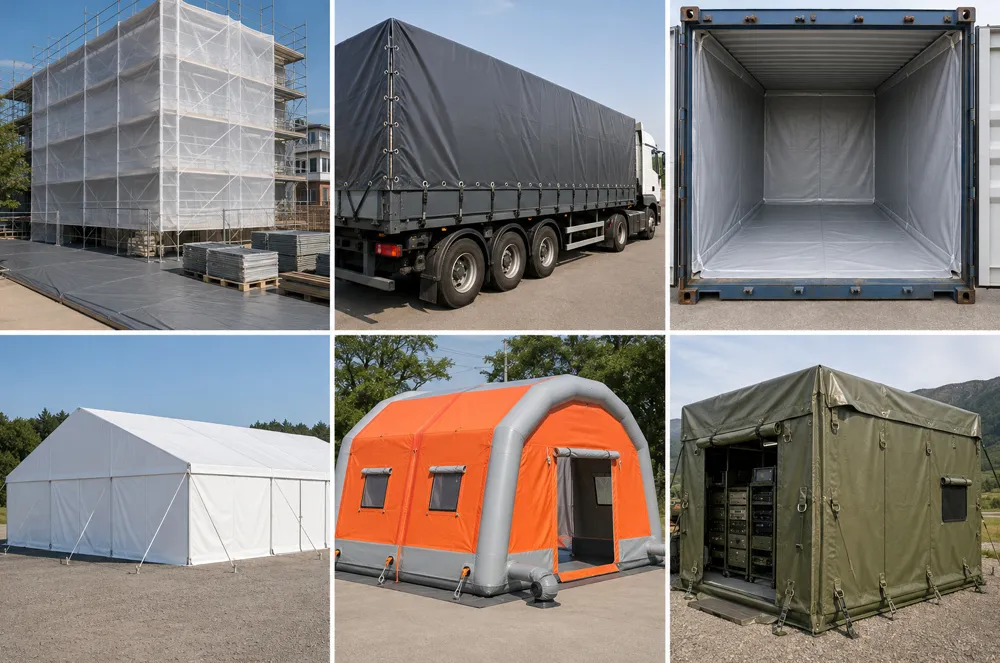
Scenario 1: Construction Site Coverage (Scaffolding Covers, Site Protection)
Recommended: 1000D polyester plain weave base fabric + 350gsm PVC coating
- Strength sufficient for construction environments
- UV-resistant, won’t embrittle under long-term sun exposure
- Cost-effective, easy for bulk replacement
Scenario 2: Cargo Transportation (Truck Tarpaulins, Container Liners)
Recommended: 1000D-1200D polyester twill weave base fabric + 320-380gsm coating
- Twill weave makes tarp softer, easier to fold and store
- Balanced thread count, good tear propagation resistance
- Won’t tear easily in windy, sandy conditions
Scenario 3: Agricultural Storage (Grain Storage Covers, Farm Equipment Covers)
Recommended: 1200D polyester high-density base fabric + 380-400gsm coating + anti-corrosion treatment
- Heavy base fabric provides sufficient puncture resistance (against branches, farm tools)
- Anti-corrosion treatment handles acids and alkalis in agricultural environments
- Good hydrolysis resistance, strength won’t degrade in humid conditions
Scenario 4: Large Outdoor Tents, Inflatable Structures
Recommended: 1500D polyester satin weave base fabric + 500gsm+ coating + UV inhibitors
- Satin weave provides excellent tear strength
- Heavy coating ensures airtightness and weather resistance
- UV inhibitors slow long-term sun aging
Scenario 5: Military / Specialized Applications
Recommended: 1500D+ nylon base fabric + 650gsm+ heavy coating
- Nylon base fabric provides exceptional strength-to-weight ratio
- Extra-heavy coating handles extreme environments
- Usually requires additional flame-retardant, anti-mold treatments
FAQ
Q1: Is higher denier always better for base fabric?
Not exactly. Denier indicates yarn thickness, but base fabric strength also depends on fiber quality, weaving density, and heat-setting process. When sourcing, don’t focus solely on denier—also check thread count, GSM, and request the manufacturer’s tensile and tear strength test data.
Q2: Plain weave vs. twill weave—which is more durable?
It depends on the application. Plain weave has better dimensional stability, suitable for fixed long-term coverage. Twill weave is more flexible, suitable for uses requiring frequent folding and storage. With normal maintenance, both can last many years—there’s no absolute “more durable” answer.
Q3: Polyester vs. nylon—which is better for long-term outdoor use?
Polyester is better for long-term outdoor use. Polyester’s UV resistance and hydrolysis resistance outperform nylon. After 3-5 years of outdoor exposure, polyester base fabric typically retains 70%+ of its strength, while nylon may drop below 50%. If you must use nylon, choose versions with UV inhibitor treatment.
Q4: Base fabric GSM vs. coating GSM—which matters more for durability?
Base fabric GSM matters more. Base fabric determines the tarpaulin’s tensile strength and tear strength ceiling. If base fabric weight is insufficient, no amount of coating provides adequate structural strength. That said, the importance of coating weight increases for applications where waterproofing is the primary concern and load-bearing is secondary.
Q5: How to judge base fabric quality?
A few practical methods:
- Visual inspection: Surface should be smooth, minimal fuzz, even color
- Touch: Should have some stiffness without being too hard (excessively rigid suggests over-processing)
- Fold test: Quickly fold 10 times, check for coating cracks
- Weigh it: For the same specification, actual GSM deviation should not exceed ±5%
Q6: What special treatments might base fabric need?
Depending on the application:
- Flame retardant: Public buildings, warehouses, military use
- UV inhibitors: Long-term outdoor exposure
- Anti-microbial / anti-mold: Humid environments, agricultural use
- Anti-static: Flammable/explosive environments
Q7: What’s the difference between scrim fabric and backing fabric?
In the PVC-coated fabric industry, these terms are often used interchangeably—both refer to base fabric. “Scrim” is more common in coated fabrics and inflatable materials, while “backing fabric” appears more in traditional textiles. Functionally, there’s no difference—just industry terminology preferences.
Summary: Choosing the Right Base Fabric Is the First Step to Sourcing Good Tarpaulin
When sourcing PVC tarpaulins, getting the base fabric right solves most of the problem. Remember these core points:
- Base fabric is the structural skeleton: No matter how thick the coating, poor base fabric means short product life
- Polyester is the mainstream choice: Unless you have specific lightweight or high-elasticity requirements, polyester base fabric is usually the best choice
- Evaluate specifications holistically: Consider denier, thread count, and GSM together—don’t judge by any single number
- Match weave to application: Plain weave is economical and practical, twill offers better flexibility, satin suits premium projects
- Base fabric and coating must match: Heavy base fabric with thin coating, or light base fabric with extra-heavy coating, both waste money