I’m the owner of LONATARP, a PVC coating factory in Haining, China. I’ve been in this business for over a decade. Every week, I get messages from buyers asking the same thing: “What’s the difference between GSM and oz?” or “How thick do I actually need?”
So I’m writing this guide for one reason — I want you to stop guessing. After reading this, you’ll know exactly what PVC tarpaulin weight means, which unit to use, and how to choose tarpaulin GSM for your specific application. Whether you’re looking for tarpaulin weight for truck cover or need to understand what is GSM in tarpaulin specifications, this guide covers it all.
Let’s get into it.
I. Why Does This Matter?
Here’s what I see too often: a buyer orders 650 GSM tarpaulin for a project that only needs 450 GSM. They spend 30% more than necessary, and the result is the same. I’ve also seen the opposite — someone orders too light and the material tears within weeks.
The confusion comes from units. GSM, oz, mil, mm — they’re all measuring weight or thickness, but most buyers have never worked with these terms before. Once you understand what each unit means, the decision becomes obvious.
This guide covers the three units you’ll encounter most: GSM, Oz, and Mil. I’ll explain each one in plain English, show you real-world comparisons, and help you choose the right spec for your application.
II. What Is GSM? (Grams per Square Meter)
The Basics

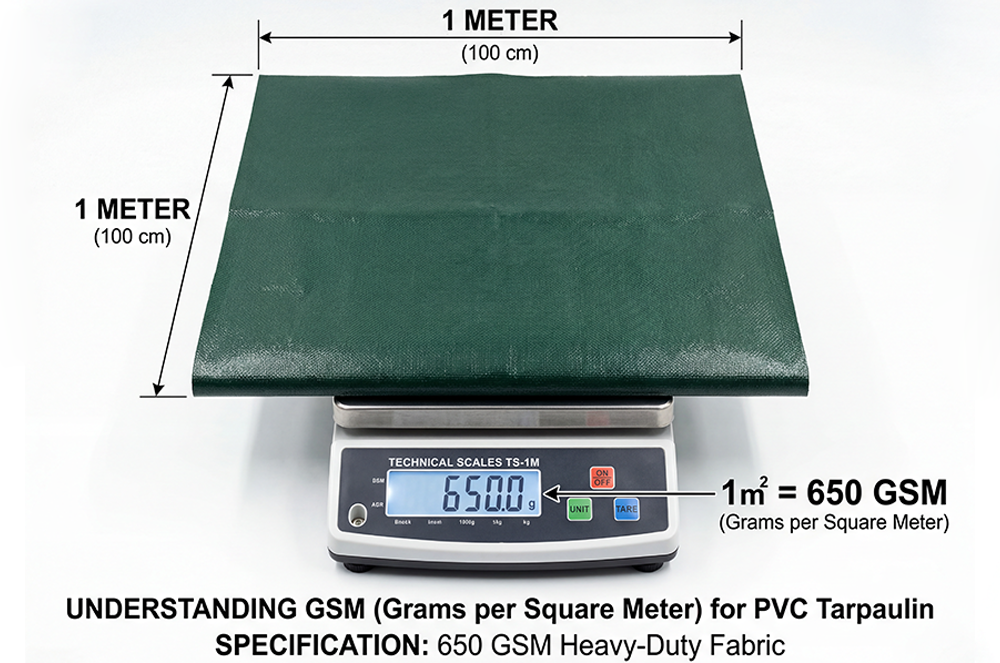
GSM stands for “grams per square meter.” It tells you how much one square meter of the tarpaulin weighs in grams.
Think of it like this: if you cut a 1-meter by 1-meter piece of tarpaulin and put it on a scale, the reading in grams is the GSM.
That’s it. Nothing complicated.
Common GSM Ranges and What They Mean
Here’s how we categorize tarpaulin GSM in our factory. Understanding what is GSM in tarpaulin starts here — GSM (grams per square meter) is the most widely used unit for measuring tarpaulin weight globally:
| GSM | Category | Typical Use |
|---|---|---|
| 300-400 | Light Duty | Temporary covers, indoor use, short-term protection |
| 450-550 | Medium Duty | General cargo covers, truck beds, construction site covers |
| 600-750 | Heavy Duty | Large machinery covers, long-term outdoor storage, aggressive environments |
| 800+ | Extra Heavy | Industrial applications, harsh weather conditions, military-grade |
How GSM Affects Durability
In my experience, every 50 GSM increase adds roughly 15-20% to the material’s tear strength and abrasion resistance. This relationship between tarpaulin weight vs durability is crucial for making smart purchasing decisions. But here’s the catch — the base fabric matters as much as the coating.
A 600 GSM tarpaulin with a weak 500D base fabric will perform worse than a 550 GSM tarpaulin with an 840D base fabric. When you’re evaluating specs, ask about both the coating weight AND the base fabric denier.
A real example: Last year, a construction company in Chile ordered 650 GSM tarps for a 6-month project. The material performed flawlessly through heavy wind, rain, and dust. They came back this year for 2,000㎡ more. The key was that we used 840D polyester base fabric — not the standard 500D. This demonstrates how heavy duty tarpaulin weight specifications need to account for both GSM and base fabric quality.

III. What Is Oz? (Ounces per Square Yard)
The Basics
Oz stands for ounces per square yard. If GSM is metric, oz is imperial — used mostly in the US and UK markets.
1 square yard = 0.836 square meters
So oz and GSM aren’t directly comparable without conversion. Here’s a quick reference:
GSM to Oz Conversion
| GSM | Approximate Oz | Use Case |
|---|---|---|
| 340 | 10 oz | Light-duty truck covers |
| 440 | 13 oz | Standard cargo covers |
| 510 | 15 oz | Heavy-duty flatbed tarps |
| 610 | 18 oz | Industrial-grade covers |
| 680 | 20 oz | Extreme-duty applications |
Use this tarpaulin oz to GSM conversion table as your quick reference. The conversion isn’t perfect because different factories use slightly different base fabrics and coating methods. But this table gives you a practical baseline for comparing specifications across markets.
When to Use Oz
Use oz specifications when:
- You’re sourcing from US or UK suppliers
- Your customers are familiar with oz measurements
- The project spec sheet requires oz
For most international buyers, GSM is more common and more precise. But if your market is North America, oz is what your customers expect to see.
IV. What Is Mil? (Thousandth of an Inch)
The Basics
Mil measures thickness — specifically, one mil equals one thousandth of an inch (0.001″).
Unlike GSM and oz, which measure weight per area, mil measures linear thickness. This unit is most relevant for the PVC coating layer itself, not the finished tarpaulin.
When Mil Matters
Mil is useful when you’re comparing PVC films, TPU films, or thin laminated layers. Understanding what mil thickness for tarpaulin you need depends on your application. If you’re buying PVC tarpaulin in roll form or need very specific coating thickness, mil gives you the precision GSM can’t.
Common mil ranges for PVC coatings:
- 0.3mm to 0.5mm (12-20 mil): Standard PVC coating thickness mm for general use
- 0.5mm to 0.8mm (20-31 mil): Heavy coating for demanding applications
- 0.8mm+ (31+ mil): Industrial-grade, often double-coated
These PVC tarpaulin thickness guide specifications help you match coating thickness to your requirements.
Mil vs. GSM: Are They Related?
Partially. A thicker coating generally means higher GSM, but it’s not a 1:1 relationship. The base fabric weight, coating density, and lamination method all affect the final GSM.
Think of it this way: two tarpaulins can both be 600 GSM but have very different mil measurements if one uses a lighter base fabric with more coating, and the other uses a heavier base fabric with less coating.
V. How to Choose the Right Weight and Thickness
This is where most buyers get stuck. If you’ve been wondering how thick should tarpaulin be for your application, the answer starts with three questions.
Three Questions to Ask First
- How long does the material need to last? (Days? Weeks? Months? Years?)
- What’s the environment? (Indoor? Outdoor? Extreme weather? Chemical exposure?)
- How much stress will it face? (Wind load? Abrasion? Point loads?)
Once you have the answers, the decision gets much easier.
Light Weight (300-400 GSM / 9-12 oz)
Best for:
- Temporary covers (days to weeks)
- Indoor storage
- Dust protection
- Short-term construction site covers
- PVC tarpaulin weight for agriculture (row covers, nurseries)
What to expect: Affordable, easy to handle, suitable for non-critical applications. Will degrade faster under UV exposure and mechanical stress.
Example: A logistics company in Brazil uses 350 GSM tarps for protecting palletized goods during 2-week sea freight. Works perfectly. No need to pay for 550 GSM here.
Medium Weight (450-550 GSM / 13-16 oz)
Best for:
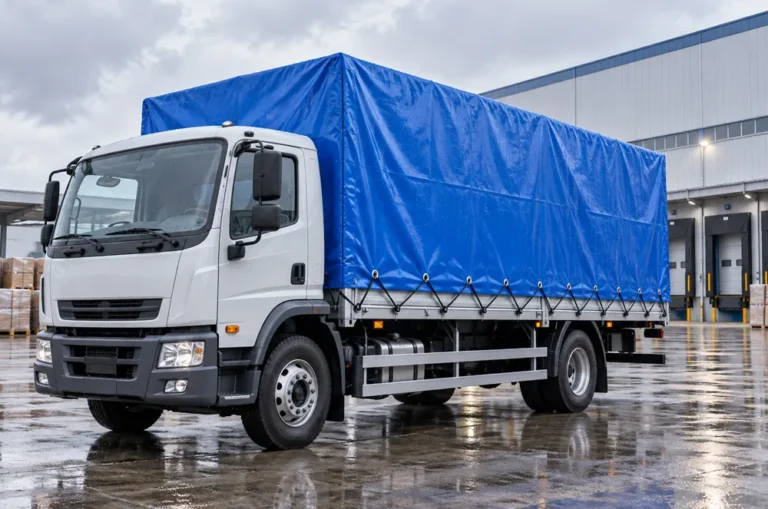
- Standard tarpaulin weight for truck cover applications
- Equipment protection (3-12 months)
- Construction site temporary structures
- Outdoor storage (up to 1 year)
- General cargo protection
This is the most common industrial tarpaulin specifications range for commercial transportation.
What to expect: Good balance of durability and cost. Handles regular handling, moderate wind, and seasonal weather changes. This is the most common spec for commercial use.
Example: A trucking fleet in Germany orders 500 GSM tarps for their regional routes. They get 2-3 years of service life with proper handling. Replacement rate dropped 40% after switching from their previous 400 GSM supplier.
Heavy Weight (600-750 GSM / 18-22 oz)
Best for:
- Long-term outdoor storage (1-3 years)
- Large machinery covers
- Aggressive environments (coastal, desert, industrial zones)
- Flatbed trailers with high tension requirements
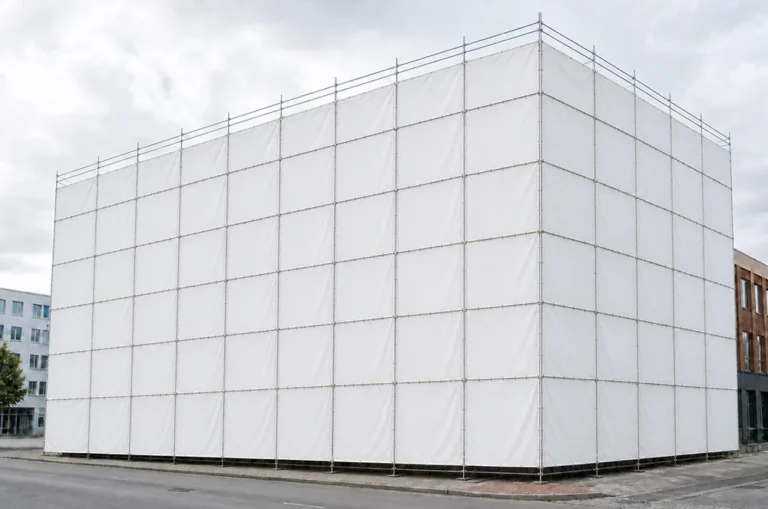
- Architectural membranes and temporary structures
Heavy duty tarpaulin weight in this range delivers maximum durability for demanding applications. These industrial tarpaulin specifications meet the requirements of mining, construction, and transportation sectors.
What to expect: Significantly better tear strength, UV resistance, and abrasion resistance. Higher upfront cost, but lower replacement frequency and better total cost of ownership.
Example: An Australian mining contractor uses 680 GSM tarps to cover excavators at remote sites. The material handles extreme heat, dust storms, and occasional heavy rain. They’re still using the same set after 18 months — their previous 450 GSM covers lasted 4 months.
Extra Heavy (800+ GSM / 24+ oz)
Best for:
- Industrial-grade applications
- Harsh chemical environments
- Long-term permanent installations
- Military or defense use
- Container covers in extreme climates
What to expect: Maximum durability and longevity. Typically uses heavy-denier base fabrics (1000D+) and thick coatings. Not needed for most applications — but when you need it, nothing else will do.
VI. Common Mistakes Buyers Make
After years of talking to buyers, here are the mistakes I see most often:
Mistake 1: Over-specifying
I had a buyer last month order 750 GSM for a 3-month construction site cover. The 500 GSM option would have saved them 25% on material cost, and the performance would have been identical. Always match the spec to the actual application, not the worst-case scenario.
Mistake 2: Ignoring Base Fabric
GSM tells you the coating weight. It doesn’t tell you the base fabric quality. Ask for the base fabric denier (500D, 840D, 1000D). A 500 GSM tarp with 840D base fabric outperforms a 550 GSM tarp with 500D base fabric in most tests.
Mistake 3: Not Considering UV Exposure
If your tarp will be outdoors for more than 6 months, UV resistance matters. Check if the material includes UV inhibitors. Standard PVC coatings without UV treatment will degrade faster in sunny climates.
Mistake 4: Focusing Only on Price Per Square Meter
A 400 GSM tarp at $0.80/㎡ that lasts 6 months costs more per year than a 550 GSM tarp at $1.10/㎡ that lasts 3 years. Always calculate total cost of ownership, not just upfront cost.
VII. FAQ
Q1: Can you customize the weight and thickness?
Yes. We produce PVC tarpaulins from 300 GSM to 1000+ GSM. We can adjust the base fabric denier, coating method, and lamination to meet your specific requirements. For custom specs, contact us with your project details and we’ll provide technical recommendations.
Q2: What’s your minimum order quantity?
Our standard MOQ is 5,000㎡. For sample orders (50-500㎡), we have a different pricing structure. If you’re unsure about quantity, start with a sample order to verify quality before committing to full MOQ.
Q3: How do I know which GSM is right for my project?
Share your application details with us — expected lifespan, environment conditions, mechanical stress factors. We’ll recommend the appropriate spec based on your requirements, not just push our highest-margin product. Sometimes lighter is better for your use case.
Q4: Do you provide certificates?
Yes. We hold CE, SGS, and ISO 9001 certifications. Material test reports are available for each order. If you need third-party inspection or specific test protocols, let us know in advance.
Q5: What’s the delivery time?
Standard orders ship within 15 days from deposit confirmation. For large orders (20,000㎡+), we typically need 20-25 days. Rush orders are available — contact us to discuss your timeline.
Q6: How do you handle quality issues?
We provide pre-shipment inspection reports and photos of finished rolls. If quality issues arise after delivery, we respond within 48 hours and provide replacement or compensation according to our warranty terms. We’ve been in business over 12 years — our reputation depends on consistent quality.
Q7: Can you print logos or custom designs on the tarps?
Yes. We offer custom printing (silk screen, UV printing) and can produce tarps with your brand logo, product information, or custom colors. Setup fees apply for custom printing — contact us for a quote based on your design and quantity.
Summary
Here’s what you should take away from this guide:
Key points:
- GSM (grams per square meter) is the most common unit for tarpaulin weight — higher GSM means heavier and generally more durable
- Oz (ounces per square yard) is the imperial equivalent, used primarily in US and UK markets
- Mil measures coating thickness in thousandths of an inch — useful for comparing PVC films and precision applications
- Match your GSM to actual application needs — don’t over-specify and waste money, but don’t under-specify and risk early failure
- Ask about base fabric denier, not just GSM — the combination of base fabric + coating determines real performance
- Calculate total cost of ownership, not just upfront cost per square meter
The right spec for your project depends on:
- Expected lifespan
- Environmental conditions
- Mechanical stress levels
- Budget constraints
If you’re still unsure, contact us with your project details and we’ll help you choose the right specification. We’d rather spend 10 minutes explaining options than have you order the wrong material.