Custom boat covers protect boats during storage, transport, service, and seasonal exposure. The important word is custom. A cover for a small fishing boat, pontoon boat, speedboat, workboat, or cabin boat cannot be judged by length alone because rails, consoles, engines, windshields, seats, and deck equipment all change the final fit.
In marine cover projects, I usually start with the boat shape before discussing fabric weight. If the cover cannot sit correctly around raised parts, water may collect, straps may pull unevenly, and the fabric may rub against sharp corners. A strong material still fails early when the fit is wrong.
This guide is written for distributors, marine service companies, boat dealers, rental fleets, and procurement teams that need repeatable custom boat cover production rather than one-off retail covers.
I. Why Boat Type Changes the Cover Design
Different boat types need different cover logic. A fishing boat may have a raised console, rod holders, outboard motor, and irregular deck hardware. A pontoon boat usually needs longer side coverage and more attention to rail shape. A speedboat may require a tighter aerodynamic fit for transport. A workboat may need stronger abrasion resistance and easier handling.
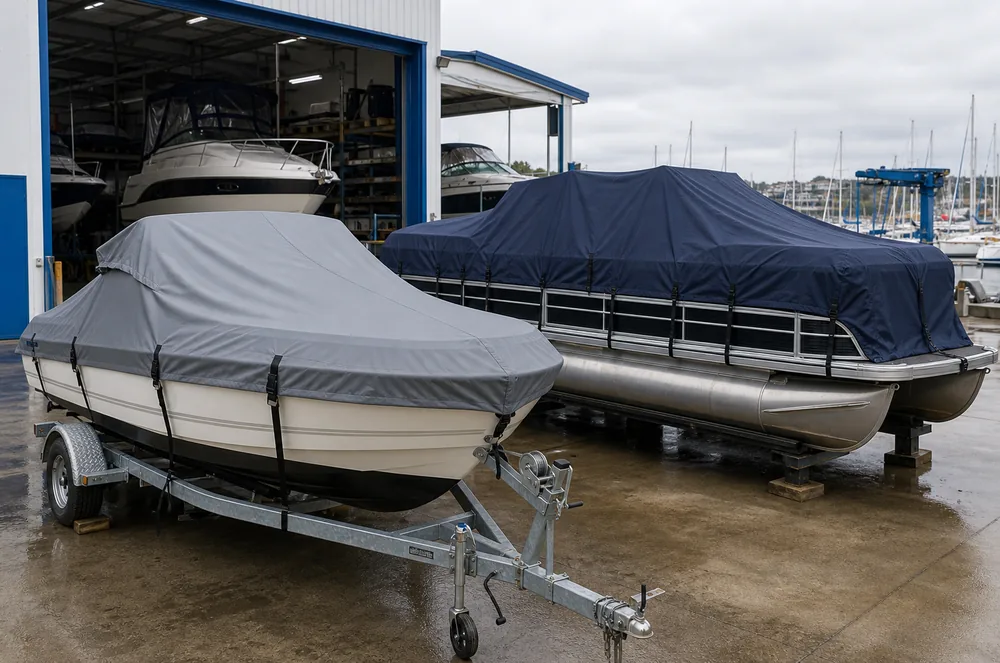
That is why I avoid quoting only from a simple length and width. For a reliable custom cover, the buyer should identify the boat type, highest points, rail layout, motor position, cover purpose, and whether the boat will be covered on a trailer, in water, or in storage.
For outdoor and marina applications, boat covers often sit within a broader sports and outdoor tarpaulin requirement. The same buyer may need covers for equipment, mats, water-related facilities, and seasonal storage, but each cover should still be specified by its actual use.
For dealers and rental companies, the boat type also affects inventory control. If the cover program includes several boat families, the buyer should not mix all covers under one general SKU. A clear size and shape record helps workers identify the correct cover quickly and reduces mistakes during seasonal storage or delivery preparation.
II. Protection Goals: Storage, Transport, and Weather Exposure
A boat cover can protect against rain, dust, UV exposure, bird droppings, salt spray, dirt, leaves, and surface contamination. For B2B buyers, the question is not simply whether the cover is waterproof. The real question is what the cover must survive during its routine: stationary storage, road transport, marina service, rental turnover, or dealer display.
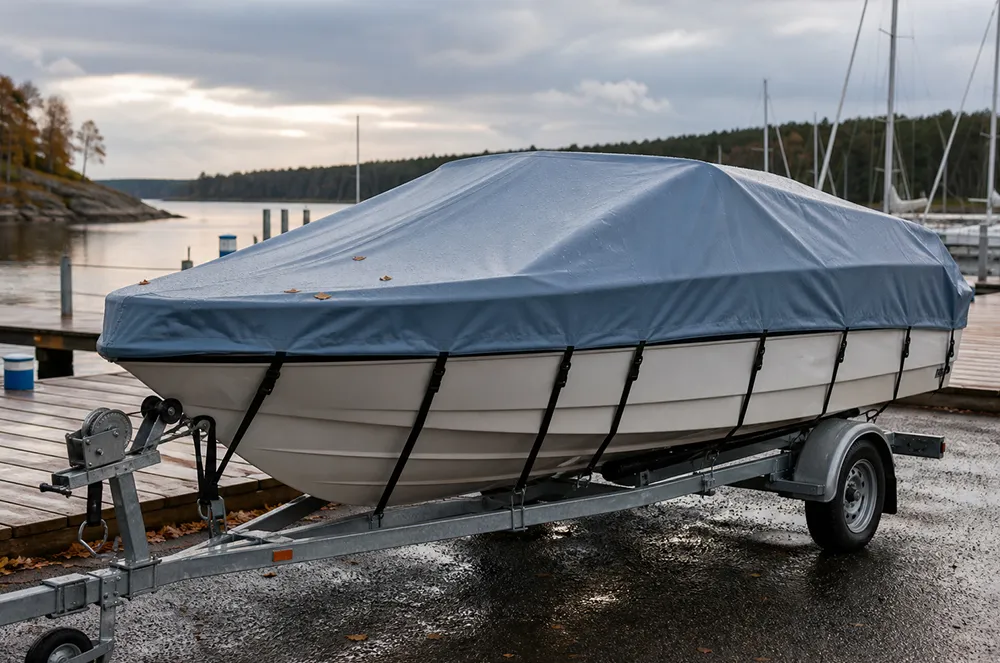
If the boat is stored outdoors for long periods, UV resistance, waterproofing, slope, and ventilation become important. If the boat is transported on a trailer, strap strength, wind flap control, reinforced stress zones, and a secure perimeter matter more. If the cover is used by a rental fleet, fast installation and repeat handling may become the main issue.
Where full water resistance is the priority, buyers may compare the boat cover requirement with a broader waterproof cover specification. The difference is that a boat cover must follow a complex shape and often needs more tailored fastening than a flat equipment cover.
Drainage should be reviewed early. A flat cover surface can hold rainwater, and that water adds weight. If the cover sags, water pooling may pull against seams, straps, and grommets. A practical design needs enough slope or support planning so the cover protects the boat instead of becoming another stress source.
Ventilation is another detail that deserves attention. A fully sealed cover may keep rain away but can trap moisture if the boat is stored for a long period. Depending on the boat type and storage environment, buyers may need vents, a looser perimeter, or a handling routine that allows the boat to dry before covering. This is especially important for marine service providers who handle many boats in a short season.
III. Material, Fit, and Reinforcement Choices
Marine covers need a balance of flexibility, waterproofing, tear resistance, and handling comfort. PVC-coated fabric and vinyl-style materials are common directions because they can be welded, cleaned, reinforced, and produced in different weights and colors. A heavier fabric may improve durability, but it can also make installation harder for crews.
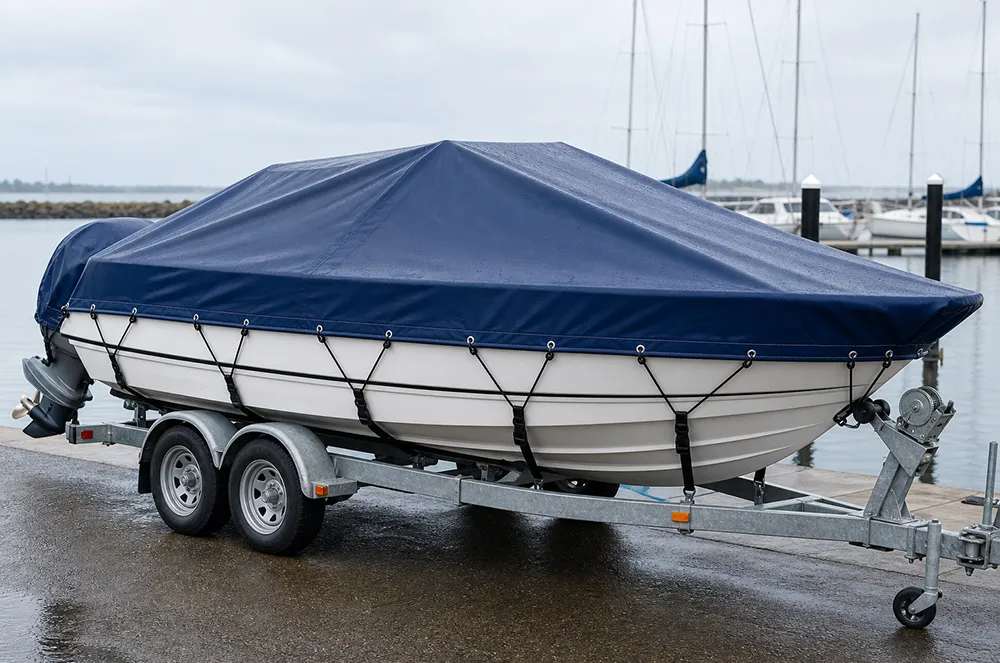
For buyers comparing materials, vinyl tarps can be a useful reference because they explain waterproof PVC cover behavior. A boat cover, however, needs more attention to shape and hardware. The fabric must work together with hems, reinforcement patches, straps, buckles, elastic edges, rope channels, or grommets.
Reinforcement should be placed where the cover actually carries stress. Common areas include the bow, windshield edge, motor area, rail contact points, tie-down positions, and corners. If the buyer has an old damaged cover, the failure pattern is valuable information. It shows where the next version needs stronger support.
Hardware choice should follow the user routine. A dealer may prefer a cleaner appearance for display covers, while a rental fleet may prefer faster fastening and stronger replacement parts. Straps, buckles, elastic edges, rope channels, and grommets all work differently. I prefer to choose hardware after understanding who will install the cover and how often it will be removed.
For manufacturers or local finishing shops, buying tarpaulin rolls may be more practical than finished covers. For dealers, distributors, and fleet programs, finished custom covers may be better because the factory can control dimensions, welding, edge structure, hardware spacing, and packing consistency.
IV. Details Buyers Should Confirm Before Sampling
Before sampling, I prefer to collect photos from multiple angles, boat dimensions, cover purpose, engine position, windshield height, rail shape, fastening preference, color, packing method, and expected order quantity. If the buyer can provide an old cover sample or drawing, the factory can understand the fit much faster.
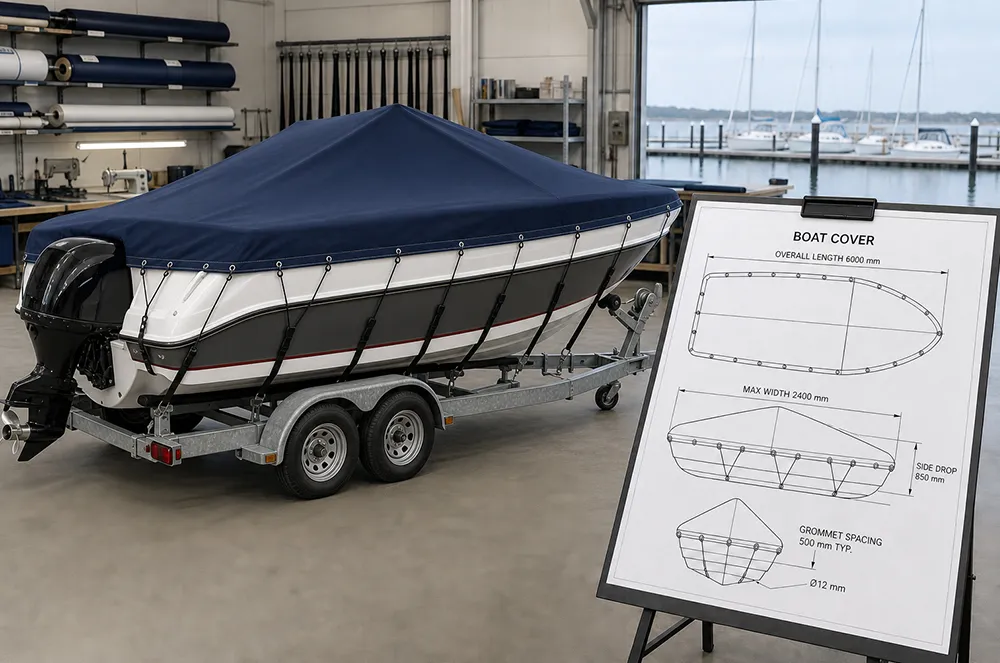
Fit tolerance is one of the main risks in boat cover production. If the cover is too tight, workers may pull too hard on straps or seams. If it is too loose, wind can lift the fabric and create noise, abrasion, and water pockets. A sample helps both sides confirm whether the design follows the boat shape correctly.
For LonaTarp boat cover production, the normal minimum order quantity is 5,000 square meters. Before a larger order starts, the buyer should approve a sample or first article, especially when repeated sizes, branded colors, specific hardware, or dealer-ready packaging are required.
When the buyer needs a non-standard layout, the logic is similar to custom made tarps: define the shape, stress points, edge design, fastening method, and inspection requirements before production. The difference is that boat covers usually require more three-dimensional fit control than simple rectangular covers.
For export orders, packing and loading plans should be confirmed with the cover design. A heavy fitted cover can crease if packed without support, and small hardware bags can be lost if they are not bundled consistently. When covers are shipped for dealer networks, clear carton or bale identification helps the buyer avoid mixing models after arrival.
V. Production, Inspection, and Repeat Orders
For repeat orders, the approved production sheet is important. It should include boat type, finished cover size, fabric weight, color, seam method, reinforcement areas, strap or buckle layout, grommet spacing if used, packing method, and photos from the approved sample. Without that record, the second order can drift away from the first approved version.
Quality inspection should match the cover’s real use. I would check fabric surface, welding continuity, stitch quality if sewing is used, hardware placement, edge reinforcement, corner shape, and whether the cover folds and packs without damaging its own stress points. If the cover is for trailer transport, strap strength and wind-flap areas deserve extra attention.
For distributors and dealers, packaging is part of the product. A cover that arrives clean, folded consistently, and labeled clearly is easier to store and distribute. For marine service companies, practical packing also helps workers identify the correct cover quickly when several boat types are handled in one facility.
Repeat quality depends on documentation. The approved sample should be supported by photos, measurement notes, material record, hardware list, and packing instructions. When the next batch is ordered months later, this file prevents the factory and buyer from relying on memory. It also gives the buyer a clear standard for incoming inspection.
If the buyer serves different regions, climate should be added to the record as well. A cover used in strong sun, humid coastal storage, or cold winter transport may need different material emphasis. Recording the use region helps the factory avoid treating every marine cover order as the same product.
Custom boat covers work best when buyers treat the boat shape, use routine, material, reinforcement, fastening, and sample review as one system. If those details are clear before production, the finished cover is easier to install, easier to repeat, and more reliable for B2B marine protection programs. The best order files make future replacement covers faster to quote and easier to inspect.
| Boat cover use | Specification focus | Buyer note |
|---|---|---|
| Outdoor storage | Waterproofing, UV resistance, drainage slope | Avoid flat areas that hold water |
| Trailer transport | Straps, wind flap control, reinforced edges | Confirm road speed and tie-down points |
| Dealer or fleet program | Repeat sizes, packing, sample record | Keep approved specifications for reorders |