A useful custom tarp quote checklist should save time for both the buyer and the manufacturer. It should not be a long form full of generic questions. For a B2B buyer, the goal is simple: send enough real project information so the supplier can choose the right material, edge structure, hardware layout, packing method, and sample process before calculating the price.
When we receive a custom tarp quote request, the fastest answers usually come from buyers who describe the cover job first. Size matters, but the tarp also has to survive the way it will be pulled, folded, fixed, packed, and used outdoors. This article explains what to prepare before asking for a custom tarp quotation, especially for buyers comparing suppliers for a bulk or repeat order.
I. Start With the Application and Failure Risk
The first detail in a
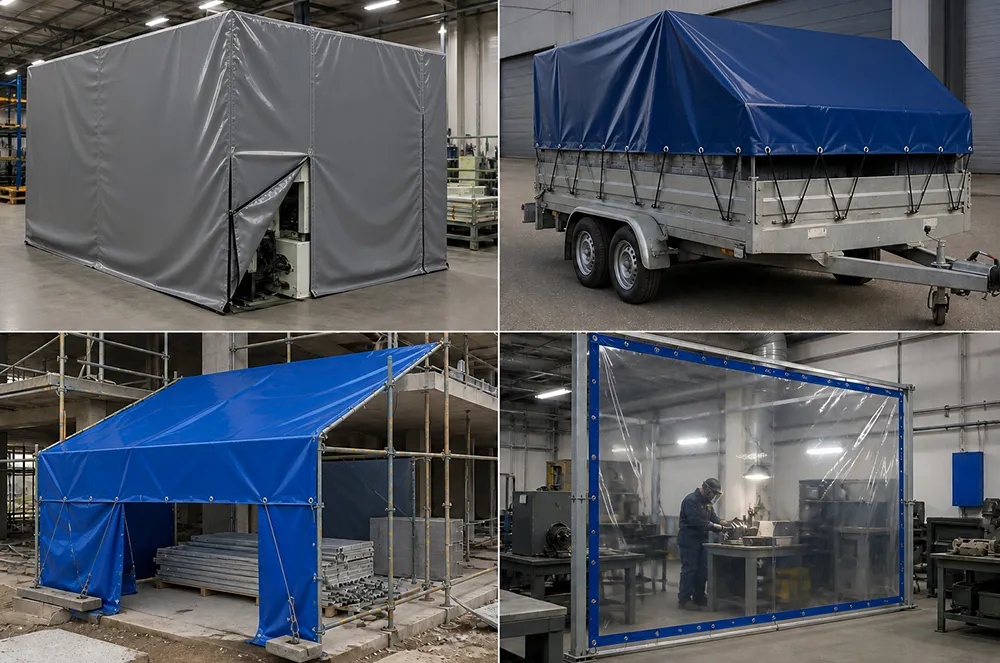
tarp quote request is not the color or the price target. It is the job the cover must do. A machine cover in a warehouse, a transport cover on an open trailer, a temporary construction cover, and a clear enclosure panel may all be custom tarps, but the failure risks are different. One buyer may need abrasion resistance at metal corners. Another may need waterproofing, cold flexibility, flame resistance, or a fixing plan that prevents edge tearing.
For a more accurate custom tarp manufacturer quote, describe the product or area being covered, whether the tarp stays outdoors, how often it is opened, and whether it touches rough ground, sharp edges, machinery corners, or strong wind. These details help us decide whether the cover needs a softer folding material, a stronger base fabric, thicker coating, welded reinforcement, webbing, D-rings, or a different fixing point layout.
A short application note is often enough. For example, “PVC equipment covers for outdoor storage, installed on steel frames, opened weekly, exposed to sun and rain” gives a clearer direction than “blue heavy duty tarp.” The first version lets the factory prepare a real custom PVC tarp quote; the second version still leaves too many assumptions.
II. Confirm Finished Size, Quantity, and Tolerance
The second part of a
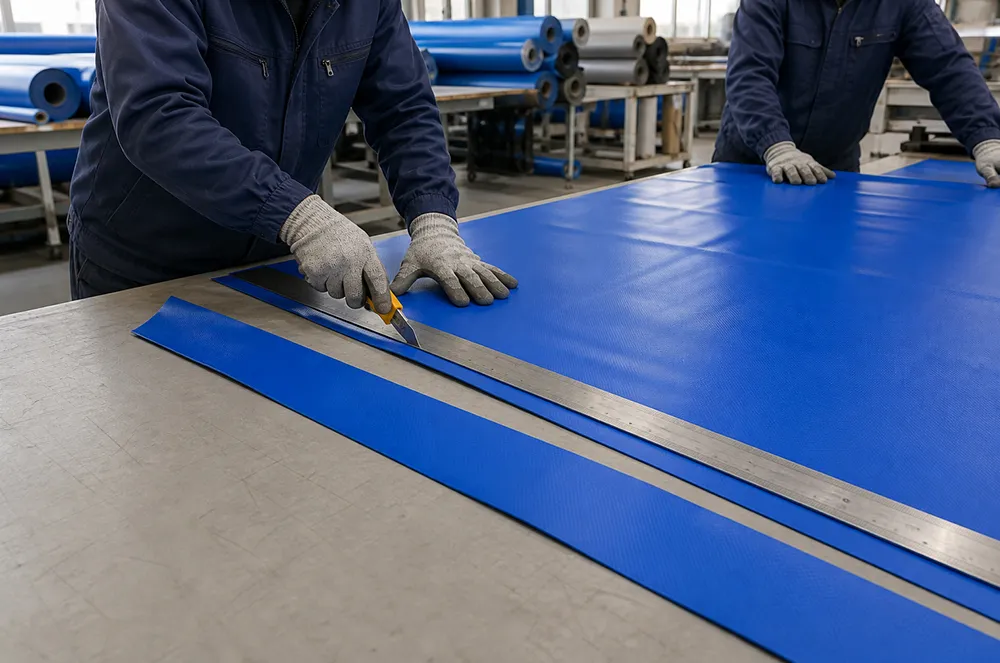
custom tarp quote checklist is the finished size. Buyers sometimes send the size of the object, the cutting size, or an estimated cover size without saying which one it is. For made-to-order tarps, this can change the finished panel, seam position, reinforcement layout, and roll-width loss. If several sizes are needed, send the size mix instead of only the total square meters.
For custom-made tarps, we usually want finished length and width, quantity per size, acceptable tolerance, and whether the cover needs hems, pockets, zippers, windows, straps, or shaped corners. If the tarp has holes, cutouts, or irregular sides, a simple drawing is more useful than a long paragraph.
Roll width also affects price. A size that fits the available tarpaulin rolls cleanly may need fewer welded joins and less waste. A very wide finished tarp may require panel joining, and the joint position should be planned around water flow, pulling direction, and visual requirements. This is why custom tarp specifications should include both the finished size and the working condition, not size alone.
| Quote detail | Why it affects price | What to send |
|---|---|---|
| Application and exposure | Controls material route, coating function and reinforcement level | Use case, weather, contact points, opening frequency and fixing method |
| Finished size and quantity | Affects cutting plan, welded joins, roll loss and batch setup | Length, width, quantity per size, tolerance and drawing if available |
| Edge and hardware | Changes labor, reinforcement, hardware cost and pull strength | Hem, webbing, grommet spacing, D-rings, straps, zippers or pockets |
| Packing and delivery | Affects folded size, labels, carton, pallet and export handling | Packing style, destination, mark requirement and reorder record needs |
III. Choose Material Details Before Comparing Price
A
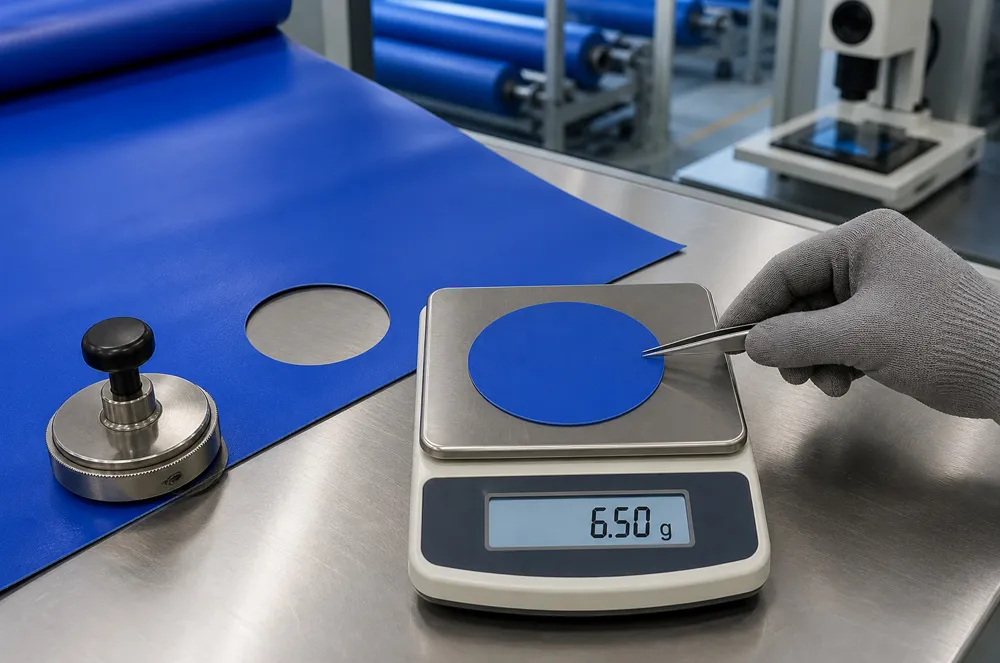
custom tarps quote should compare materials that can perform the same job. If one supplier quotes a lower GSM material and another quotes a stronger coated fabric with better reinforcement, the two prices are not directly comparable. For most repeat-use industrial covers, PVC tarpaulin is useful because the polyester base fabric carries strength while the PVC coating supports waterproofing, weather resistance, color, and weldability.
Good custom tarp material selection starts from failure mode. For rough ground, ask about abrasion resistance and coating thickness. For repeated folding, ask whether the material stays manageable. For welding, ask whether the coating system welds cleanly and keeps seam strength. For long outdoor use, ask about the weather formulation and the test method instead of accepting one vague UV claim.
GSM is still useful, but it should not be the only buying rule. The base fabric, coating mass, coating stability, filler level, weldability, tear strength, and edge design all affect the finished cover. If the buyer wants a bulk custom tarp quote, the material sample should match the production material, not just the color.
IV. Define Edges, Grommets, and Fastening Points
Many quotation gaps happen at the edge. A buyer may ask for a tarp with grommets, but the price changes with hem width, reinforcement layer,
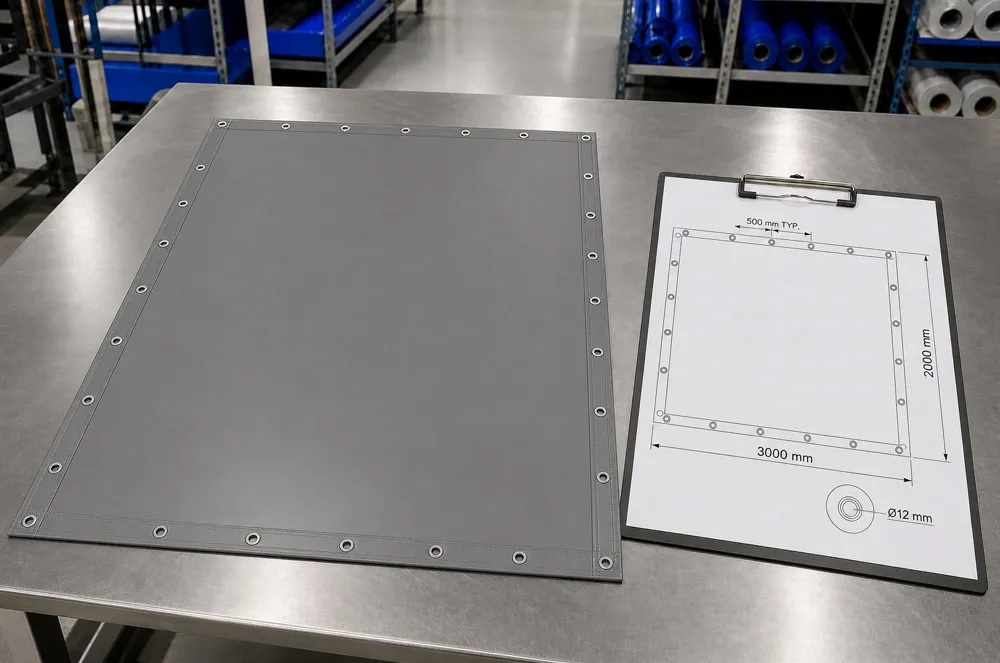
custom tarp grommet spacing, grommet material, webbing, D-rings, straps, rope pockets, and corner patches. The edge is where much of the field stress enters the tarp, so it should be specified before the final price is compared.
For a cover that will be tied down under wind load, custom tarp edge reinforcement may matter more than a small difference in fabric weight. If the tarp will be pulled from one side, we need to know the pull direction. If it is fixed around a machine frame, we need anchor-point positions. If it is folded every day, the reinforcement should not make the cover too stiff for workers to handle.
Simple drawings are very helpful here. A marked drawing can show hole spacing, corner radius, zipper direction, pocket depth, reinforcement strips, and special cutouts. That turns custom tarp order details into a production-ready specification instead of a guessing exercise.
V. Decide on Sample, Packing, and Repeat-Order Records
Before bulk production, buyers should decide whether they need a sample, a material swatch, a finished corner sample, or a full-size sample.
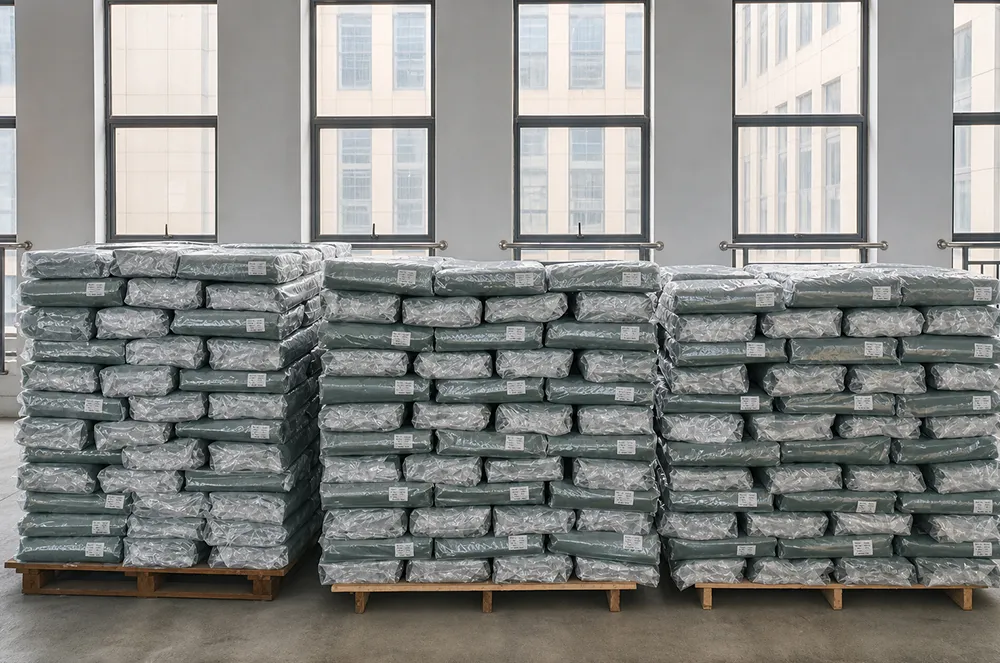
Custom tarp sample approval is especially important when the order includes hardware, welded hems, printed marks, transparent panels, zippers, or a size that must fit existing equipment.
For export orders, custom tarp packing also belongs in the quotation stage. Folded size, carton or pallet packing, label rules, individual bags, shipping marks, and container loading can all affect the final cost and delivery plan. If the buyer plans repeat orders, we also recommend keeping a record of material code, color, finished size, edge structure, hardware spacing, packing method, and approved sample photos.
In our quality control work, the best repeat orders are the ones with a clear approved sample and a practical specification record. For LonaTarp made-to-order production, the usual B2B MOQ is 5,000 square meters, so preparing the details before the first quotation helps avoid sample revisions, price misunderstandings, and batch changes later.
Before production, prepare these details
- Application, exposure, fixing method and main failure risk.
- Finished size, quantity per size, tolerance and drawing if available.
- Material target, GSM range, coating function and sample requirement.
- Hem, reinforcement, grommet spacing, webbing, D-rings or other hardware.
- Packing style, destination, label requirement and repeat-order record.
With those details ready, a custom made tarps quote becomes much easier to compare. The supplier can price the same structure, the buyer can judge value more clearly, and the first sample has a better chance of matching the real production need.