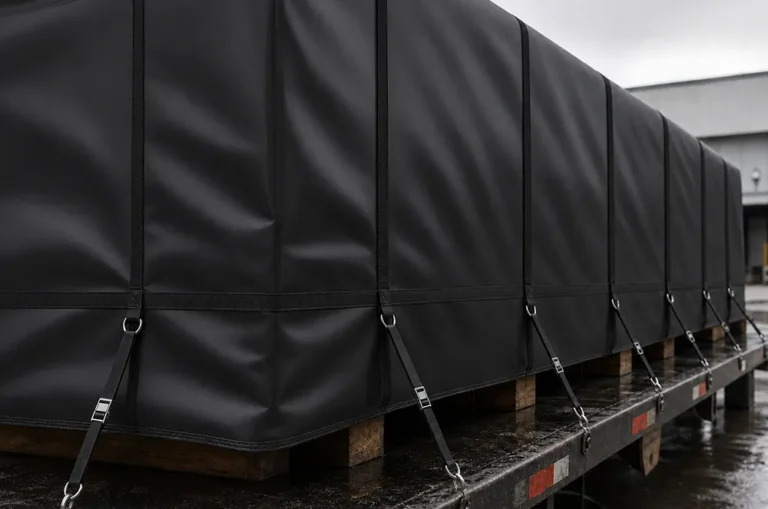
Choosing tarp hardware is not only about picking a grommet size or adding more tie-down points. In a bulk order, the hardware decides how force moves from the rope, strap or frame into the tarpaulin body. If that force is not spread through the edge, the cover may look strong on paper but still tear around the first stressed point.
As a manufacturer, we usually check the tarp hardware together with fabric weight, base fabric strength, coating behavior, hem design, reinforcement patches and the way the customer will fasten the cover on site. This guide explains how to choose tarp hardware for custom covers, especially when the order will be used repeatedly in transport, construction, storage, agriculture or industrial protection.
I. Start With the Load Path
Before choosing any tarp grommets, straps or D-rings, define where the pulling force will enter the cover. A small equipment cover may only need edge eyelets for light fixing. A large cargo cover, container cover or outdoor storage tarp needs a stronger load path because wind, vibration and repeated tightening all work on the same edge.
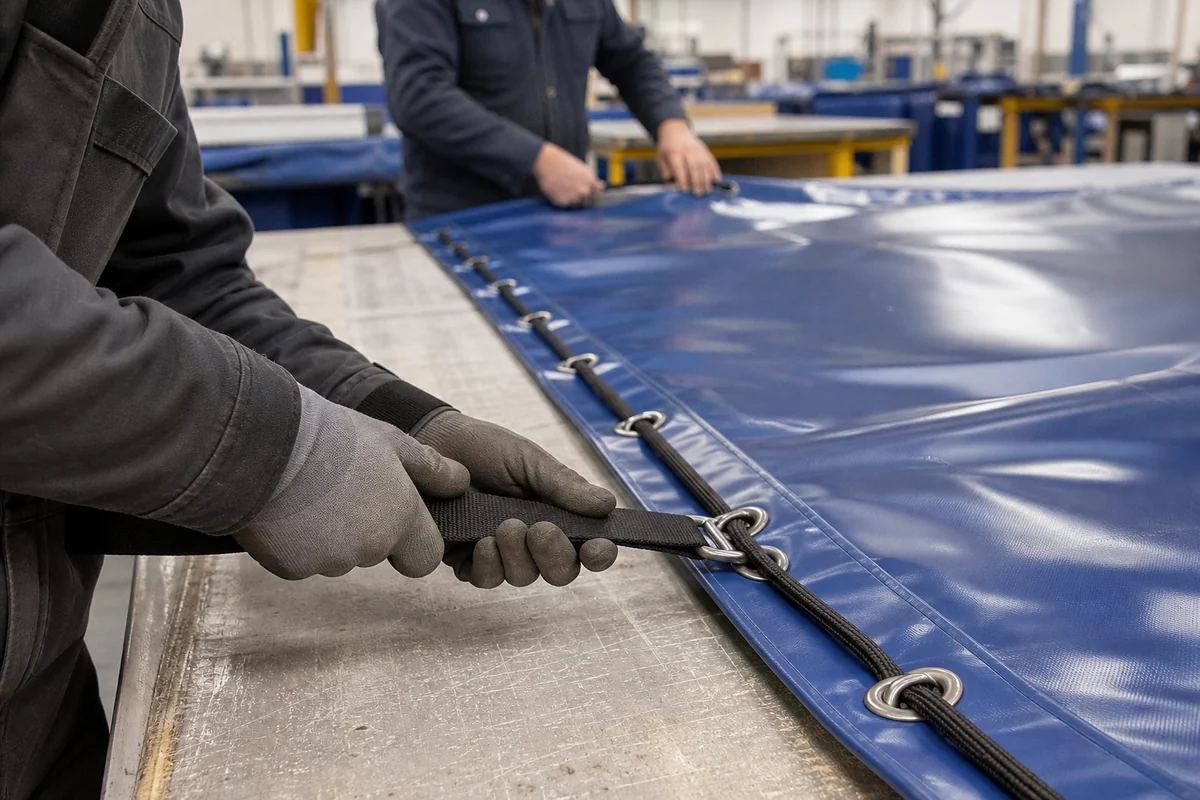
The load path starts at the tie-down device, passes through the hardware, moves into the hem or webbing, and then spreads into the coated fabric. If one part is much weaker than the others, that part becomes the failure point. This is why tarp hardware for custom covers should be specified as a system instead of as loose accessories.
For custom made tarps, we normally ask how the cover will be pulled, whether it will stay fixed for long periods, and whether operators will remove it every day. These answers help decide whether the order needs simple eyelets, closer spacing, heavier reinforcement, webbing straps, D-rings, buckle points or a combination of several hardware types.
II. Choose Grommets and Eyelets by Use
Tarp grommets and tarp eyelets are common because they make a cover easy to tie, hang or tension. For light covers, standard metal eyelets may be enough. For larger covers, heavy duty tarp eyelets should be checked together with the base fabric, hem thickness and the rope or hook that will pass through the hole.
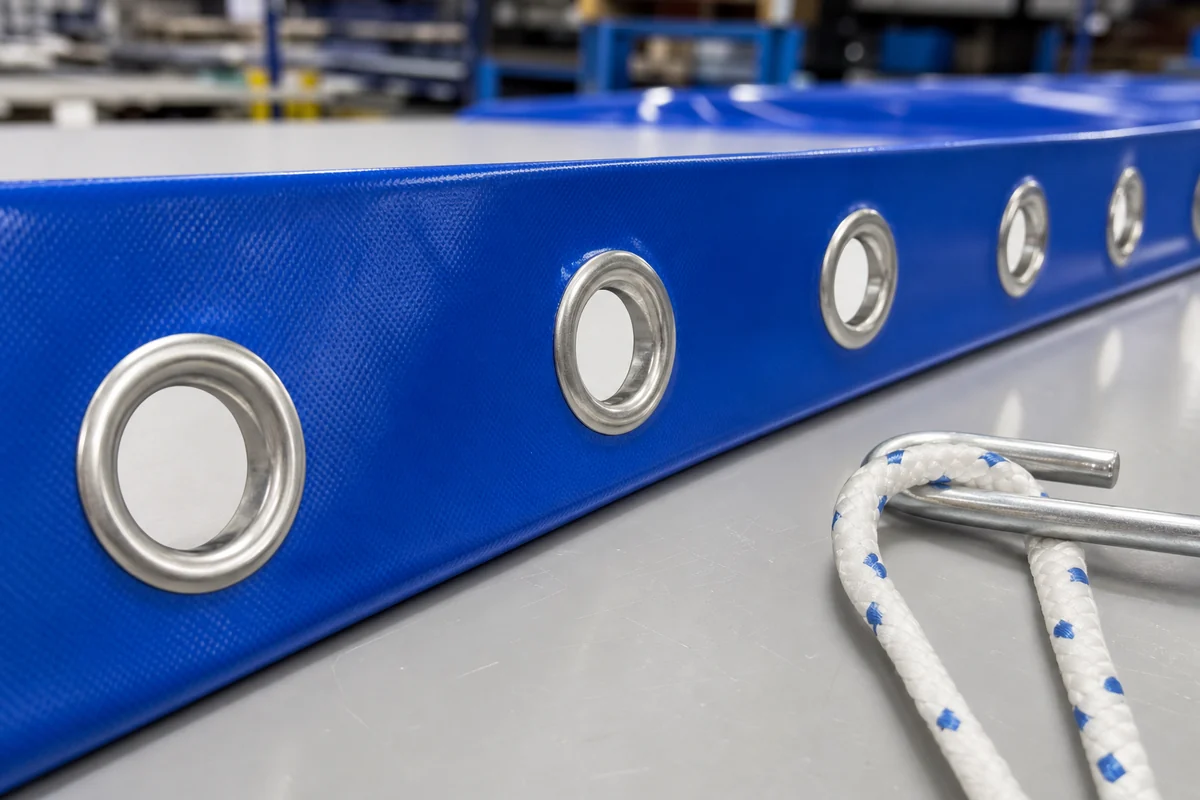
Size matters, but it should match the fastening method. A hole that is too small slows installation and can damage the rope or hook. A hole that is too large may reduce contact around the metal ring and concentrate stress around the edge. If the buyer asks for a tarp with grommets, the drawing should confirm inner diameter, outside diameter, material, finish, washer type and spacing.
Tarp grommet spacing is another important decision. Wide spacing can reduce cost, but it may allow the tarp edge to flap or belly between fixing points. Very close spacing adds labor and may make the edge stiff without solving the real stress problem. For windy sites, moving vehicles or sharp corner contact, spacing should be decided with the finished panel size and tie-down direction in mind.
III. Use D-Rings, Webbing and Straps for Higher Stress
D-rings for tarps are useful when the pulling force is directional and stronger than a basic eyelet should handle. They are often used with webbing, straps, buckles or rope systems because they transfer tension through a wider stitched or welded area. This helps when a cover must be tightened hard without tearing the coated fabric around a single hole.
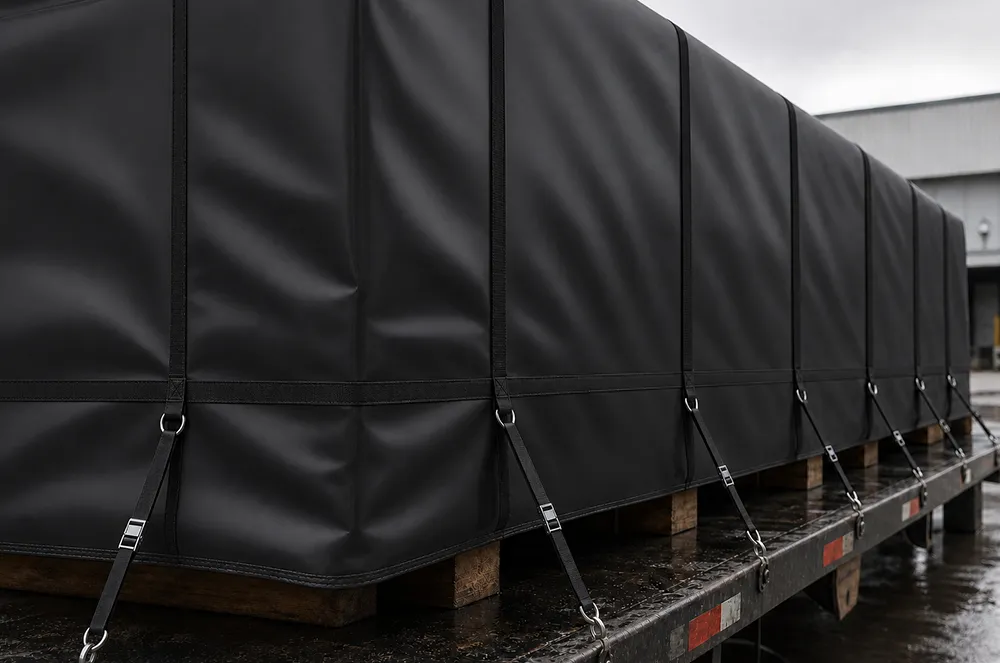
Tarp webbing straps can also make handling easier. Instead of asking workers to tie ropes through every grommet, the cover can be produced with fixed tarp strap attachment points, welded webbing loops or buckle positions. This is practical for fleet covers, machinery covers, warehouse curtains and repeated outdoor covering work where speed matters.
When we design heavy duty tarps, we do not place D-rings or straps by appearance. We look at the pull angle, the weight of the finished cover, the contact surface, and whether the operator will tighten from one side or from several directions. A strong D-ring on a weak edge will still fail, so the reinforcement under the hardware is part of the specification.
IV. Reinforce Edges Before Adding Hardware
Most hardware failures are really edge failures. The metal ring, hook or strap may stay intact, while the coated fabric tears around it. That usually means the tarp edge reinforcement was not designed for the real working condition.
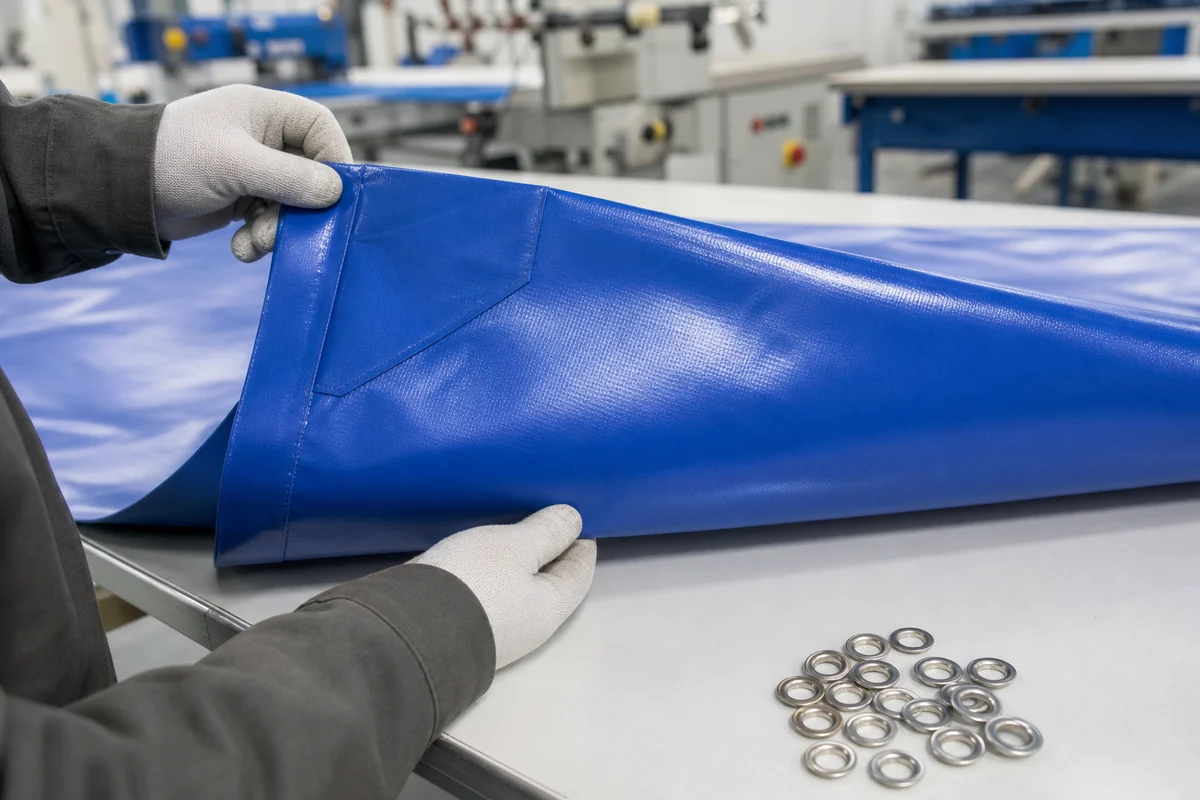
A reinforced hem can be welded, sewn or combined with extra webbing depending on the material and application. PVC coated tarpaulin is often suitable for welding, which creates a sealed and clean edge when the coating, fabric and production settings match. For high-stress corners, reinforced tarp corners can be added with larger patches to spread force away from a single point.
| Hardware decision | What it affects | What to confirm before production |
|---|---|---|
| Grommet or eyelet size | Tie-down fit and edge stress | Hole diameter, metal finish, washer strength and rope or hook size |
| Grommet spacing | Fabric movement between fixing points | Panel size, wind exposure, tie-down direction and handling frequency |
| D-rings or webbing loops | Stronger directional pulling | Pull angle, webbing width, weld or stitch length and backing patch |
| Straps, buckles or ropes | Installation speed and repeat handling | Operator method, tensioning route, replacement need and packed size |
| Corner reinforcement | Failure control at high-stress points | Patch size, edge layout, rubbing points and sample pull direction |
A welded hem with grommets can be clean and efficient, but it should not be treated as one fixed standard. A warehouse divider, a truck cover and an outdoor equipment cover may all use grommets, yet each one may need a different hem width, reinforcement strip or corner patch.
V. Match Hardware to Material and Production Method
Hardware also needs to match the tarp material.
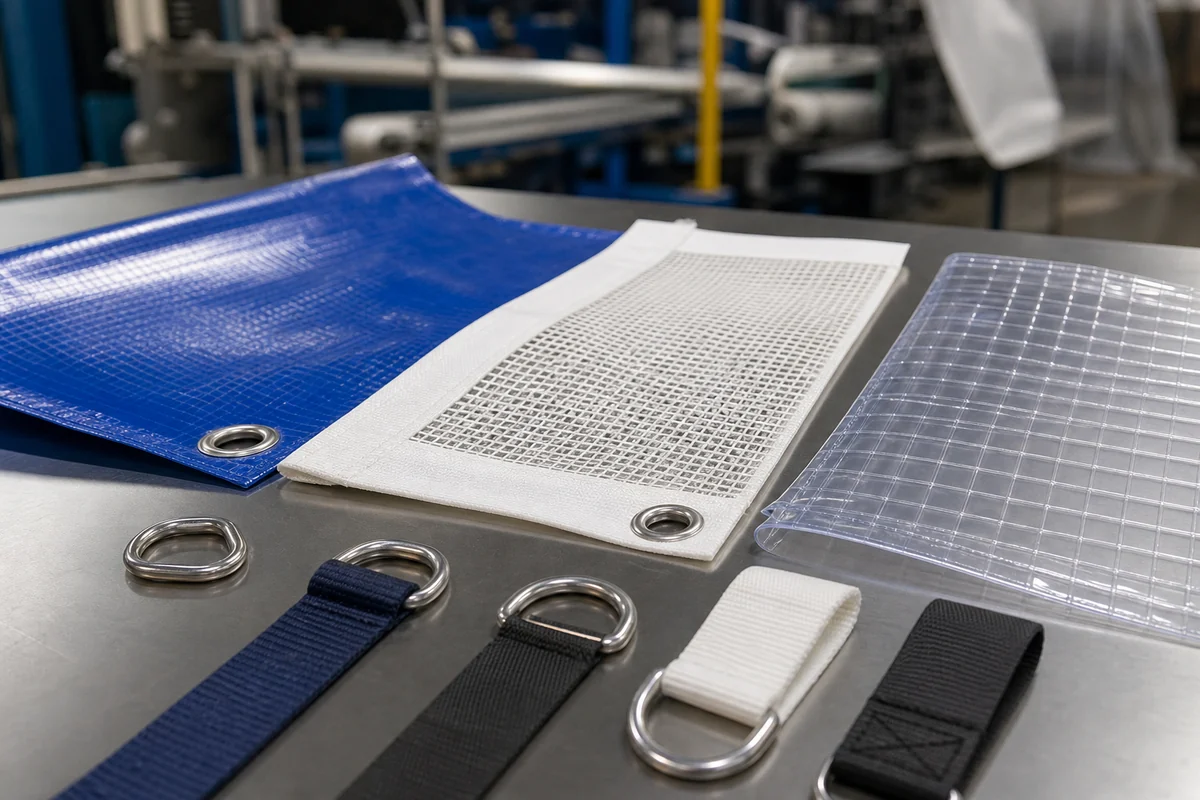
Vinyl tarps made from PVC coated fabric can usually support welding, reinforced hems and durable hardware when the base fabric and coating are chosen correctly. The base fabric carries tensile and tear strength, while the coating supports waterproofing, weather resistance, color stability and weldability.
Mesh tarps may need a different hardware layout because the fabric is more open and air can pass through it. A clear PVC cover may need careful pressure control around the hardware because the surface is more visually sensitive and scratches can be more obvious. For clear tarps, buyers often care about visibility as much as fixing strength.
Do not choose PVC tarp hardware by GSM alone. Two fabrics with similar weight can have different base fabric, coating ratio, flexibility and welding behavior. For a bulk tarp order hardware plan, the better approach is to confirm the application first, then choose the fabric, reinforcement and accessories as one finished-cover specification.
VI. Confirm Samples Before Bulk Orders
Before mass production, a sample panel or full sample cover is the best way to check whether the custom tarp hardware layout works in practice. The sample should show the real edge construction, grommet or eyelet spacing, strap positions, D-rings, webbing, corner patches and any special attachment points.
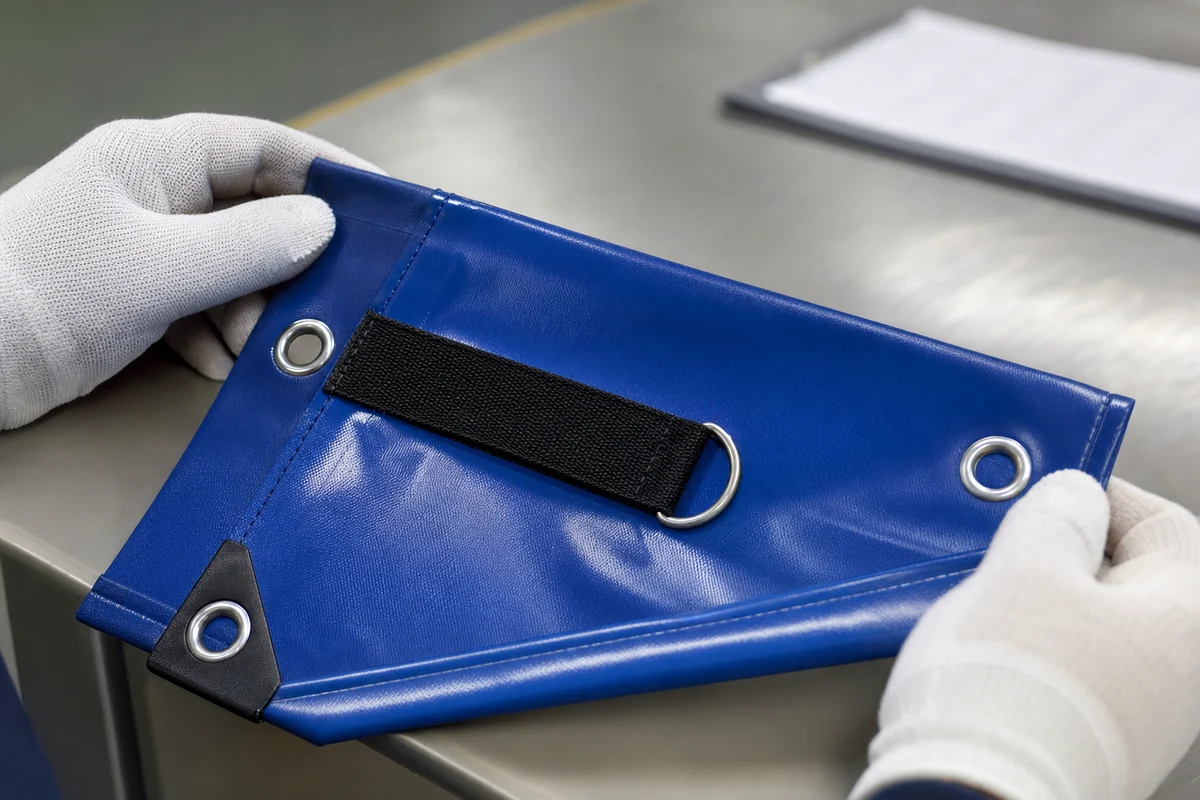
In our factory workflow, the sample is not only for color and size confirmation. It is also used to check the hand feel, folding behavior, welding quality, hardware placement and whether the finished cover can be handled by the customer’s team. For repeat B2B orders, this step reduces the risk of changing the specification after production has already started.
Before production, prepare these details
- Finished cover size, shape and tolerance requirement.
- Fixing method: rope, hook, strap, buckle, frame or mixed system.
- Expected pull direction, wind exposure and contact points.
- Preferred tarp grommet spacing or required hardware drawing.
- Edge reinforcement, reinforced tarp corners and any rubbing areas.
- Sample test points, packing method and inspection standard.
Once these details are clear, the supplier can match fabric, edge design and tarp tie down hardware before production. For custom orders, LonaTarp can help review the hardware layout with the cover application, then confirm the sample before bulk manufacturing and quality control inspection.