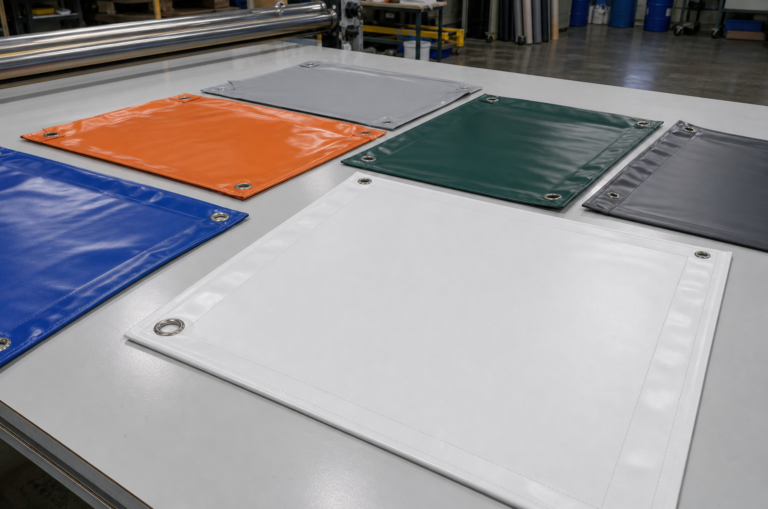
Common custom tarp order mistakes usually happen before the factory cuts any fabric. Buyers lose time when they ask for a price before defining the real job, send flat dimensions that ignore the installed shape, compare suppliers by GSM alone, or leave edge and hardware details open until production is about to start. Most of those problems are preventable. When the buyer and the manufacturer confirm fit points, load path, seam layout, grommet spacing, access details, and sample revisions early, the bulk order becomes easier to quote and much easier to reproduce.
This article is not another quote form. It is a risk-control guide for B2B buyers who want to avoid the most expensive custom tarp ordering mistakes before the first custom tarp order is locked. It also targets the custom tarp specification mistakes that usually show up later as fit complaints, seam stress, or hardware rework. If you are still comparing broad options, the main custom made tarps page is the right starting point. If the project is already moving toward drawings and approval, the points below are what usually stop field complaints before they happen.
I. Starting With Price Instead of the Real Service Conditions
Many failed orders begin with a short message such as “send your best price for a custom tarp.” That question sounds efficient, but it hides the decisions that actually control performance. A tarp for a machine that stays outdoors all year, sees repeated folding, and rubs against sharp brackets needs a different material route from a temporary indoor dust cover. Before asking for price, a buyer should explain whether the tarp will face rain pooling, wind uplift, abrasion, heat, UV exposure, chemicals, or frequent removal by one operator. Those conditions decide fabric structure, coating route, welding method, reinforcement plan, and even packing style.
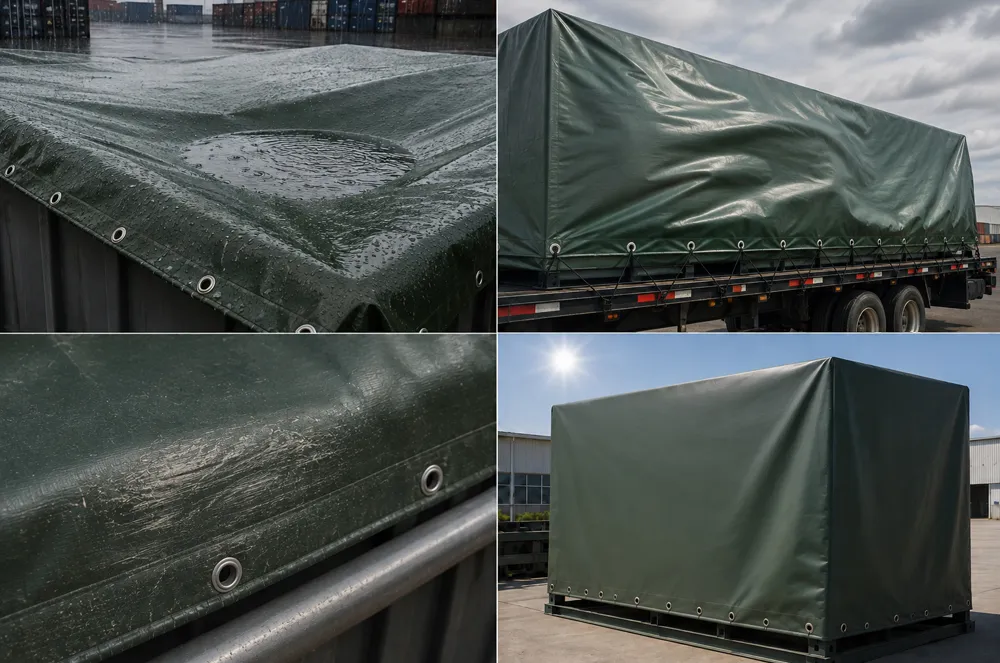
From a factory view, the order is already drifting if the application is described only as “cover” or “protection.” We need to know what is being covered, how long the tarp stays installed, whether the cover is tensioned or loose, and where failure would be unacceptable. On a truck side opening, the weak point may be flap movement and hardware pull. On a generator cover, the risk may be hot surfaces, corners, and maintenance access. On an export pallet line, the risk may be repeated fork handling rather than weather. The more clearly those service conditions are stated, the less often the supplier has to guess with a generic heavy-duty option.
A good first brief should also mention what cannot fail. Some buyers care most about waterproofing. Others care more about appearance, foldability, or whether the tarp can be removed quickly for inspection. That priority order matters because the same PVC coated fabric can be adjusted through base fabric choice, coating weight, surface treatment, reinforcement, and finishing details. Product knowledge from the current PVC references was applied here carefully: waterproofing comes from the continuous PVC barrier, but finished-cover failure often begins at seams, edges, holes, or rubbing points, not in the center panel.
II. Sending Flat Measurements Without the Installed Geometry
The second major mistake is treating a custom tarp as if it were only a flat rectangle. Buyers often send overall width and length, but not the drop, overlap, corner relief, sleeve depth, or the way the cover sits around handles, frames, vents, hinges, or lifting points. A factory can still quote something from that limited information, but the finished tarp may become tight at one corner, loose in the wind, or impossible to close around the actual equipment. Installed geometry matters more than nominal panel size.
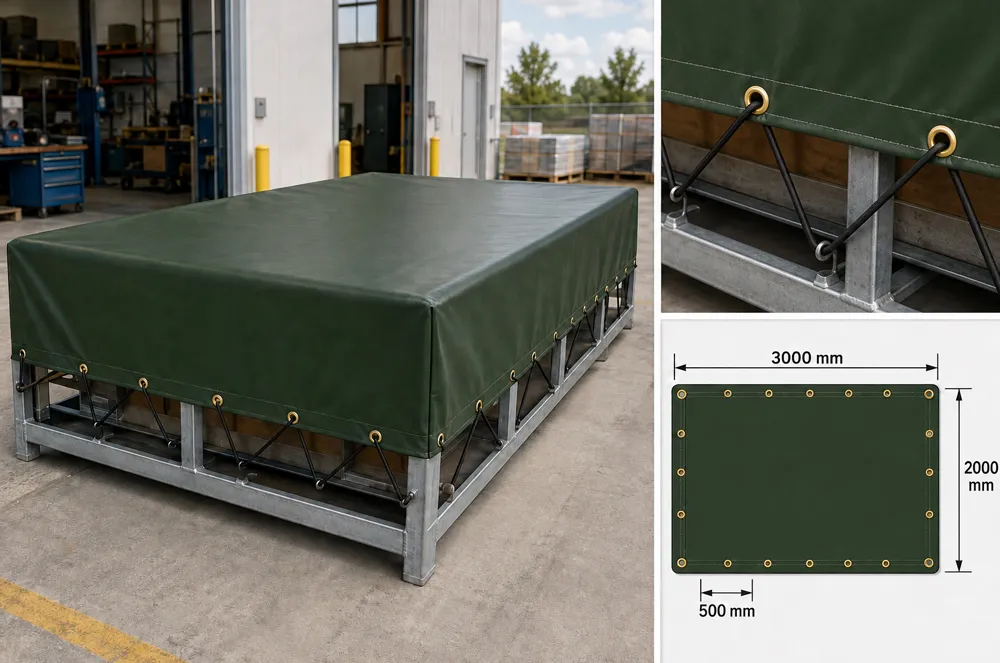
For that reason, I prefer buyers to provide finished dimensions together with simple installation photos and one marked drawing. The drawing does not need CAD complexity, but it should show front and back, drop direction, openings, hardware position, seam restrictions, finished size tolerance, and acceptable tolerance by key zone. The published custom tarp drawing guide is useful here because it turns field measurements into something production can actually follow. If the tarp wraps around a frame or hangs over a rail, note whether the size is measured flat, installed, or under tension. Those differences are where rework usually starts.
| What buyers often send | What production actually needs | Why it changes the outcome |
|---|---|---|
| Overall length x width only | Finished size, drop, overlap, corner shape, and tolerance | A tarp can fit the panel size but still fail on the installed shape |
| “Put holes around the edge” | Exact grommet spacing, offset, starting point, and corner treatment | Hardware rows drift quickly if spacing is assumed rather than fixed |
| One front photo | Front, side, back, stress-point photos, and drawing notes | Photos reveal obstructions, abrasion points, and access zones that numbers miss |
| “Same as last time” | Previous revision, approved sample, and any field change | Repeat orders drift when revision history is not tied to the new PO |
Oversized tarps create another measurement trap. When the finished panel is wider than the roll width, seam placement and welding count change the appearance, the folding behavior, and sometimes the cost. That is why the article on how roll width affects custom tarp cost exists as a separate support piece. The point is not just price. Seam location can affect water flow, eyelet load distribution, and how the cover folds after removal. Buyers who care about clean appearance or specific seam-free zones should say so before the order is confirmed.
III. Choosing by GSM Alone and Ignoring Material Route
Another recurring mistake is comparing suppliers by one number, usually GSM, and assuming the heavier sheet is automatically safer. GSM matters, but it does not tell the whole story. The current product knowledge files are explicit on this point: the polyester base fabric, PVC coating formulation, adhesion, width, surface treatment, and fabrication route all affect the real strength and service behavior. Two materials with similar weight can behave very differently in tear resistance, fold endurance, seam stability, or outdoor ageing.

In practice, buyers should say what they need the material to do, not only what they want it to weigh. Is the tarp mainly resisting rain, abrasion, or wind flap? Will it be fixed with webbing and eyelets, or sleeved over a frame? Does it need a cleaner surface for printing, or a formula that stays flexible in lower temperatures? If the project is outdoors, color also matters because bright colors and darker heat-absorbing colors can age differently. If the order requires printing, ink adhesion, surface treatment, and future welded seam compatibility must be considered together rather than added as late options.
This is also where buyers sometimes choose the wrong reinforcement logic. They order thicker body fabric, but leave the edge, corner, and hardware zone generic. Yet on many finished tarps, the failure begins at the edge or attachment line first. A better decision path is to define the load path, then choose the body material, then specify edge reinforcement only where the job needs it. That approach keeps the product more economical and usually more reliable than a blanket move to “the heaviest tarp you have.”
IV. Leaving Edge Details, Hardware, and Approval Control Until the End
The last mistake is assuming finishing details can be decided after the price is accepted. In reality, reinforced hems, webbing, rope-in-hem, sleeves, buckles, D-rings, zipper doors, inspection flaps, hook-and-loop closures, and metal eyelets are not cosmetic extras. They define how the tarp is installed and where the force enters the cover. A generic edge may be acceptable on one job and completely wrong on another. That is why hardware choice deserves the same attention as the fabric itself, and the separate article on
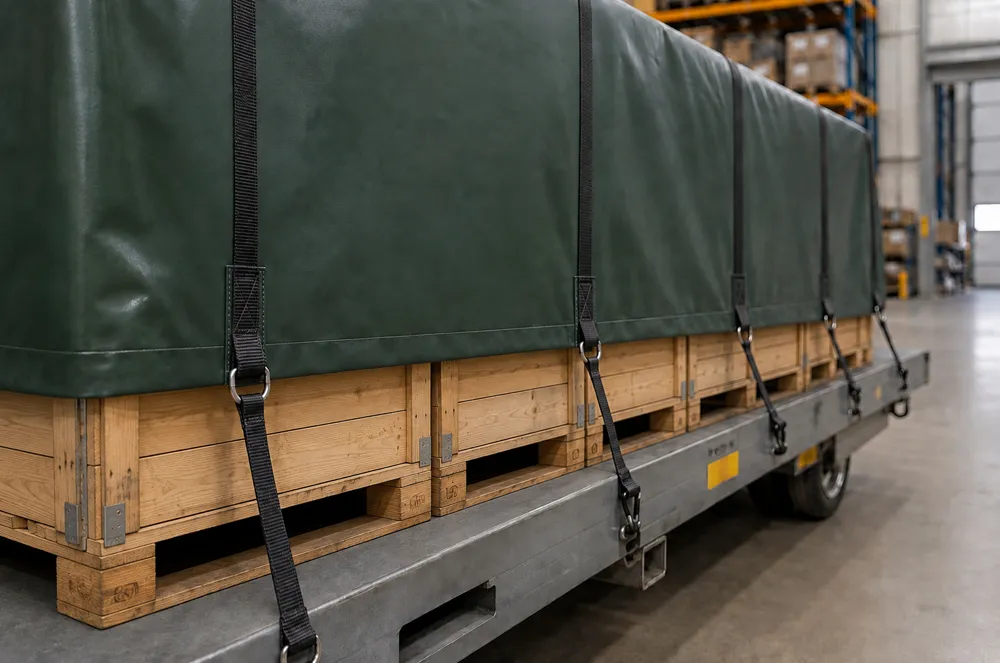
how to choose tarp hardware is often useful before final approval.
For example, grommet spacing should follow the way the tarp is fixed, not a default number copied from another order. Corners may need extra layers or a different hardware offset. Access panels should be positioned around the real service routine, not in the most convenient place for flat fabrication. If the tarp is lifted or folded frequently, the buyer should also say whether labels, handles, or orientation marks are required. These details change production steps, inspection points, and even the best packing method.
The safest control point is an approved sample or signed revision package before mass production. That package should tie together the latest drawing, material code, color reference, edge structure, hardware layout, and any print file. If one item changes, the revision note should change as well. Otherwise, the factory may produce correctly against an older instruction while the buyer expects a newer version. When the specification is finally ready, the order can move faster through approval if the inquiry is sent through the standard contact channel with the drawing, photos, quantity, target use, and sample requirement attached in one place.
A custom tarp order is usually successful when the buyer removes ambiguity before production begins. Price matters, but clarity matters first. Most custom tarp buying mistakes are really communication mistakes: the application is vague, the drawing is incomplete, or the approval file is split across too many messages. The fewer assumptions left in the application, drawing, material route, and edge plan, the fewer surprises appear in the finished bundle.