For commercial projects, the right pool cover material is not simply the thickest fabric or the cheapest roll. A hotel, school, municipal pool, resort, or pool contractor usually needs to balance drainage, debris control, sunlight blocking, handling weight, welded seams, edge reinforcement, storage, and any safety-related system requirement. Mesh PVC-coated fabric is usually chosen for drainage and easier handling. Solid PVC-coated fabric is usually chosen when the operator wants stronger separation from rainwater, dust, leaves, and sunlight. The final specification should be confirmed by pool size, staff routine, climate, cover purpose, and sample approval before bulk production.
LonaTarp works on custom B2B pool cover tarp projects. We do not sell one-piece retail covers from stock. Bulk production normally starts from 5,000 sqm of fabric, with material structure, color, GSM, coating, edge finishing, accessories, and packing confirmed before production.
I. Start With the Cover’s Job, Not the Material Name
When buyers ask for swimming pool cover material, the first question should be: what must the cover do on this pool? A seasonal outdoor pool may need debris control and UV resistance. A heated hotel pool may care more about evaporation and staff handling. A public facility may need a safety-related system, where fabric is only one part of the complete cover design.
Material names can be misleading. “PVC,” “vinyl,” “mesh,” and “solid” describe different parts of the decision. PVC or vinyl usually refers to the coated polymer surface. Mesh describes an open fabric structure. Solid describes a closed surface that blocks water and debris more completely. A commercial buyer should define the cover purpose first, then match the fabric structure, coating, reinforcement, and fabrication method.
For custom projects, we usually ask for the pool drawing, edge details, cover purpose, expected season, removal frequency, storage method, destination climate, and any required document or test target. Without those inputs, two quotations may use the same material name but deliver very different covers.
II. Why Thickness and GSM Are Only the Starting Point
Pool cover thickness matters, but it should not be used alone to judge quality. A thicker cover may feel stronger, yet performance also depends on the polyester base fabric, PVC coating formula, coating adhesion, UV package, mildew resistance, low-temperature flexibility, welding behavior, and edge reinforcement.
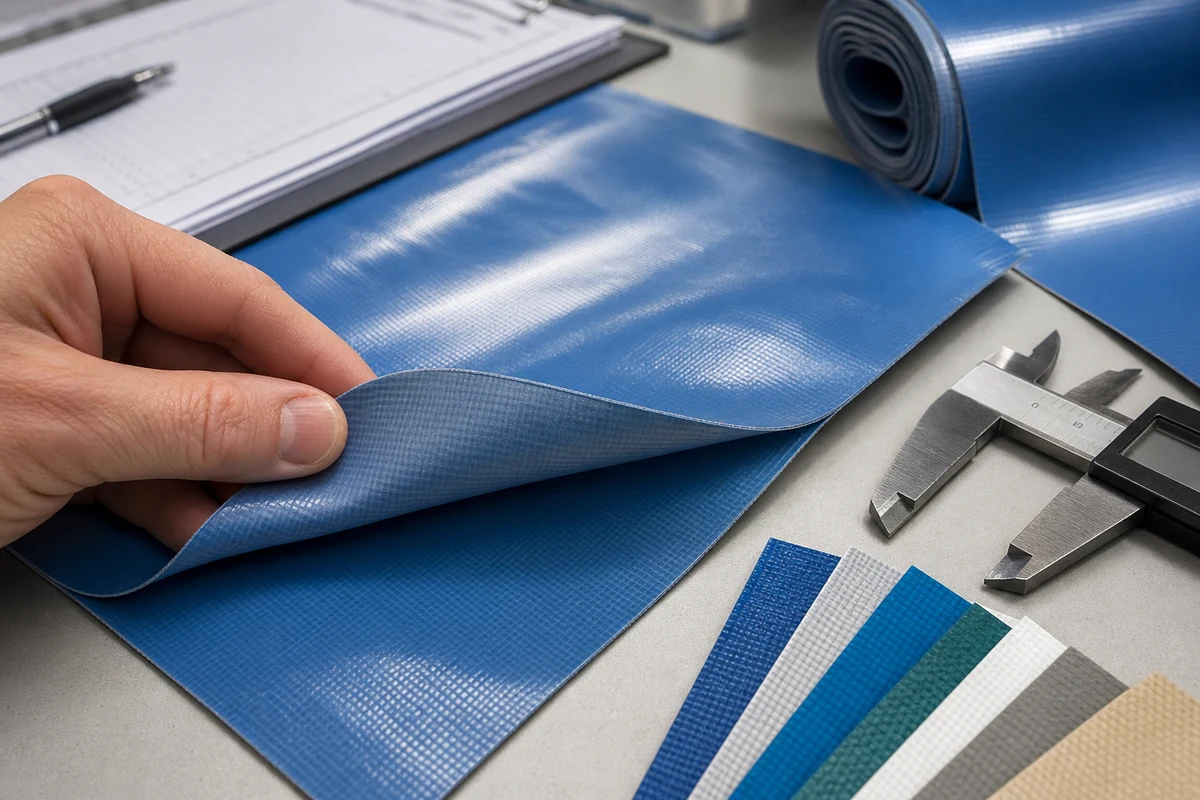
In production, this matters because extra weight can come from more coating, a stronger base fabric, or simply a heavier formulation. These options do not perform the same way. For example, a cover that looks heavy on paper may still fail early if the edge tears around grommets, the weld peels, or the coating becomes brittle after outdoor exposure.
For B2B purchasing, ask suppliers to define the structure instead of only giving a thickness number. Useful specification points include GSM, base fabric denier or yarn count, coating type, surface finish, roll width, tear strength target, weldability, UV or mildew package, color, and the intended edge construction. Sample approval is important when the cover will be repeated across several pools or distributor batches.
III. When Mesh PVC-Coated Fabric Makes Sense
Mesh pool cover material is usually selected when drainage, lower handling weight, and easier storage are more important than full water separation. Rain can pass through the mesh instead of collecting on top of the cover, which may reduce the load during wet seasons and make removal easier for maintenance staff.
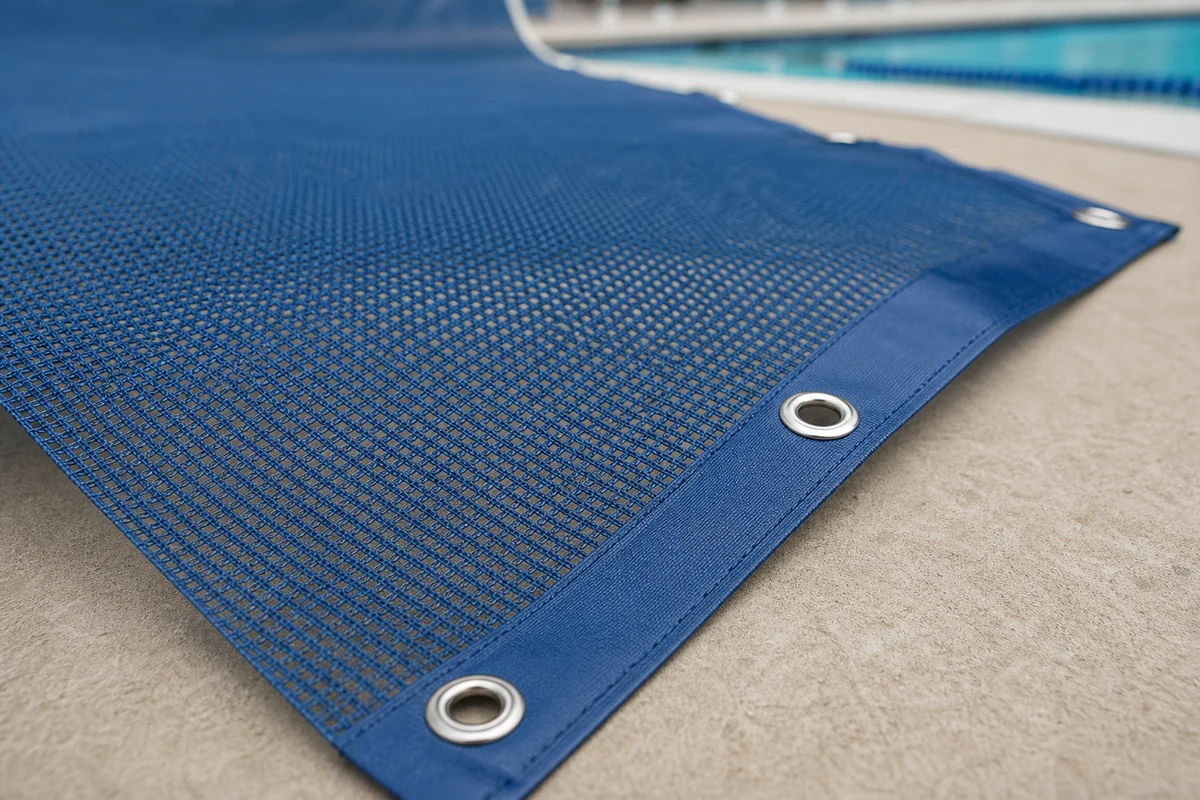
For commercial buyers, the important details are mesh opening, yarn strength, PVC coating coverage, UV resistance, color stability, tear strength, edge reinforcement, and how the cover will be attached around the pool. A loose or under-reinforced edge can become the weak point even when the center fabric still looks good.
The tradeoff is contamination control. Mesh can stop leaves and larger debris, but fine dirt, stained water from leaves, and some sunlight may still reach the pool. That is why mesh is often a practical option for facilities that prioritize drainage and handling, while accepting more cleaning work when the pool reopens.
IV. When Solid PVC-Coated Fabric Is the Better Direction
Solid PVC-coated fabric is the better starting point when the project needs stronger isolation from rainwater, fine dust, leaves, sunlight, or long off-season contamination. A solid cover can help reduce the amount of dirty water entering the pool, and it can block more light than mesh when algae control is part of the maintenance plan.
The main risk is water management on top of the cover. If rainwater cannot drain through, the project needs a pump, drain panel, slope, or written maintenance routine. Without this step, the cover can become heavy, harder to remove, and more stressful on seams, anchors, corners, and reinforced hems.
Large commercial solid covers also need practical fabrication planning. Panel width, welded seam direction, folding line, storage space, corner reinforcement, grommet spacing, and packing method all affect whether staff can use the cover repeatedly. For that reason, we normally review drawings and edge conditions before confirming the final fabrication method.
V. What to Check When Replacing Old Cover Fabric
Pool cover replacement fabric should not be ordered only by copying the old color and approximate weight. First check why the old cover is being replaced. Did the fabric crack, stretch, tear near the edge, peel at welded seams, fade, grow mildew, or become too heavy for staff to handle? Each failure points to a different specification change.
If the center panel is still acceptable but the perimeter failed, the next order may need stronger hems, different webbing, closer grommet spacing, cleaner welding, or better corner reinforcement. If the surface became brittle or faded, the issue may be UV exposure, color choice, coating formula, or local climate. If mildew is the problem, storage practice and anti-mildew requirements should both be reviewed.
For repeat buyers, keeping a sample from the old cover is useful. A supplier can compare the old material, confirm the new fabric direction, and avoid changing too many variables at once. This is especially important for distributors or contractors who need consistent batches rather than a one-time replacement.
VI. The “Best Material” Depends on the Project Priority
The best material for pool cover projects is the one that solves the operator’s main risk with the least installation and maintenance friction. For some pools, that means PVC-coated mesh because drainage and handling are the biggest problems. For others, it means solid PVC-coated fabric because the operator wants better isolation from dirty water, fine debris, and sunlight.
This is also why a material conversation should happen before a price conversation. A cheap cover that is difficult to remove, poorly reinforced, or mismatched to the climate can cost more in maintenance than it saves in the purchase order.
VII. RFQ Checklist for a Commercial Pool Cover Project
A commercial pool cover quote becomes faster and more accurate when the buyer sends enough information at the beginning. For LonaTarp, the most useful RFQ inputs are:
- Pool drawing, dimensions, shape, step position, rail position, and irregular edges.
- Cover purpose: debris control, seasonal protection, heat retention, evaporation reduction, safety-related use, or distributor resale program.
- Preferred material direction: PVC-coated mesh, solid PVC-coated fabric, or open to recommendation.
- Target GSM or thickness range, if already specified by the project.
- Color, surface finish, UV resistance, mildew resistance, cold resistance, or other performance requirements.
- Edge design: welded hem, webbing, reinforced corners, grommets, straps, buckles, or anchor interface.
- Quantity, destination country, packing requirement, sample approval plan, and expected delivery schedule.
For a custom commercial pool cover, LonaTarp can support fabric selection, cutting, welding, sewing, grommet installation, edge reinforcement, and OEM/ODM production. MOQ normally starts from 5,000 sqm of fabric. If your project has different colors, GSM ranges, base fabrics, or performance requirements, each specification should be checked separately before production.
For product capability and application details, see our custom pool cover tarp page. For inspection before bulk orders, see how we manage quality control for custom tarpaulin and coated fabric products.
VIII. FAQ
Is PVC or vinyl better for pool cover material?
For many buyers, PVC and vinyl refer to similar coated material language. The real decision is not the word itself, but the structure: mesh or solid fabric, base fabric strength, coating formula, UV resistance, mildew resistance, weldability, and edge reinforcement.
Is thicker pool cover fabric always better?
No. Thickness can help, but it does not prove tear resistance, coating adhesion, UV stability, welding quality, or edge strength. For commercial projects, compare the full specification and confirm samples before bulk production.
Can LonaTarp supply a single replacement cover for a home pool?
No. LonaTarp focuses on B2B custom production, not single-piece retail stock. Bulk orders normally start from 5,000 sqm of fabric, and each material specification is made to order.
Should a safety pool cover use mesh or solid fabric?
Both may be possible depending on the project, but safety-related covers must be checked as a complete system. The buyer should confirm local requirements, anchor layout, hardware, labels, installation instructions, and testing documents before production.
What should I send before asking for a material recommendation?
Send the pool drawing, size, cover purpose, expected season, climate, handling routine, preferred material direction, quantity, destination country, and any standard, testing, or documentation requirement.