Inflatable Jet Ski Dock Manufacturer
Custom PVC drop-stitch PWC docks for yachts, marinas, rental fleets, and OEM programs.
B2B Only, No Retail Sales
300 m MOQ | OEM/ODM Available

Requirement & Quote

Tarps Approval

Roll Production

10-Day Processing

Global Shipping
Get a Quote
Get a quote for your exactspecification. Simply enter the detailsof what you’d like, shape, size &colour.
- Completely Bespoke
- Made to Measure
- Hassle Free
Custom Inflatable Jet Ski Dock for PWC Programs
A custom inflatable jet ski dock should be designed around the watercraft and docking motion—not selected from platform size alone. LonaTarp produces the pressure-holding drop-stitch material and fabricates the finished dock, allowing the entry geometry, contact zones, welded structure, deck, attachments and sample checks to be reviewed under one project drawing.
We develop made-to-order docks for marine brands, yacht suppliers, PWC distributors, rental fleets and other commercial programs. Share the craft details and operating route first; we will then review whether the project needs a guided drive-on layout, a float-in berth or another recovery arrangement.
Plan the Inflatable PWC Dock Around the Watercraft
Two PWCs with similar overall lengths can place different loads on the dock because their hull shapes, beam, intake area and weight distribution are not identical. The approach angle also changes the work required from the entry section. A dock used beside a yacht may need a different connection and freeboard relationship from one attached to a marina pontoon.
Before we prepare a drawing for an inflatable PWC dock, we normally review the following information:
| Project Input | Why It Changes the Finished Dock | What the Buyer Should Provide |
|---|---|---|
| PWC model and hull dimensions | Defines berth width, contact clearance and entry geometry | Model, length, beam and relevant hull photos or drawing |
| Operating weight and load position | Affects local reinforcement and how the dock settles in use | Craft weight, fuel/gear condition and any unusual concentrated load |
| Docking and recovery motion | Determines whether the entry should guide, support or allow manual positioning | Drive-on, float-in or assisted recovery procedure |
| Connection interface | Controls attachment direction and movement relative to the yacht or pontoon | Connection side, height, pull direction and interface drawing |
| Water and exposure | Influences surface, fitting and material review | Fresh/salt water, temperature, UV exposure, storage and cleaning method |
| Deployment and packing | Changes valve access, handle placement and folded package limits | Crew route, inflation equipment, storage opening and target package handling |
Not sure what you need? Please let us know your PWC model, dock size, docking method, connection interface and customization requirements. We will help you select the right inflatable jet ski dock solution.
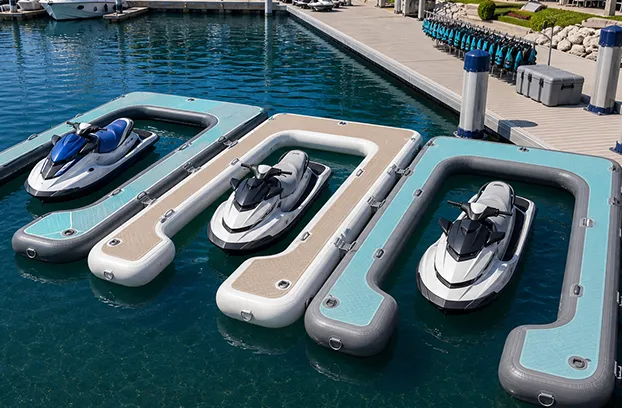
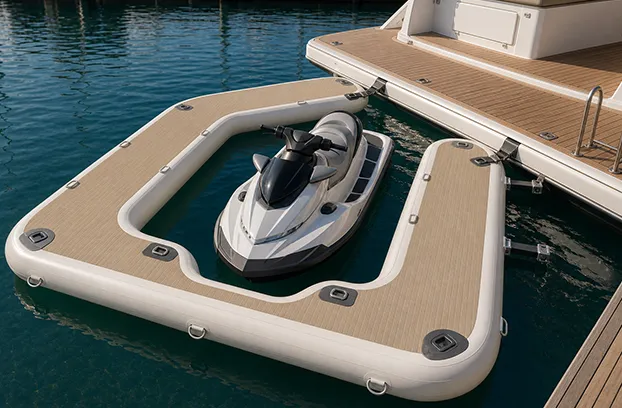
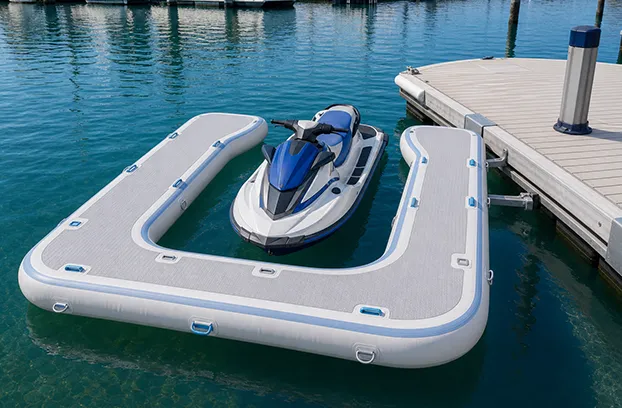
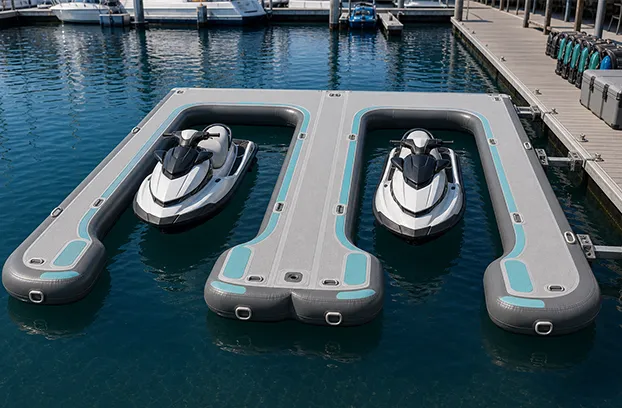
Select a Layout Around the Docking Route
The product outline should make the PWC easier to position without creating hard contact against the hull, intake or steering area. We do not assign a universal berth size or claim that one dock fits every craft. The layout is confirmed from the buyer’s PWC and the planned procedure.
Review the Material and Finished Dock as One Pressure System
The flat center panel is only one part of the finished product. Internal connecting yarns hold the two coated faces at a controlled height, while sidewalls and perimeter seams close the pressure chamber. Entry sections, corners, attachment patches and valve zones introduce different stresses from the open deck area.
As an inflatable jet ski dock manufacturer, we review each inflatable jetski dock project by checking the pressure-holding panel together with the sidewall path, welded overlap, local reinforcement and selected fittings. High-frequency or hot-air welding is chosen after the material and joint construction are confirmed. Process settings and overlap cannot be copied from a different material without sample validation.
This material-to-finished-product control is useful for repeat programs because the approved material structure, cutting allowance, weld route and inspection points can be retained as one controlled specification. It does not replace project testing; it makes the source of a variation easier to trace.
Verify Key Interfaces Before Bulk Production
An attractive inflatable jet ski dock can still be difficult to operate if its interfaces are not tested with the actual PWC, dock layout and adjacent structure. Before bulk production, we review the entry opening and guide path, hull and intake contact zones, attachment direction, pressure chamber, perimeter seams, valve zones, crew access and service points together.
The preproduction sample should confirm the inflated outline, height, berth dimensions, docking and release sequence, pressure-retention result, fitting positions, connection direction, EVA or other walk surface, packaging details and private-label identification where required. If the buyer cannot provide the actual craft, the reference model, dimensional evidence and review limits should be recorded, instead of turning an unverified fit assumption into a universal compatibility claim.
FAQ About Inflatable Jet Ski Docks
Can LonaTarp produce both the drop-stitch material and the complete dock?
Yes. We manufacture the pressure-holding material and convert it into the finished dock through cutting, sidewall closure, welding, valve and reinforcement installation, surface work and inspection. The exact construction and accessories are set by the approved project.
Is an inflatable jetski dock different from an inflatable PWC dock?
The two phrases normally describe the same product category; PWC means personal watercraft. The real design difference comes from the craft, docking motion, berth layout, connection and operating environment—not the wording used in the enquiry.
Can one dock be used for different PWC models?
It may be possible, but compatibility should be proven rather than assumed. Send the models, hull dimensions, operating weights and intended parking position. We can then decide whether one geometry is suitable or separate drawings are needed.
Can you make single- and double-PWC layouts?
Single-, double- or other custom arrangements can be evaluated. Bay count, separation, access, stability and the adjacent yacht or pontoon interface must be confirmed together before the dimensions are approved.
How are working pressure and load capacity selected?
They are not selected from thickness alone. The pressure-holding structure, span, craft load, contact zones, seams, fittings, temperature and docking action all affect the result. The working range and acceptance method are agreed through the drawing and sample.
Can the dock be developed for salt-water use?
Salt-water exposure can be included in the project review. Please provide the exposure cycle, temperature, cleaning method, storage practice and fitting requirements so that the material, surface and hardware can be evaluated together.
What are the MOQ and production lead time?
Our material production is normally planned from a 300 m baseline. The finished-dock MOQ depends on the approved size, berth geometry, fittings, branding and packaging. Standard production is usually about 15 days after the specification and sample are approved; complex components or additional testing can change the schedule.
What should be checked on a preproduction sample?
At minimum, check inflated dimensions, berth fit, entry and release procedure, pressure retention under the agreed method, perimeter and reinforcement details, fitting positions, surface coverage and packing. The acceptance list should match the intended operating route.