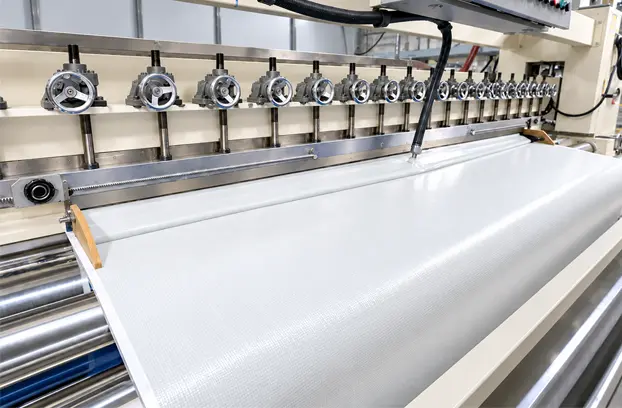
A gas holder membrane is a flexible, reinforced fabric that stores gas at low pressure. Instead of a rigid steel tank, the membrane rises as gas flows in and falls as gas is drawn out. Many gas holder membranes are made from PVC-coated polyester, and the inner gas-holding layer must be as gas-tight as possible.
Most of these membranes hold biogas. Recently, a long-duration energy storage developer visited our factory with a different gas in mind: carbon dioxide. They asked us to develop a membrane material for that job. This article explains what a gas holder membrane does, what to check when choosing the material, and the three-layer composite we are co-developing.
If you are sourcing gas-tight fabric for inflatable products rather than gas storage, see our airtight PVC coated fabric range.
I. What Is a Gas Holder Membrane?
A gas holder membrane is the fabric skin of a low-pressure gas storage system. It replaces the steel bell or tank of a traditional gasholder with a welded fabric envelope. The envelope expands and contracts with the stored volume, so the system does not need a heavy rigid shell.
The membrane fabric usually has three parts:
- A woven polyester base fabric that carries the load.
- PVC coating on both sides that seals the fabric and protects the yarns.
- A surface finish that helps the outer face resist weather and UV.
How a Double Membrane Biogas Holder Works
The most common design is the double membrane biogas holder. An outer membrane is kept inflated by a support-air blower and protects the system from wind, snow, rain and UV. Inside it, an inner membrane holds the gas and rises or falls as the stored volume changes. The inner gas membrane may be a PVC-coated fabric or a plastic film, depending on the system design.
Gas storage systems use the membrane in different ways:
| Design | How it works | What the fabric must do |
|---|---|---|
| Single membrane | One membrane covers a tank or digester and contains the gas | Hold gas and resist weather in one layer |
| Double membrane | An outer membrane is kept taut by blower air; an inner membrane holds the gas and moves with the volume | Outer: wind, snow, UV. Inner: gas-tightness and flexibility |
| Three membrane | A bottom membrane is added under the inner gas membrane, so the system can sit on a concrete slab | Bottom: seal against the base. Inner and outer as above |
In a double-membrane or three-membrane gas holder, the inner and outer layers have different jobs. They should not automatically get the same fabric.
II. Why CO₂ Storage Asks More of the Membrane
The developer publishes how its system uses the dome. When the system charges, CO₂ is drawn from the dome, compressed, liquefied and stored in pressure vessels. When it discharges, the CO₂ is heated, evaporated and expanded through a turbine, and then flows back into the dome. The dome works as an atmospheric gasholder.
For the membrane, this means:
- The CO₂ has to stay in the system. The developer describes the process as running with zero atmospheric emissions. The membrane wall is part of that boundary, so gas-tightness matters for daily operation.
- The membrane fills and empties again and again. Every charge and discharge moves the membrane. The fabric has to keep its seal after repeated flexing.
A standard PVC-coated biogas membrane fabric is a good starting point. For this project, however, the developer wanted a material with an added barrier layer against CO₂ leakage.
III. How to Choose Gas Holder Membrane Material
Before choosing a gas holder membrane material, define four things.
1. The gas and what else it carries
Name the stored gas: biogas, CO₂ or another gas. Also list moisture, hydrogen sulfide or other compounds in the gas stream. The coating has to tolerate what touches it, and the gas-tightness target depends on the gas.
2. Which layer the fabric is for
An outer weather membrane needs strength, UV resistance and the ability to carry wind and snow loads. An inner gas membrane needs gas-tightness and must stay flexible as the volume changes. A bottom membrane needs to seal against the base. Specify each layer separately.
3. Strength and base fabric
The base fabric sets most of the tensile and tear strength. For large membranes, we work with heavy woven polyester such as 1300D and 1500D yarn at 30×32 threads per inch. The 1500D 30×32 construction is the same woven base we use for our membrane-structure fabric.
4. Seams and connections
A gas holder membrane is only as tight as its seams and pipe penetrations, and a large membrane has long welded seams. Confirm how the system builder will weld the panels and connect them to the base and fittings. Ask the material supplier to confirm the fabric suits that welding method before you place a volume order.
IV. The Three-Layer Composite We Are Co-Developing
For the CO₂ storage project, we are developing a multilayer gas barrier membrane instead of a single coated fabric. It has three layers:
| Layer | Material | Weight | Base fabric |
|---|---|---|---|
| Outer layer | Double-sided PVC-coated polyester fabric | 1350 g/m² or 1200 g/m² | 1500D or 1300D, 30×32 |
| Middle layer | Aluminized PET film | — | — |
| Bottom layer | Double-sided PVC-coated polyester fabric | 950 g/m² | 1500D or 1300D, 30×32 |
Outer Layer: 1350 or 1200 g/m² PVC-Coated Fabric
The outer layer is the heavier of the two fabric layers. We offer it in two common weights, 1350 g/m² and 1200 g/m². Both sides are PVC-coated, so the polyester base is fully sealed.
Middle Layer: Aluminized PET Film
The middle layer is a PET film with an aluminum coating. Its job is to help reduce CO₂ leakage through the membrane wall. The two coated fabrics on either side protect the film and carry the mechanical load.
Bottom Layer: 950 g/m² PVC-Coated Fabric
The bottom layer is a 950 g/m² double-sided PVC-coated fabric. Like the outer layer, its base fabric can be 1500D or 1300D woven polyester at 30×32.
V. Why Add a Barrier Film Instead of Thicker PVC?
A thicker PVC coating adds weight and strength. The barrier layer was added for a different reason: to help keep CO₂ inside the membrane.
This design has three practical advantages:
- Each layer has one main job. The fabrics carry load and resist the environment; the film is there for the gas barrier.
- The film is protected. It sits between two coated fabrics instead of being exposed to UV, abrasion or handling damage.
- The fabric layers can be adjusted separately. The outer layer comes in two weights, and both fabric layers can use 1300D or 1500D base fabric, so the composite can be tuned to the load without changing the barrier layer.
We do not publish a CO₂ permeation figure for this composite. If gas permeation is part of your specification, tell us the test method you use, and we will discuss it with you during development.
VI. Developing a Gas Holder Membrane Material With Us
We are a PVC-coated fabric manufacturer with 42 million m² annual capacity. We coat and laminate fabric on our own production lines. For gas storage projects, we develop the gas-tight membrane fabric around your system, not the other way round.
To start a development project, send us:
- The stored gas and any moisture or other compounds in it.
- The layer you need the fabric for: outer, inner, bottom or a single membrane.
- Your operating conditions: working pressure range, site temperature range and expected filling cycles.
- Your system size, or the membrane area you expect to need.
- Your welding method and any seam strength requirement.
- Required test methods or standards for strength, gas-tightness or fire performance.
For roll material, our minimum order is 5,000 m² per order. Development of a new composite starts with the specification above, and lead time is confirmed once the specification is fixed. You can also read more about our custom PVC fabric production.
VII. FAQ
What is a gas holder called?
A gas holder is also called a gasholder or gasometer. Older gasholders used a rigid steel bell. Modern low-pressure gas holders often use flexible membranes, which is why they are called membrane gas holders or double-membrane gas holders.
How do gas separation membranes work?
Gas separation membranes are a different product from gas holder membranes. A separation membrane lets some gases pass faster than others, for example to upgrade biogas into biomethane. A gas holder membrane does the opposite: it is designed to keep the stored gas inside. Our composite is a storage membrane, not a separation membrane.
How to store CO₂ gas?
Small amounts of CO₂ are usually stored compressed or liquefied in steel cylinders and pressure vessels. Large volumes of CO₂ at atmospheric pressure can be held in a flexible membrane gas holder, which expands and contracts with the stored volume. For that kind of storage, the membrane needs low gas permeation and reliable seams.