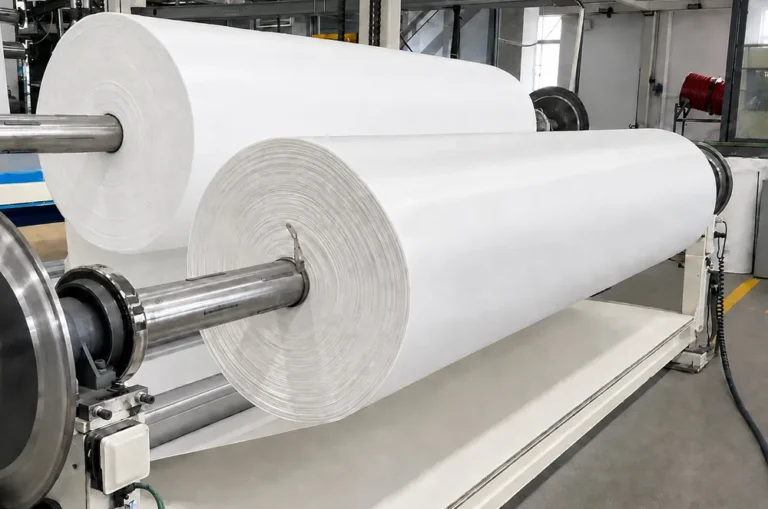
PVC tarpaulin tensile strength tells you how much pulling force an intact strip of fabric takes before it breaks, usually in N/5cm for warp and weft. It is only one of three numbers that matter. Tear strength tells you how well a small cut resists spreading, and peel strength tells you how firmly the PVC coating holds on to the polyester base fabric. Two suppliers’ figures can only be compared when the test method, specimen width and direction match.
I have spent more than 20 years in PVC tarpaulin, and the question I hear most from importers is still the same: “Supplier A says 3,000 and supplier B says 2,500. Which fabric is stronger?” Very often the honest answer is “we can’t tell yet.” This guide explains why, and shows the numbers we actually measure on our own PVC tarpaulin rolls.
I. What Tensile, Tear and Peel Strength Measure on a PVC Tarpaulin
A PVC tarpaulin can fail in three different ways, and each strength value describes one of them.
Tensile Strength: Pulling Intact Fabric Until It Breaks
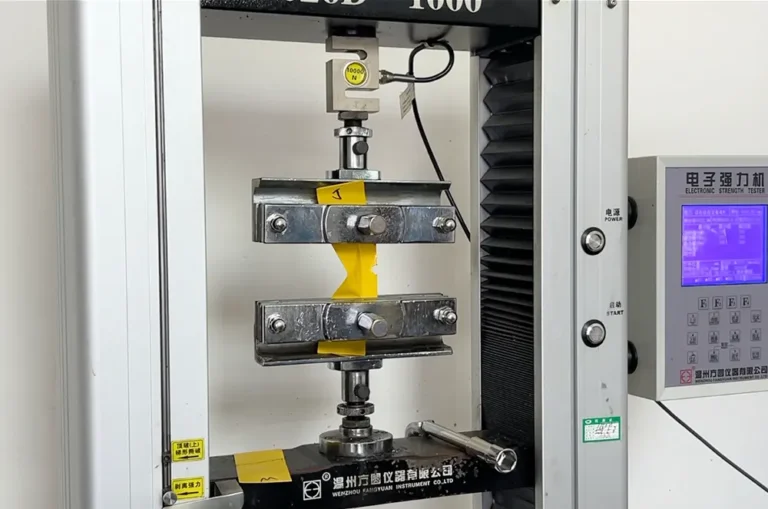
In a tensile test, a strip of fabric is clamped at both ends and pulled at a constant speed until it breaks. The lab records the maximum force and, usually, the elongation at break. Because the PVC coating has almost no load-bearing strength of its own, tensile strength mostly reflects the polyester base fabric: yarn size, yarn quality and how many yarns sit in each direction.
Tensile strength matters when a whole panel is under load, such as a side curtain tensioned between rails or a tent roof in the wind. It is not a working load. A result of 2,500 N/5cm does not mean a finished tarp can hold 250 kg.
Tear Strength: Stopping a Cut From Running
Most tarps in the field do not fail from a clean, even pull. They fail because something sharp makes a small cut, and that cut keeps growing every time the tarp flaps or is re-tensioned. A tear test starts with a cut in the specimen and measures the force needed to keep it tearing. For truck covers, flatbed tarps and anything handled every day, I pay more attention to tear strength than to tensile strength.
Peel (Adhesion) Strength: Keeping the Coating on the Base Fabric
Peel strength, also called coating adhesion, measures how much force it takes to separate the PVC layer from the base fabric. A tarp can have excellent tensile strength and still fail if the coating lifts, bubbles or peels at the folds; our guide to PVC tarpaulin delamination covers the causes and how to prevent them. Peel strength also matters for welding: if the coating is not bonded well to the fabric, a welded seam can pull the coating off instead of holding.
| Value | What fails | Typical unit | Where it matters most |
|---|---|---|---|
| Tensile strength | Intact fabric breaks | N/5cm (warp/weft) | Tensioned panels, curtains, tents |
| Tear strength | A cut keeps spreading | N (warp/weft) | Truck tarps, handled covers, edges |
| Peel strength | Coating separates from fabric | N/5cm | Folding, welding, long outdoor use |
A higher tensile number does not guarantee a higher tear or peel number. These are three separate tests, and you should not divide one by another to get a “safety ratio.”
II. PVC Tarpaulin Test Standards: DIN, ISO and ASTM Methods
Our data sheets quote three DIN methods: DIN 53354 for tensile strength, DIN 53363 for tear strength (trapezoid specimen) and DIN 53357 for peel strength. You will see the same three numbers on many PVC tarpaulin data sheets from Europe and Asia. On our own testing equipment, we test each order to the method it calls for: these DIN methods, or the Chinese national methods GB/T 3923 (strip tensile), GB/T 3917.3 (trapezoid tear) and FZ/T 80007 (peel), as in the record in section VI.
Buyers outside Germany often see the same properties written under ISO, EN or ASTM numbers instead. The closest current equivalents are ISO 1421 for tensile strength, EN 1875-3 for trapezoid tear and ISO 2411 for coating adhesion. When a buyer’s tender names one of these, or an ASTM method, we produce to that requirement and arrange testing to it (more on that in section V).
| Property | DIN method on our data sheets | ISO / EN equivalent | Common US method | Usual unit |
|---|---|---|---|---|
| Tensile strength | DIN 53354 | ISO 1421 (strip or grab method) | ASTM D751 | N/5cm, lbf/in |
| Tear strength | DIN 53363 (trapezoid) | EN 1875-3 (trapezoid), ISO 4674-1 (constant-rate methods) | ASTM D751, ASTM D5587 (trapezoid), ASTM D2261 (tongue) | N, daN, lbf |
| Peel / adhesion | DIN 53357 | ISO 2411 | ASTM D751 | N/5cm, N/cm, lbf/in |
Why Results From Different Methods Cannot Be Compared
A trapezoid tear, a tongue tear and a pendulum (Elmendorf) tear all report a force, but they load the fabric in different ways and give different numbers for the same roll. Strip and grab tensile tests also differ. We see this on our own testing equipment: the same roll gives different values under different methods. There is no reliable conversion factor between them, so if two data sheets use different methods, the only fair comparison is to test both fabrics with the same method.
III. How to Read the Strength Section of a PVC Tarpaulin Technical Data Sheet
When a customer sends me a competitor’s data sheet, I read the strength section in this order.
Warp and Weft: Why Every Value Comes in Pairs
Warp runs along the roll length; weft runs across the roll width. Strength is rarely the same in both directions, so a good sheet gives two values, for example 2500/2300 N/5cm. A single number with no direction usually means you are missing information. Ask which direction it is, or ask for both.
Some sheets also list elongation at break: how far the strip stretches, in percent, before it breaks. It matters for tensioned structures and inflatables, where the fabric must stretch evenly without permanent deformation. If your design depends on stretch, ask for elongation in both directions, measured in the same tensile test.
Units and Conversions
Before comparing, put both sheets into the same unit and the same specimen width.
| From | To | Conversion |
|---|---|---|
| 1 daN | N | × 10 |
| 1 N/cm | N/5cm | × 5 |
| 1 lbf/in | N/5cm | × 8.76 |
| 1 N/5cm | lbf/in | × 0.114 |
You will also see tear strength written as N/5cm on many sheets, including some of our own older product sheets. Strictly speaking, a trapezoid tear result is a force in N, not a force per width. When you compare tear values, treat N/5cm on a tear line as N, and confirm the method with the supplier.
Typical, Minimum or Guaranteed?
This is the question most buyers forget to ask. A data sheet value can be:
- a typical value (an average of production tests),
- a minimum value the supplier will accept in production, or
- a guaranteed value written into the contract.
The same fabric can look very different depending on which one is printed. Test conditions also matter: temperature, humidity, and whether the sample was aged or soaked before testing. If a sheet leaves out the test method, the unit, the direction or the basis of the value, ask before you place an order. I would rather answer those questions before the order than after the goods arrive.
Red Flags in the Strength Section
- No test method listed next to the value.
- One value instead of warp and weft.
- Tear strength with no method, or a unit that does not match the method.
- No date or revision on the data sheet.
- “Heavy duty” or a high GSM offered as proof of strength.
IV. Typical PVC Tarpaulin Tensile Strength by Base Fabric and Process
Below are our own numbers. They come from two sources: the data sheets we give customers, and the median results of our in-house inspection records from 2023 to 2026 (each order is tested for tensile, tear and peel). Where the same construction appears in more than one source, we show the highest figure. Tensile and peel are in N/5cm; tear is in N. Data sheet values are quoted to DIN 53354, DIN 53363 and DIN 53357; inspection medians come from our routine tests to the method each order required.
| Construction (polyester base) | Process | Weight g/m² | Tensile warp/weft N/5cm | Tear warp/weft N | Peel N/5cm | Source |
|---|---|---|---|---|---|---|
| 840D 18×18 woven | Varies by product | 500–550 | 2100/1950 | 330/250 | 100 | Highest of our data sheets |
| 500×840D 30×18 woven, 5 cm rip-stop grid | Knife coated | 422 | 2040/1642 | 269/305 | 66/58 | Inspection median, 45 samples |
| 1000D 20×20 woven | Varies by product | 550–750 | 3020/2352 | 490/404 | 100 | Highest of our data sheets and inspection medians (up to 356 samples) |
| 1000D 23×23 woven | Varies by product | 700–850 | 3500/3100 | 390/320 | 180 | Highest of our data sheets |
| 1000D 30×30 woven | Varies by product | 750–1500 | 4526/3800 | 500/450 | 200 | Highest of our data sheets |
| 1000D 30×32 woven | Knife coated | 964 | 4042/3752 | 876/793 | 120/111 | Inspection median, 29 samples |
| 1300D 30×32 woven | Varies by product | 950–1050 | 5000/4866 | 1182/1215 | 150 | Highest of our data sheets and inspection median (16 samples) |
| 1500D 30×32 woven | Knife coated, lacquered both sides | 1216 | 6071/5752 | 1352/1354 | 133/140 | Inspection median, 43 samples |
| 1000D 23×23 woven, 80 twists | Impregnated and laminated | 839 | 3639/2919 | 538/445 | 152/150 | Inspection median, 21 samples |
| 1000D 9×9 warp-knitted (pool liner) | Wet paste / film sizing | 1909 | 1692/1240 | 463/331 | 109/126 | Inspection median, 170 samples |
Our data sheet figures are the values we quote to customers, and our inspection medians are usually higher. These are production results, not guaranteed minimums. Your order is tested on its own; see section V. For a full set of values on one product, see our 650gsm PVC coated tarpaulin page.
Why a Heavier PVC Tarpaulin Is Not Always Stronger
Look at the last row. Our 1,909 g/m² reinforced pool liner has lower tensile strength than our 550–750 g/m² tarpaulin on a 1000D 20×20 base. Most of the pool liner’s weight is PVC, which adds thickness, waterproofing and abrasion resistance but very little tensile strength. The load is carried by the yarns. That is why I always ask customers for the base fabric, not just the GSM. Our guides on denier and thread count and the weight and thickness chart explain those two specs in more detail.
Tear strength follows the same logic. Heavier yarns resist tearing better: at the same 30×32 construction, tear rises from 876 N with 1000D yarn to more than 1,300 N with 1500D yarn. A woven rip-stop grid is the other way to stop a tear from running, which is how our ripstop PVC tarpaulin is built.
How the Coating Process Changes Peel Strength
You may read that knife-coated PVC tarpaulin always has better peel strength than laminated PVC tarpaulin. Our records do not support that as a general rule. It depends on how the lamination is done. From our own production, these are the lower limits we work to:
| Process | Peel strength we work to, N/5cm |
|---|---|
| Cold lamination | Lowest of these; we use it only for low-cost, non-structural products |
| Film sizing (paste on the film) | about 60–100 |
| Wet paste lamination | from 70–80 |
| Knife coating | from 60–70 |
| Impregnation + lamination | 100 or more, up to about 200 |
Impregnating the base fabric before laminating gives the strongest bond we make, which is why we use it for airtight PVC fabrics and liquid containers. For truck curtains and general tarpaulin, knife coating gives a good balance of flexibility, fold resistance and adhesion. If you want the full comparison of the two processes, read knife coating vs lamination.
Typical Strength by Application: What Our Data Sheets Show
Customers often ask me what strength their product needs. The table below groups the ranges on our current data sheets by the end use each fabric was developed for. Tensile strength is tested to DIN 53354, tear to DIN 53363 and adhesion to DIN 53357. Like many data sheets, ours print tear in N/5cm; read those values as N.
| Application | Weight g/m² | Base fabric (polyester) | Tensile warp / weft N/5cm | Tear warp / weft N | Adhesion N/5cm |
|---|---|---|---|---|---|
| Truck tarpaulin, trailer cover, side curtain | 420–1,300 | 500×840D 30×19 to 1000D 30×30 | 2,095–4,526 / 1,537–3,718 | 127–383 / 120–341 | 83–100 |
| Tent and tent keder | 680–950 | 1000D 9×9 to 1000D 30×30 | 1,780–3,712 / 1,409–3,208 | 260–382 / 202–341 | 70–100 |
| Inflatable bouncy house | 420–610 | 500D 18×18 to 1000D 20×22 | 1,450–2,700 / 1,250–2,500 | 180–340 / 140–350 | 70–100 |
| Aquaculture shrimp tank | 500–1,100 | 840D 18×18 to 1000D 30×30 | 2,000–4,000 / 1,800–3,500 | 125–300 / 100–250 | 100–120 |
| Water tank | 900–2,000 | 1000×1300D 30×26 to 2000D 32×34 | 3,354–9,070 / 3,421–9,440 | 263–635 / 210–599 | 150–190 |
| Inflatable boat | 750–1,500 | 1000D 23×23 to 1000D 30×30 | 3,500–4,200 / 3,100–3,800 | 370–500 / 320–450 | 180–200 |
| Architectural membrane | 900–1,350 | 1000D 30×32 to 2000D 30×32 | 4,000–8,000 / 3,500–7,500 | 300–600 / 250–550 | 120 |
| General and light-duty covers* | 300–750 | 200×300D 18×12 to 1000D 20×20 | 450–2,910 / 270–2,590 | 90–490 / 80–340 | 40–90 |
*Tensile strength for the general and light-duty cover range is tested to ISO 1421, not DIN 53354, so compare it only with ISO 1421 results.
Use these ranges as a starting point, not a limit. The water tank and inflatable boat fabrics, which hold water or air under pressure, carry the highest adhesion values in our range. For truck side curtains and tents, tear strength usually matters more than the top tensile figure. We match the base fabric and coating to your product, and the final values are agreed in your order specification.
V. How to Write Strength Requirements Into a PVC Tarpaulin Purchase Spec
A clear spec protects both sides. When you send an inquiry, I recommend writing the strength requirement like this:
- The test method and edition for each property (for example, tensile to DIN 53354 or ISO 1421, tear to DIN 53363 or EN 1875-3).
- Values for both warp and weft, plus elongation at break if your product is tensioned or inflated.
- The unit and specimen width.
- Whether the value is a minimum or an average.
- Any conditioning: after ageing, after soaking, or at low temperature.
- Whether you need a third-party report, and which country’s standard it must follow.
Our RFQ checklist covers the rest of the order details, such as width, colour, finish and packing.
What We Test on Every Order
Every production order is tested on our own testing equipment, to the method the order calls for (DIN or the Chinese national method), for:
- tensile strength, warp and weft (DIN 53354 or GB/T 3923);
- tear strength, warp and weft, trapezoid specimen (DIN 53363 or GB/T 3917.3);
- peel strength (DIN 53357 or FZ/T 80007);
- weight, with a tolerance of ±10 g/m²;
- thickness, colour difference and bow and skew.
Third-Party Testing to Your Country’s Standard
Most of our customers do not ask for a third-party report, so we do not order one by default. If you need one, we will produce to your country’s standard and send the finished material to a third-party lab for testing. Here is how it works:
- For an order that meets our minimum order quantity, the customer pays the testing fee.
- For an order of two to three containers or more, our factory pays the testing fee.
- We normally test after production, on the goods you will actually receive.
- If the material fails the agreed standard because of a production problem, our factory takes responsibility for the loss. You are not left carrying the risk.
The same applies to other performance tests, not only strength. And if a requirement is beyond what we can make, I will tell you that at the start. I would rather lose an order than promise a number we cannot deliver.
Seam Strength Is a Separate Test
Fabric strength does not tell you how strong a welded seam will be. For finished tarps, we test peel on welded samples as well: 5 cm samples for high-frequency welds and 3 cm samples for hot-air welds. If your product has welded seams, grommets or webbing, add those tests to your spec. Our guide to welded seam samples explains what a good sample should show.
VI. A Real Test Record From Our Lab
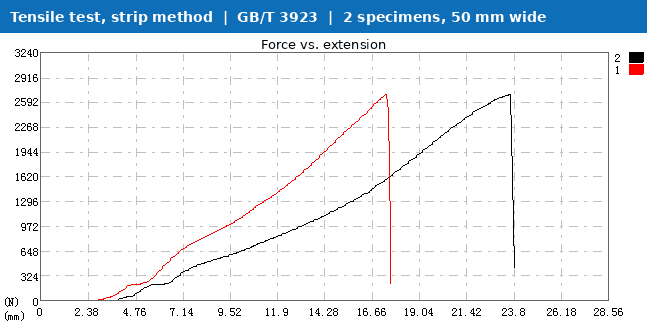
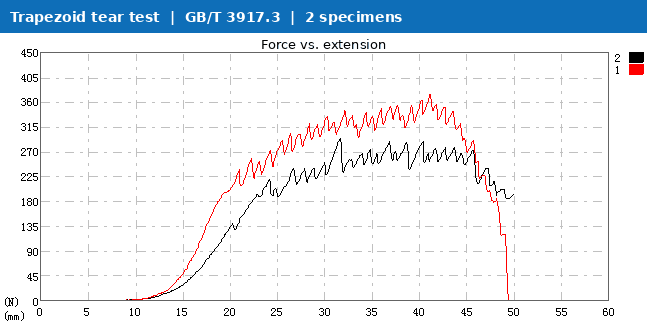
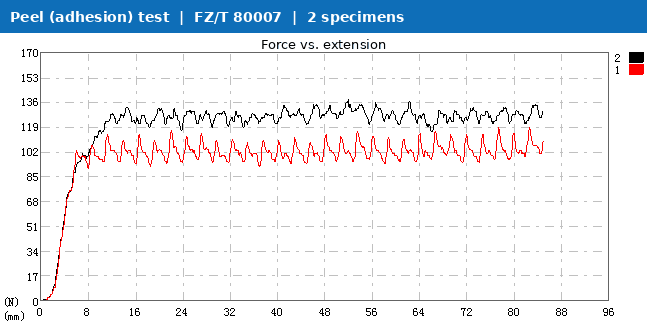
The numbers in section IV are summaries. Here is one complete record from our own testing equipment, shown exactly as the machine reported it. We keep the test record for every sample we test, so the values behind a shipment can be traced later. You can see how testing fits into our production on our quality control page.
Our tester runs both the DIN methods described in section II and the Chinese national methods. This record was run to the Chinese methods named on each chart (GB/T 3923 for strip tensile, GB/T 3917.3 for trapezoid tear and FZ/T 80007 for peel), so compare them only with results from the same methods.
The Sample: 700 g/m² Impregnated PVC Fabric, 1000D 20×20
A yellow PVC fabric on a 1000D 20×20 woven polyester base, impregnated, with a glossy face. Tested on 14 July 2025, with specimen 1 cut in the warp direction and specimen 2 in the weft direction.
| Test | Method on the record | Settings | Result |
|---|---|---|---|
| Tensile, strip method | GB/T 3923 | 50 mm wide, 100 mm between clamps, 300 mm/min | Warp 2,705 N, elongation 14.1% Weft 2,700 N, elongation 19.0% |
| Trapezoid tear | GB/T 3917.3 | 400 mm/min | Warp 322 N peak average (highest peak 377 N) Weft 255 N peak average (highest peak 295 N) |
| Peel (adhesion) | FZ/T 80007 | 400 mm/min | Specimen 1: 111 N Specimen 2: 132 N (average of ten peaks) |
How to Read This Record
Two things are worth noticing. The tensile curves climb to one clear break, so the result is a single maximum. The tear and peel curves are saw-toothed, because each peak is a yarn or a bond point giving way. That is why tear and peel are reported as an average of peaks, and why a supplier should tell you which average they used.
Also look at the spread between specimens: the two peel results are 111 N and 132 N. Real fabric varies from point to point, which is why a single number on a data sheet should always be read together with the method, the number of specimens and whether it is an average or a minimum.
VII. FAQ
How can I test the strength of fabric?
Coated fabric is tested on a tensile testing machine. For tensile strength, a strip is pulled until it breaks; for tear strength, a pre-cut specimen is torn; for peel strength, the coating is pulled away from the base fabric. Each test follows a named standard, such as DIN 53354, DIN 53363 and DIN 53357, or their ISO, EN and ASTM equivalents. A quick hand test can show an obvious defect, but only a lab test gives numbers you can compare.
What is fabric tearing strength?
Tearing strength is the force needed to keep a cut growing through the fabric. It is measured in newtons in both warp and weft. For PVC tarpaulin it depends mainly on the base yarn size, the weave density and how freely the yarns can move inside the coating.
What is the tensile strength of PVC?
PVC on its own is a plastic with fairly low strength. PVC tarpaulin gets its strength from the polyester base fabric under the coating. That is why tarpaulin tensile strength is reported per width of fabric (for example N/5cm) and ranges from about 1,200 N/5cm to more than 6,000 N/5cm across the constructions in our own inspection records, and our heaviest water-tank fabrics reach about 9,000 N/5cm on the data sheet. The difference comes mainly from the base fabric.
How do you test peel strength?
A strip is cut from the coated fabric, the coating is separated from the base fabric at one end, and the two ends are pulled apart in a tensile tester. The force is recorded per width of specimen, usually in N/5cm. We test to DIN 53357 or FZ/T 80007, depending on the order; the current international method is ISO 2411.