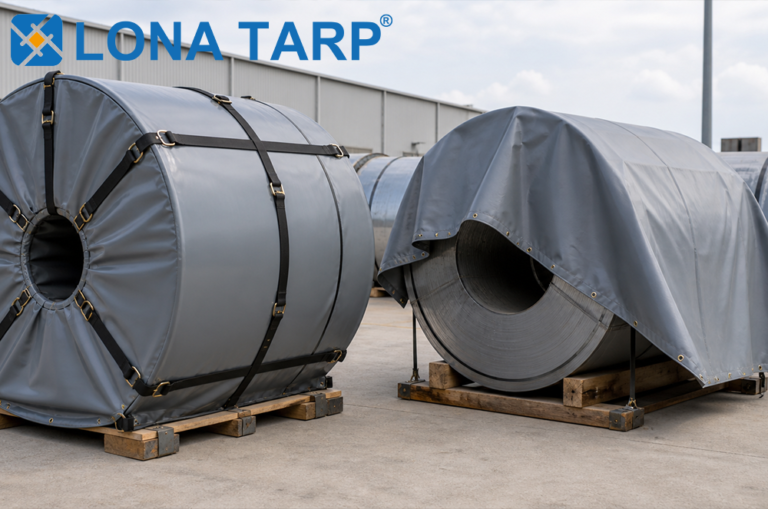
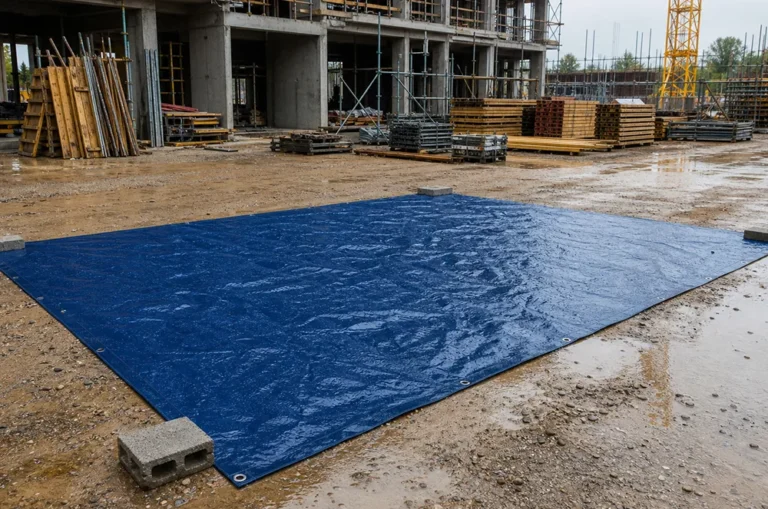
A useful vinyl tarp RFQ lets every supplier quote the same finished product. It connects the operating brief to dimensions, material requirements, seams, reinforcement, hardware, branding, packaging and acceptance checks. Without that detail, two prices may describe different constructions.
This guide covers the buying process for made-to-order commercial vinyl tarps. If you are still deciding which construction best fits the operating conditions, start with Best Vinyl Tarps for Commercial Use, then return here to build the purchase specification.

1. Turn the use case into an operating brief
Give the supplier enough context to identify fabrication risks without asking them to guess the product. State what the tarp covers, where it is used, how it is installed, how often it moves and which types of contact or exposure matter.
| Brief item | Information to provide | Why the supplier needs it |
|---|---|---|
| Product and use | Cargo cover, fitted machine cover, curtain, storage cover or other finished item | Sets the basic geometry and fabrication route |
| Operating environment | Indoor or outdoor use, temperature, sunlight, rain, wind and relevant contact substances | Identifies performance requirements that need confirmation |
| Handling | Installation method, removal frequency, folding and storage | Affects finished mass, flexibility and hardware design |
| Load and contact points | Pulling direction, sharp corners, rubbing areas and water-pooling risk | Guides reinforcement and attachment details |
| Mandatory requirements | Named standard, classification, report or buyer acceptance test | Prevents vague claims from replacing project evidence |
Separate mandatory requirements from preferences. A required flame classification or fitting dimension belongs in the acceptance specification. Color, gloss or packaging style may be adjustable unless the buyer marks it as fixed.
2. Define finished dimensions with a drawing
State whether every dimension is a finished dimension or a cut-panel dimension. Include the unit, permitted tolerance, required overlap and any allowance for fitting. For a shaped cover, provide length, width, height or depth together with the locations of corners, openings, access panels and fixing points.
A reference photo helps explain the use, but a drawing controls production more clearly. Mark seam positions, panel direction, labels and hardware orientation when these details affect installation. If the buyer supplies a physical sample, record which features must be copied and which may be changed.

3. Write the material and performance requirements separately
Identify the proposed PVC-coated or PVC-laminated construction and the full material specification available for the project. Depending on the product, this may include total GSM or oz/yd², thickness, base-fabric yarn and density, color, finish and surface treatment.
Do not treat one number as proof of the others. GSM describes mass per area; thickness describes a distance; denier describes yarn linear density. None of them alone proves tear strength, coating adhesion, seam performance or suitability for the operating environment.
List performance requirements as acceptance items. For tensile, tear, adhesion, weathering, cold flexibility, flame retardancy or chemical contact, identify the applicable test method, direction or condition, required result and whether the evidence must match the exact proposed construction. Final commitments should follow the agreed specification, sample, test route and contract.

4. Specify fabrication, edges and hardware
The RFQ should describe how the material becomes the finished tarp. State where welded or sewn joins are acceptable, the required seam or overlap arrangement, and whether sewn areas need a separate water-control detail. Mark hems, webbing, rope edges, corner patches and wear pads on the drawing.
For grommets, D-rings, straps, buckles, hooks, zippers or hook-and-loop closures, specify:
- type, material and key size;
- spacing and distance from the edge;
- orientation and expected direction of load;
- reinforcement around the attachment point; and
- corrosion, appearance or compatibility requirements.
A statement such as “grommets every metre” is incomplete when corners or load directions need a different reinforcement arrangement.
5. Make branding, packaging and quantity quoteable
List each SKU by finished size, color, material, accessories and quantity. For printing, provide artwork, dimensions, position, color references and the required approval route. State labels, barcodes, individual bags, carton quantities, pallet limits and shipping marks when they affect the quotation.
Commercial terms should include the destination, requested trade term, target schedule and any inspection or documentation requirement. LonaTarp’s made-to-order finished tarp MOQ is 30 pieces. Orders with several sizes, colors or accessory combinations need the quantity per SKU so production and packing can be planned correctly.
6. Compare quotations on the same scope
| Comparison area | Check in every quotation |
|---|---|
| Material | Construction, weight/thickness identifiers, color, finish and required performance evidence |
| Finished product | Dimensions, tolerance, panel layout, seams, hems and reinforcement |
| Hardware and accessories | Type, quantity, spacing, material, orientation and attachment method |
| Approval and inspection | Material sample, finished sample, test or inspection scope and who bears the cost |
| Commercial scope | Quantity by SKU, packaging, trade term, lead time basis and quotation validity |
When one quotation is lower, identify which line is different before calling it a saving. Missing reinforcement, a different base fabric, fewer accessories, lighter packaging or a reduced inspection scope can change both price and risk.
7. Approve a representative sample and acceptance plan
A material swatch is useful for color, surface and preliminary processing checks. A finished or pre-production sample is needed when fit, seams, reinforcement or hardware determine acceptance. Confirm which type of sample is being approved.
The finished sample review should cover dimensions, panel and seam positions, welded or sewn areas, reinforcement, hardware, accessories, printing, fit and packaging. Record the approved drawing and sample reference. Agree how bulk production will be checked, including sampling, measurement conditions, allowed variation and the treatment of nonconforming items.

8. Keep a purchase record that supports repeat orders
Store the final drawing, material code, approved color, performance evidence, sample record, bill of materials, packaging instructions and inspection result together. Repeat orders should refer to this complete record. Reordering only by a general name such as “18 oz blue tarp” can lose the details that controlled the first batch.
When any component changes, identify the affected acceptance items and approve them again. A new coating formulation, hardware supplier, panel layout or packaging method may require a focused review even if the product name stays the same.
Vinyl tarp RFQ checklist
- finished-product use and operating environment;
- drawing, finished dimensions, unit and tolerance;
- quantity for each size, color and accessory combination;
- material construction and required performance evidence;
- seams, hems, reinforcement and contact-point protection;
- hardware type, spacing, orientation and attachment;
- printing, labels, packing and pallet requirements;
- sample, test and inspection plan;
- destination, trade term and target schedule; and
- reference photos or an existing sample, with the features to retain clearly marked.