PVC coated fabric is made by bonding PVC to a polyester base fabric and fusing it with heat. At LonaTarp, we do this in two ways. In knife coating, liquid PVC paste is spread onto the fabric and fused in an oven. In semi-coating, the fabric is first impregnated with paste and then laminated with calendered PVC film. Both routes finish with surface treatment, testing and winding into rolls.
This guide walks through the PVC coated fabric manufacturing process step by step. It shows what the finished cross-section looks like and which steps to name in a roll specification when you buy in bulk.
I. What PVC Coated Fabric Is Made Of
Every PVC coated fabric has two parts: a polyester base fabric that carries the load and a PVC compound that makes it waterproof, weatherproof and weldable.
The Base Fabric
Most industrial grades use high-tenacity, low-shrink polyester filament yarn. Two constructions are common:
- Woven fabric: warp and weft yarns interlace. It gives a flat surface and good dimensional stability.
- Biaxial warp-knitted fabric: straight warp and weft yarns are tied together by a binding yarn. Because the yarns lie straight, more of their strength is used, and the fabric is faster to produce.
The base fabric is described by yarn denier and count, for example 1000D × 1000D, 20 × 20 per inch. Two fabrics with the same final weight can perform very differently if their base fabrics differ, so compare the base fabric, not only the GSM. On request, the base can also use anti-wicking or flame-retardant yarns.
The PVC Compound
PVC resin is mixed with plasticizers for flexibility, heat stabilizers, fillers, pigments and functional additives. The additive package controls UV resistance, flame retardancy, mold resistance, cold-crack resistance and weldability. On our lines, the compound takes two forms: a liquid paste for coating and impregnation, and a calendered film for lamination. We mix the paste and calender the film in our own factory.
PVC Resin Is Not PVC Fabric
Search “how is PVC fabric made” and many results explain how PVC resin itself is produced from vinyl chloride at a chemical plant (see ECVM’s overview of PVC production). A coated fabric factory starts one step later: it buys the resin and turns it into a coating on fabric. The process below starts there.
II. The PVC Coated Fabric Manufacturing Process, Step by Step
The PVC coating process on fabrics runs in six steps, from raw base fabric to a finished, labeled roll. Step 3 is where the two production routes split.
Step 1: Prepare the Base Fabric
The base fabric is unwound under even tension so it enters the line flat and straight. Some low-density woven fabrics are heat-set or given a light acrylic binder first, so the yarns hold their position and cut edges do not fray. The fabric shrinks in the oven, so it starts wider than the finished roll.
Step 2: Mix the Paste and Calender the Film
For coating and impregnation, PVC paste resin is mixed with plasticizers, stabilizers, pigments and additives into a smooth paste. For lamination, the PVC compound is pressed between heated calender rollers into a continuous film. The rollers squeeze out most of the air, so the film is dense and even. If the design is printed, the pattern is usually printed onto this film before lamination.
Step 3: Apply the PVC to the Fabric
On a production line, coating fabric with PVC is done in one of two ways:
- Knife coating: a steel blade spreads paste onto the fabric, and the gap under the blade sets the coating thickness. Heavier grades are built up in several passes.
- Semi-coating: the fabric runs through a paste bath so the paste fills the gaps inside each yarn. After drying, calendered PVC film is laminated to both sides under heat and pressure.
Section III compares the two routes.
Step 4: Fuse in the Oven and Cool
Heat turns the liquid paste into a solid, continuous PVC layer bonded to the yarns. Oven temperature and line speed are matched to the coating weight: if the paste is not fully fused, adhesion and strength suffer. Cooling rollers then set the fabric before the next step.
Step 5: Finish the Surface
The surface can be embossed with a texture, printed with a pattern, or given an acrylic or PVDF top coat. Section V covers these options.
Step 6: Test, Trim and Wind
Samples from the run are tested against the approved specification (Section VI). The edges are trimmed to the ordered width, and the fabric is wound to the agreed roll length and labeled for shipping.
III. Knife Coating vs Semi-Coating: Two Routes, Different Strengths
Neither route is better in general: knife coating gives a softer fabric that is smooth on both sides, while semi-coating gives higher strength and better airtightness. We run both, so the route is chosen to fit the end product.
Knife Coating
In knife coating, the PVC layer forms on the fabric itself. Liquid paste is applied, metered by the blade, and fused, pass after pass. The paste also flows between the fibers, so coating and base fabric bond into one piece. The result is softer, smooth on both faces, and in most cases more resistant to repeated flexing.
Semi-Coating (Impregnation + Lamination)
In semi-coating, two steps do two jobs. Impregnation fills and seals the gaps inside each yarn. The calendered film, laid on afterward, forms the outer barrier. Heat and pressure join them into one material.
This build is why semi-coating suits airtight and watertight products:
- Sealed yarns: if the film has a pinhole, air meets yarns already filled with PVC, not open channels, so a small defect is less likely to become a leak.
- Denser film: calendering squeezes out air bubbles that can form when paste is mixed and spread.
- Better seams: the film seals at a lower temperature and supplies more melted material at the seam, and the sealed yarn ends are easier to cover.
How the Two Routes Compare
For the same base fabric, the routes differ as follows:
| Property | Knife coating | Semi-coating |
|---|---|---|
| Tensile and tear strength | Lower | Higher |
| Abrasion resistance | Lower | Higher |
| Elongation at break (average) | About 30% | About 20% |
| Resistance to repeated flexing | Better in most cases | Depends on the formula |
| Softness | Softer | Stiffer |
| Maximum weight | Up to 1,550 GSM | Up to 2,500 GSM |
| Surface | Smooth on both sides | Back side is rougher |
| Air and water tightness | Good | Better |
| Typical welding temperature | 550–650°C | 350–450°C |
Service life depends on the PVC formulation for both routes, not on the route itself. For application-by-application guidance, see our knife coating vs lamination comparison. We also run cold lamination, hot lamination and pre-coated film lamination for grades where airtightness matters less.
IV. What a PVC Coated Fabric Cross-Section Looks Like
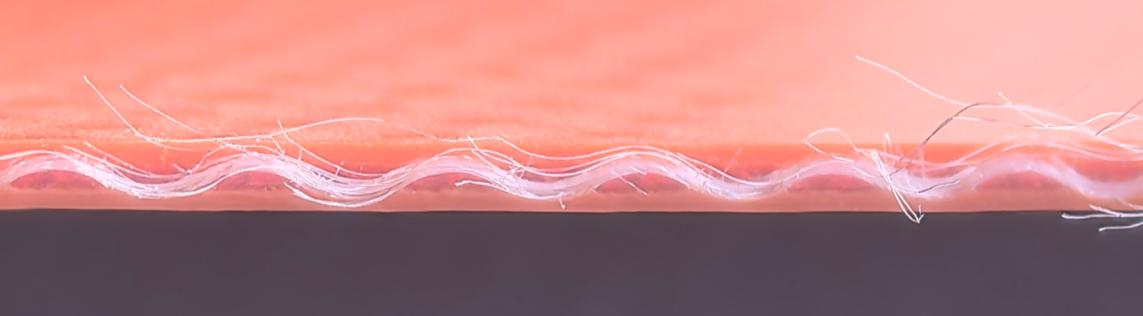
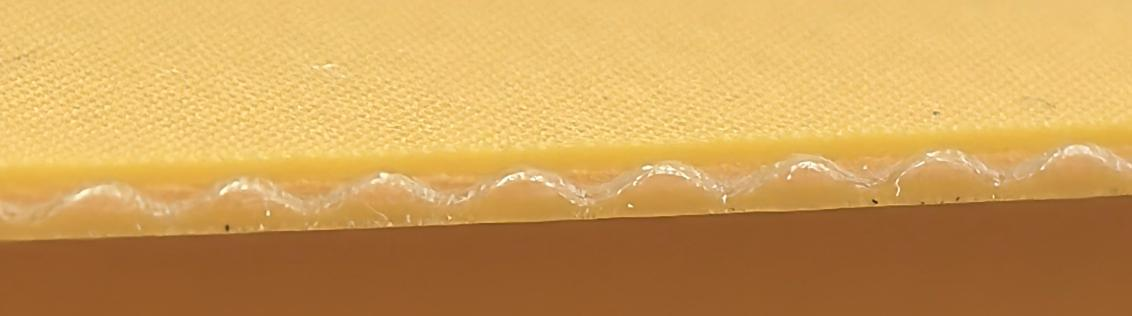
Cut through PVC coated fabric and you see a sandwich: PVC on both faces with the polyester base fabric in the middle. From the outside in, the layers are:
- Top coat (optional): a thin acrylic or PVDF lacquer that protects the surface.
- PVC top layer: carries the color, texture or print and most of the weather resistance.
- Base fabric: the polyester yarns that carry the load. In semi-coated fabric, these yarns are already filled with PVC from impregnation.
- PVC back layer: seals the back face. It is smooth on knife-coated fabric and rougher on semi-coated fabric.
The two routes also look different at the cut edge. In knife-coated fabric, the paste has flowed into the weave from the coated sides. In semi-coated fabric, the impregnated yarns sit between two distinct films. A fresh cut and a magnifier are enough to see this, and a peel test on a strip from the roll measures how well the layers hold together.
V. Surface Finishing: Embossing, Printing and Top Coats
Finishing sets how the fabric looks, feels and resists dirt. All three options below are done in our own factory.
Embossing
A heated embossing roller presses a texture into the PVC surface, such as the stone-like relief shown below. We make custom embossing rollers for buyers who want their own texture, including a brand logo built into a 3D pattern. See our embossed PVC tarpaulin range for existing textures.

Roller Printing
In roller printing, an engraved roller transfers ink onto the PVC film, usually before the film is laminated. That suits a repeat pattern or a logo across the whole roll. We also make custom printing rollers to the buyer’s artwork. Our printed PVC tarpaulin page shows current designs.
Acrylic and PVDF Top Coats
A top coat is a very thin lacquer applied after coating or lamination:
- Acrylic: basic protection that reduces surface tack and improves weathering at a lower cost.
- PVDF: stronger UV, weather and chemical resistance, and a surface that sheds dirt more easily.
A top coat can also carry anti-mold additives or make the surface printable. Top-coated fabric is harder to weld than plain PVC, but it welds well once temperature and speed are adjusted to the finish, as our PVC fabric welding guide explains.
VI. Quality Checks and What to Put in Your Specification
Each production run is tested for weight (GSM), width, peel strength, tensile and tear strength, and color difference against the approved standard. When the fabric will be welded or sewn, we also make trial samples with your seam design and confirm the processing before bulk production.
A clear specification lets us choose the right route and test the right things. Include these points in your inquiry:
| Item | What to state |
|---|---|
| Application | The end product and where it is used |
| Base fabric | Woven or warp-knitted, yarn denier and count, if you have a reference |
| Weight and thickness | Target GSM, or thickness in mm |
| Production route | Knife coating or semi-coating, or the performance you need, such as airtightness |
| Width and roll length | Usable width and preferred roll length |
| Color and surface | Color reference, embossing, print and top coat |
| Functional additives | UV, flame retardancy (for example NFPA 701), anti-mold or cold-crack resistance |
| Fabrication | Welding (HF, hot air or hot wedge), sewing or printing |
| Tests and reports | Test items, standards and acceptance values |
| Quantity | Total area per order |
VII. FAQ
How is PVC coated fabric made?
A polyester base fabric is coated with PVC paste by a knife blade, or impregnated with paste and laminated with calendered PVC film. The PVC is then fused with heat, cooled, finished, tested and wound into rolls.
What is the difference between coated and laminated PVC fabric?
Coated fabric forms its PVC layer on the fabric from liquid paste. Laminated fabric bonds a pre-made PVC film to the fabric. Semi-coating combines both: impregnation first, then lamination.
Why does PVC coated fabric delaminate?
Delamination means the PVC layers have lost their bond to the base fabric. Common causes are a base fabric too dense for the PVC to grip, too little impregnation, wrong lamination temperature or pressure, aging, and repeated folding. A peel strength test on production samples catches weak adhesion before shipment.
Can you make a custom embossed texture or a printed logo?
Yes. We make custom embossing and printing rollers to your design. Tooling and a sample are confirmed before bulk production.
Can PVC coated fabric be airtight?
Yes. Semi-coated fabric is the usual choice for airtight products, because impregnation seals the yarns and the calendered film is dense. Seam design and welding settings also need to be confirmed on samples.
LonaTarp makes PVC coated fabric on knife-coating and lamination lines, with calendering, embossing, printing and top coating in the same factory. Rolls are made to order from 5,000 m² per order. Custom finished products are made to your sizes, from 30 pieces per size, with the total order reaching 5,000 m². Lead time is typically about 15 days after the specification is approved and is confirmed for each order. To start, send your specification or a reference sample through our contact page, or browse our PVC coated fabric rolls.