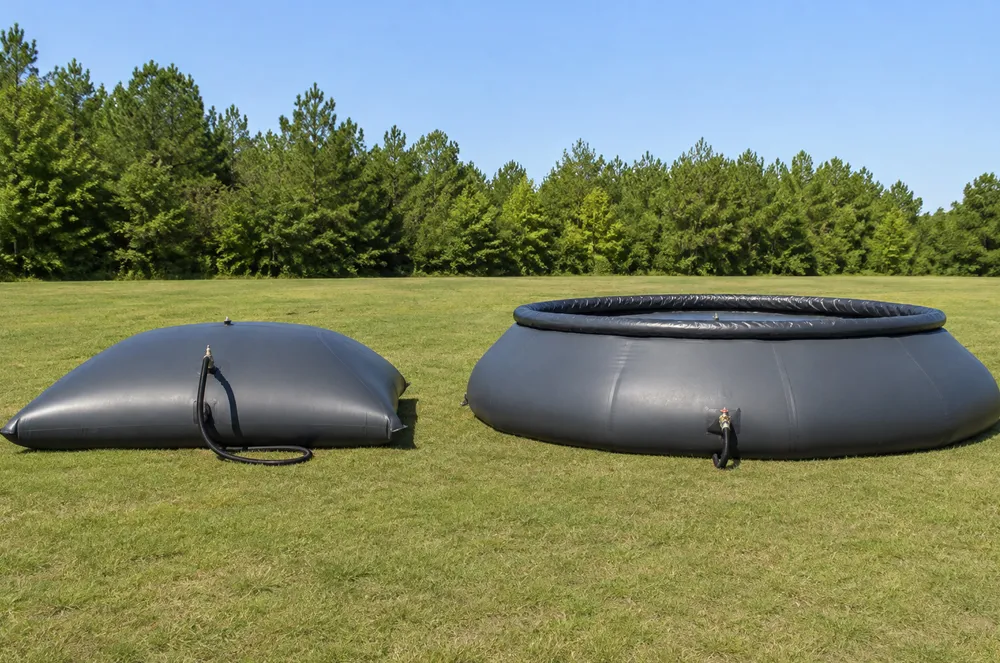
In a pillow tank vs onion tank choice, the first question is whether the project needs closed storage or open-top access. A pillow tank is a closed flexible tank filled and emptied through fittings. An onion tank is an open-top, self-rising tank whose side wall forms as water is added. Choose a pillow tank when external contamination control, low profile, and a closed transfer path matter. Choose an onion tank when crews need rapid top access for firefighting relay, emergency collection, decontamination, settling, or pump suction. Capacity alone does not decide between them.
Pillow Tank vs Onion Tank at a Glance
These are two flexible water tank types, but they solve different access problems. Calling both products “portable tanks” is not enough for specification. The buyer must define who needs access to the liquid, how quickly, through which opening, and under what contamination and safety controls.
| Decision factor | Pillow tank | Onion tank |
|---|---|---|
| Basic structure | Closed flexible envelope | Open-top self-rising basin |
| Fill and discharge | Through specified valves, vents, and hose connections | May be filled or accessed from the top; discharge uses a fitting or pump arrangement |
| Water-surface exposure | Limited by the closed system | Exposed unless a compatible cover is fitted; a cover is not the same as a sealed tank |
| Site footprint | Usually rectangular/low-profile; needs expansion clearance | Circular footprint grows with capacity; diameter and full height drive site selection |
| Access for pumping | Through fittings; controlled transfer path | Direct top access can simplify rapid suction and transfer |
| Internal cleaning access | More restricted and procedure-dependent | Open top improves reach but also admits dust, rain, debris, insects, and site contamination |
| Typical applications | Closed temporary water storage, industrial or agricultural water, low-clearance sites | Firefighting relay, emergency staging, decontamination, temporary collection and settling |
| Main operating risk | Overfill, fitting loads, puncture, fold and ground damage | Open-water contamination, unstable ground, footprint conflict, personnel access and overflow |
Closed Storage vs Open-Top Access
A closed flexible water tank reduces routine exposure of the stored liquid to dust, insects, rainfall, leaves, and casual site contact. Filling, venting, and discharge take place through specified connections, which helps a project define a controlled transfer path. “Closed” does not automatically mean sterile, potable, vapour-tight, pressure-rated, or suitable for every liquid. Those properties depend on the complete material and fitting system, cleanliness, operating method, and required test or approval.
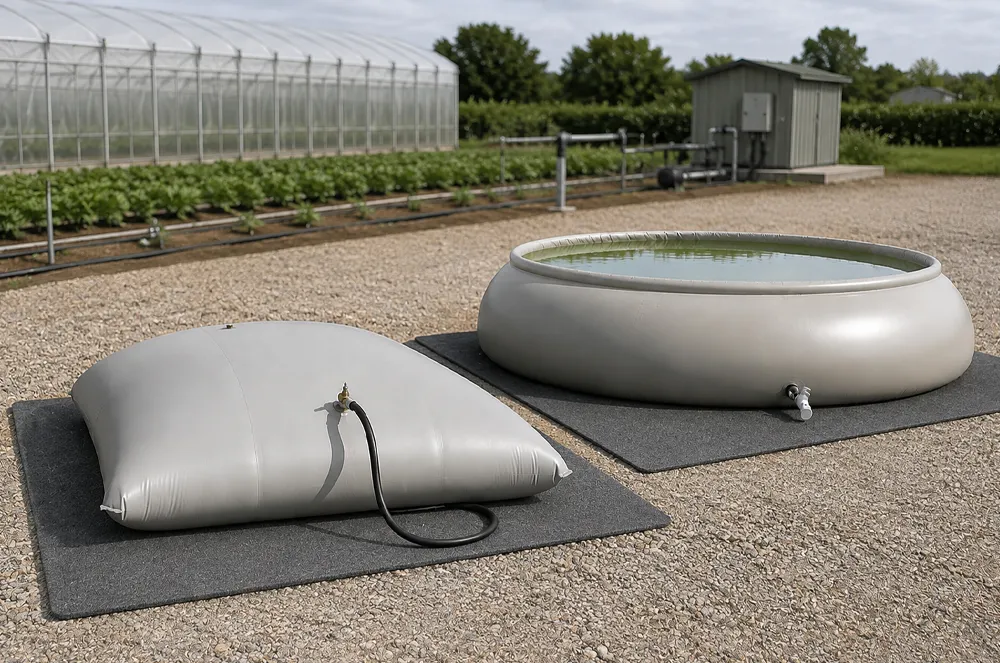
An open top water tank prioritizes access. Pumps and hoses can be positioned quickly, crews can see the water level, and collected water or wash-down flow can enter from above. The tradeoff is an exposed surface. Windblown debris, rain dilution, insects, equipment, runoff, and human access become part of the operating risk. A cover may reduce some exposure, but a loosely fitted cover does not turn an onion tank into a sealed pillow tank.
The core onion tank vs pillow tank question is therefore operational: does the project need to keep the liquid separated from the surroundings, or does it need fast access from above? If both are essential, a single flexible tank type may not satisfy the complete process. The system may need staged storage, filtration, a covered transfer tank, or another engineered arrangement.
Site Preparation, Footprint, and Deployment
Both tanks need a level, clean, stable surface free of sharp objects. A groundsheet may be required to separate the fabric from gravel, rough concrete, roots, contaminated soil, or hot surfaces. Drainage and secondary containment should reflect the volume and consequence of a release. The crew also needs clear access to valves, hoses, pumps, and inspection areas.
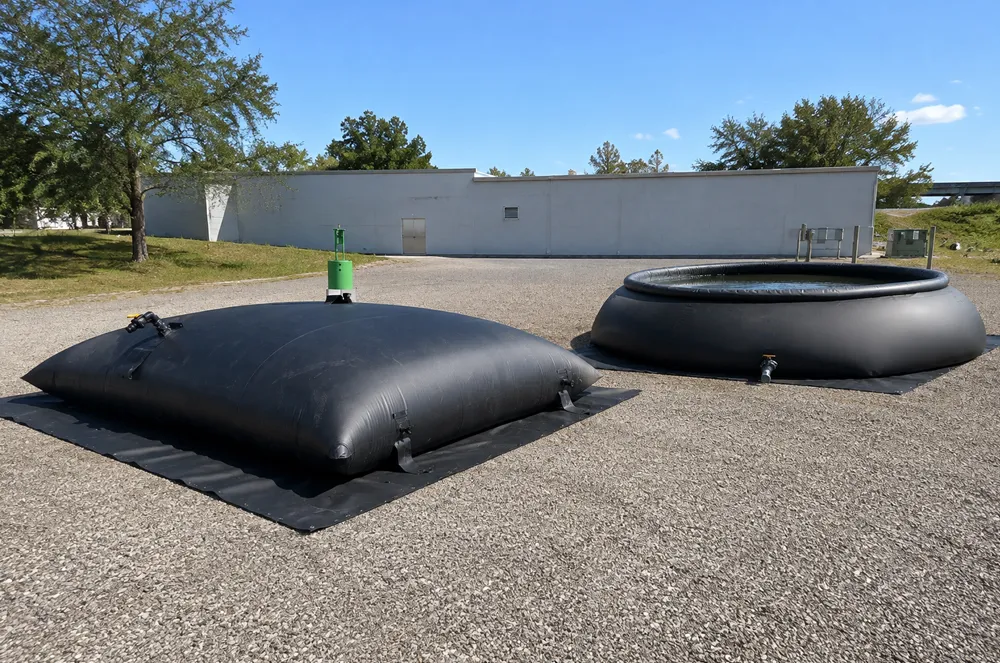
An onion tank is a self supporting water tank only after filling water creates the designed wall shape. “Self-supporting” does not mean it can tolerate a slope, partial undermining, uncontrolled vehicle movement, or an object pressing against the wall. Its full diameter and height must be known before deployment. As capacity rises, diameter can become the limiting site dimension, and the perimeter needs a safe working zone for pumps and personnel.
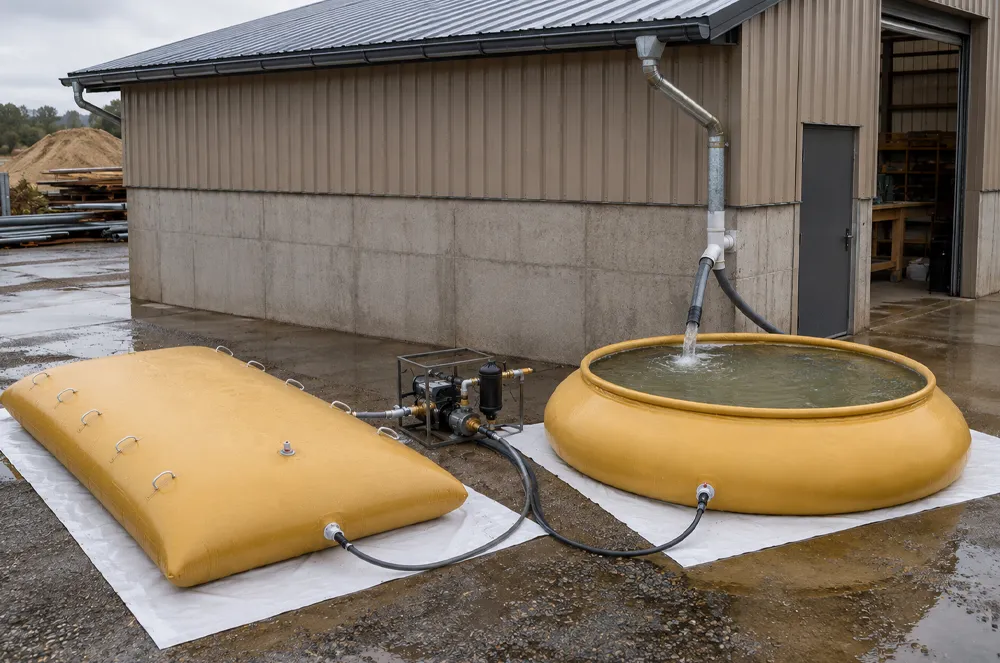
A pillow tank needs its full filled length, width, height, and edge expansion allowance. Nearby walls, posts, equipment, and hose routes must not obstruct the changing shape. Fittings should face the planned operating side and connected hoses should be supported. Filling should be supervised so rolling, local stretching, or an obstruction is detected before full volume is reached.
For both designs, compare the manufacturer’s dimensional drawing for the exact capacity rather than copying a competitor’s capacity table. Fabric stiffness, wall geometry, fittings, and fill level can change the real footprint.
Filling, Emptying, and Cleaning Differences
A pillow tank is normally filled through a connection while air management, fill rate, tank shape, and maximum level are monitored. Discharge performance depends on outlet position, hose diameter, elevation, pump duty, liquid viscosity, and the changing head as the tank empties. Do not promise a fixed emptying time from capacity alone.
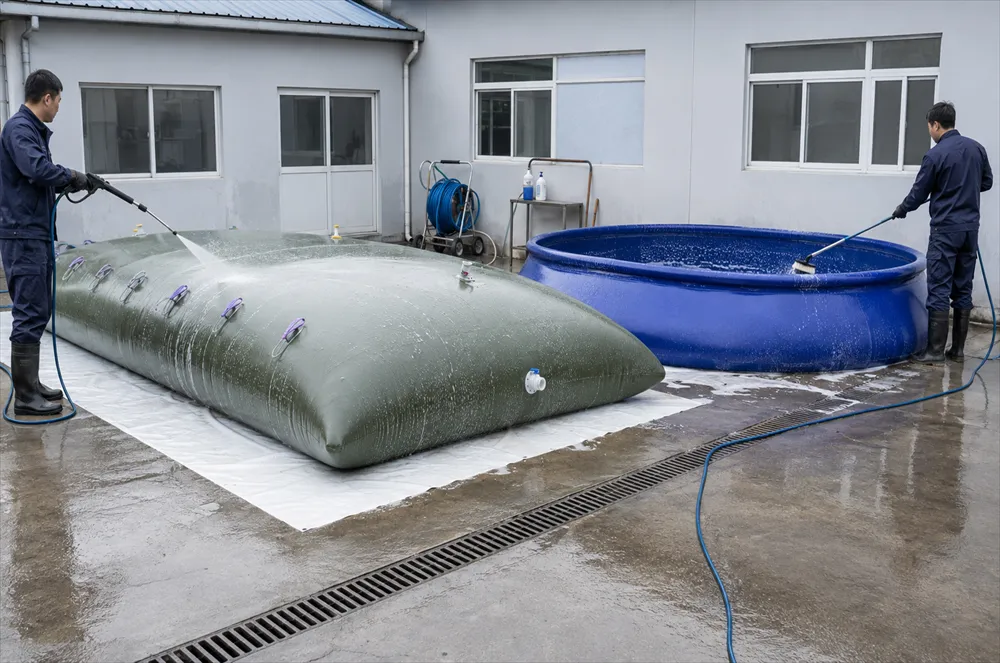
An onion water tank can accept water quickly from an open stream, tanker, hose, or pump discharge when the inflow is controlled and does not damage the wall or groundsheet. Top access also allows a suction hose or portable pump to be repositioned. Overflow, splash, erosion around the base, and a loose hose striking the fabric need control.
Cleaning presents the opposite tradeoff. Open access makes the onion tank interior easier to reach and inspect, but the open surface also receives more environmental contamination during service. A pillow tank offers a more closed process but requires a defined drain, rinse, ventilation, drying, and inspection method. For either tank, the stored liquid, coating formulation, reinforcement, welds, fittings, seals, cleaning agent, temperature, and contact time determine what procedure is acceptable.
Never reuse one tank across potable water, industrial water, fuel, or chemical service without a documented compatibility and contamination review. “Easy to clean” is not a substitute for a validated cleaning release.
Best Applications for Each Flexible Tank Type
Pillow tanks suit closed temporary water storage where the project wants a low profile and a connection-based transfer system. Possible duties include construction water, industrial process support, agricultural water, temporary rainwater holding, remote-site supply, and other non-pressurized static storage—provided the material, fittings, site, water quality, and project requirements are matched.
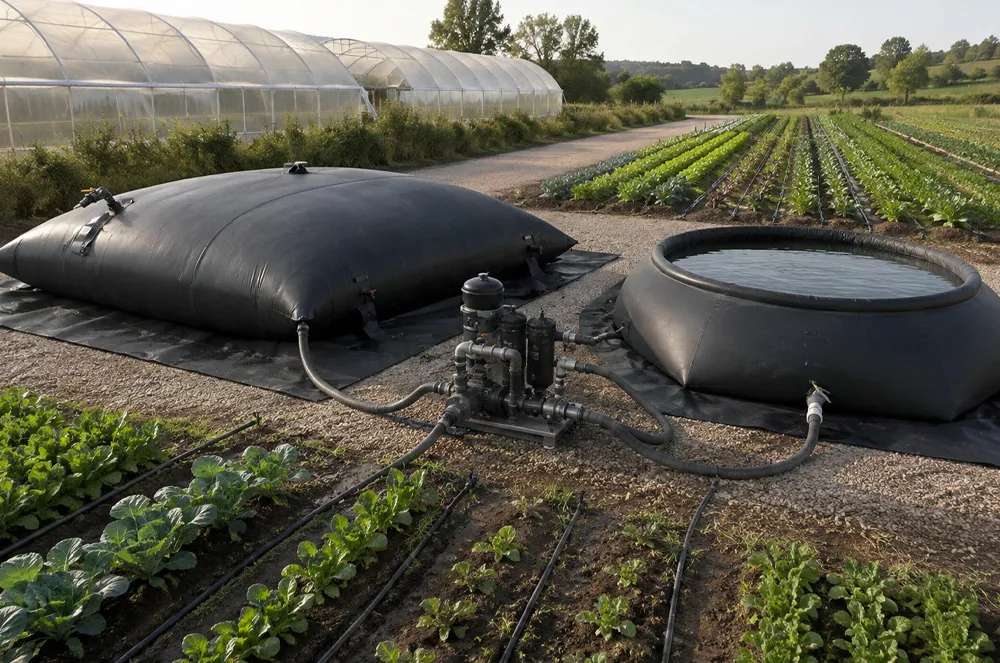
Onion tanks are useful where open access is the operating advantage. Common project roles include firefighting relay water, emergency response staging, equipment or personnel decontamination, temporary collection, settling, wash-water management, and pump supply. Using one in a fire-related operation does not by itself prove compliance with a permanent fire-water code or system standard. Using an open tank for accessible water does not by itself prove drinking-water suitability.
For temporary water storage, consider a two-stage process when water arrives dirty but must later enter a protected system. An onion tank may serve rapid collection or settling, while a closed tank receives treated water through controlled transfer. That arrangement needs filtration, pump, overflow, hose, containment, and contamination controls; it should not be improvised from two product names.
Material, Fittings, Covers, and Custom Options
PVC and TPU are broad material categories. They do not, by themselves, establish drinking-water contact safety, chemical compatibility, weld strength, UV performance, low-temperature flexibility, or service life. The coated fabric structure includes reinforcement, coating formulation, surface treatment, and interfaces. The finished tank adds seams, fittings, seals, reinforcements, and accessories. All of those elements must work as one system.
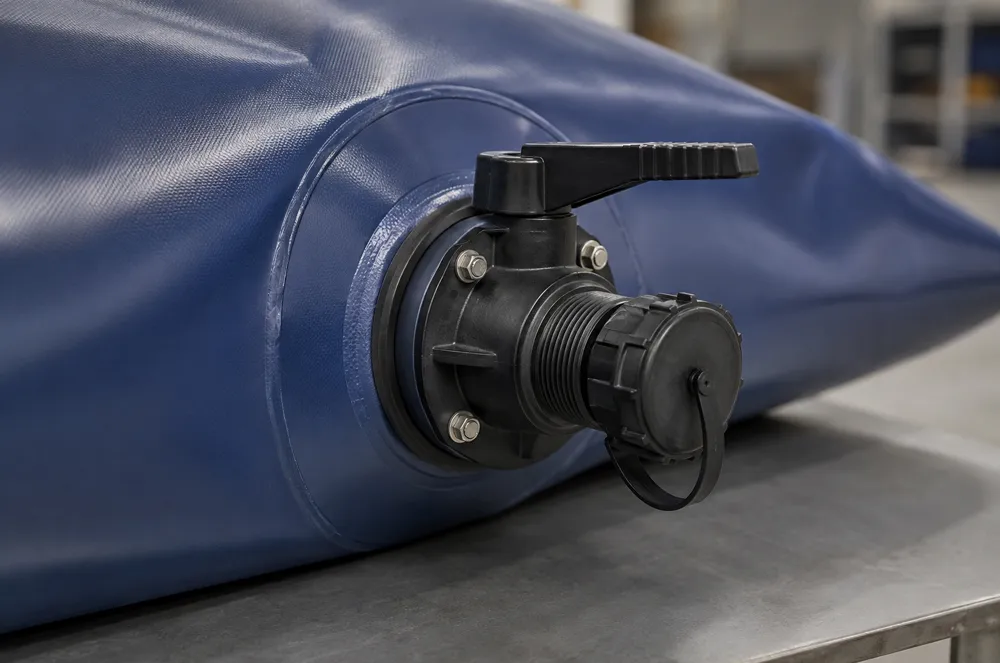
In a water bladder vs onion tank specification, list the functional components instead of writing only “heavy-duty fabric.” A pillow tank may need fill, drain, vent, inspection or service connections, protected caps, hose adapters, fitting reinforcements, groundsheet, and handling points. An onion tank may need a groundsheet, discharge fitting, overflow, compatible cover, handles, repair materials, and pump-access provisions. The exact number, position, load, material, and attachment method should follow the capacity, operating layout, liquid, and drawing.
Repair materials also need system compatibility. A generic patch kit cannot be assumed to work across coating families, surface treatments, adhesives, thermal weld methods, or contaminated service. Agree on field-repair scope, factory-repair triggers, and post-repair leak testing before shipment when the tanks will operate at remote sites.
Buyer Checklist: Which Tank Should You Specify?
Use these questions to decide between a pillow tank or onion tank:
- What liquid will be stored, and what contamination or contact requirements apply?
- Is an open water surface acceptable, useful, or prohibited?
- Must crews or pumps reach the liquid directly from the top?
- What capacity is required, and what filled length, width, diameter, and height can the site accept?
- How long will the tank remain deployed, and how many relocation cycles are expected?
- What are the ground, slope, drainage, UV, temperature, wind, traffic, and access conditions?
- How will the tank be filled, vented, emptied, overflowed, and isolated?
- Which valves, hoses, adapters, groundsheet, cover, containment, and repair provisions are required?
- Does the project involve potable water, fire response, pollutants, fuel, or chemicals that trigger specialist approval?
- What drawings, tests, documents, sample approval, and order quantity must the supplier quote against?
If closed industrial water storage is the better fit, review LonaTarp’s custom pillow tank solution. Send the liquid, capacity, available footprint, service period, deployment count, filling and discharge plan, ground conditions, fittings, target requirements, and quantity. If the project needs an onion tank or a combined system, identify the open-access duty and full site diameter so the configuration can be assessed rather than assumed.