Pool liner gauges can be confusing because a gauge number does not have one universally defined thickness across vinyl pool liner brands. For example, one supplier describes a 25-gauge liner as about 22 mil, while another identifies a specific 25-gauge model as 15 mil. Both descriptions exist, but they do not describe the same material specification.
Mil and millimeters are measurable units; gauge needs a product-specific definition. This guide explains the labels, provides a pool liner gauge chart based on traceable supplier statements and product examples, and shows how to compare 20, 25, 30, and 40 gauge liners without assuming that gauge equals mil.
I. What Do Pool Liner Gauge, Mil, and mm Mean?
Mil
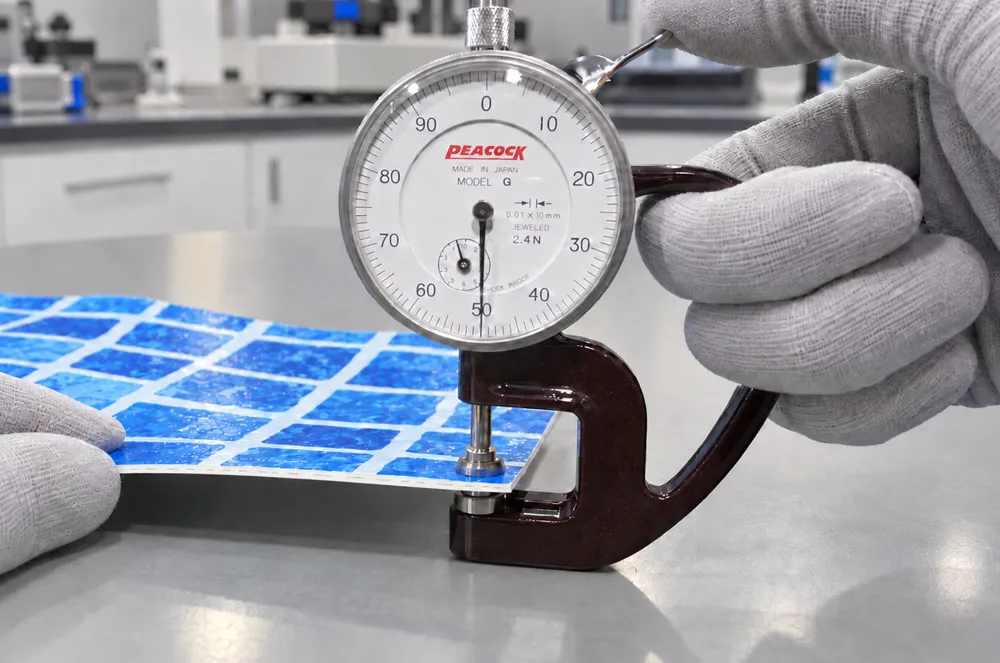
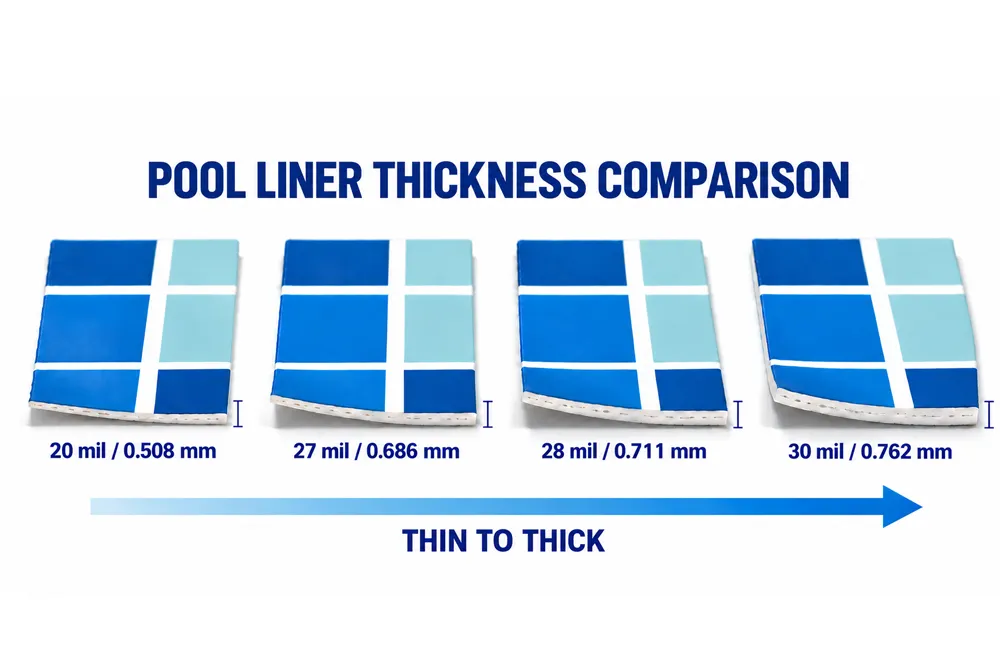
means one-thousandth of an inch. The conversion is exact: 1 mil = 0.001 inch = 0.0254 mm. A specified 20 mil liner is nominally 0.020 inch (0.508 mm) thick. Mil is not the same as millimeter: 1 mm is approximately 39.37 mil.
Millimeter (mm) is a defined metric unit. A liner specified as 0.6 mm is approximately 23.6 mil thick. These conversions describe dimensions, not material quality or expected service life.
Gauge, in pool liner advertising, is usually a grade designation used by a manufacturer or seller. There is no single reliable, cross-brand formula that converts a pool liner’s gauge label into mil. Even a term such as heavy gauge only has a clear meaning when it is tied to a named product range. The occasional misspelling guage refers to the same term.
| Label | What you can conclude | What you still need to verify |
|---|---|---|
| 20 mil | Nominal thickness of 0.020 in / 0.508 mm | Tolerance, material construction, and measurement method |
| 0.6 mm | Nominal thickness of about 23.6 mil | Whether the film is reinforced and how thickness is measured |
| 25 gauge | A seller’s or manufacturer’s gauge grade | Actual thickness in mil or mm for that particular product |
| Standard gauge / heavy gauge | A relative grade within the stated range | Comparable physical thickness and wall/floor specifications |
A nominal thickness is the target stated in the specification. A measured thickness is the result obtained from a sample under a particular test method. Do not treat sample averages, product-grade labels, and guaranteed manufacturing tolerances as interchangeable data. For background on why manufacturers prefer verifiable units, see Kayden Manufacturing’s explanation.
II. How Thick Are 20, 25, 30, and 40 Gauge Pool Liners?
The most useful pool liner gauge chart is not a universal conversion chart. It is a collection of
clearly identified examples, with the published value, its source type, and its limitations kept together.
Pool Liner Gauge Chart: Published Examples, Not Standard Conversions
| Listed gauge | Identifiable source or product | Published thickness | Evidence type and limitation |
|---|---|---|---|
| 20 gauge | Royal Swimming Pools — liner thickness chart | Approximately 12 mil | Retailer’s approximate chart; not a measurement certificate for every 20-gauge liner |
| 20 gauge | INYOPools — Standard Gauge Seabreeze liner Q&A | Approximately 18 mil | Seller’s answer about its standard-grade liner |
| 25 gauge | Mr. Pools — Willow Creek Unibead | Listed as True 15 Mil | Named product listing, not an independent laboratory result |
| 25 gauge | INYOPools — Heavy Gauge liner Q&A | Approximately 22 mil | Seller’s heavy-grade comparison with its 20-gauge offering |
| 30 gauge | Under the Sun Distribution — above-ground liner range | Approximately 15 mil wall thickness | Seller’s product-range description; floor thickness not established by this statement |
| 30 gauge | Ameri-Brand — multi-supplier vinyl sample comparison | Sample average 26 mil (0.0260 in) | Average from reported samples, not a specification for one identified retail model |
| 40 gauge | The Pool Factory — Swimline Sapphire Unibead, PERMA 40 | Mil thickness not disclosed | Specific 40-gauge product confirmed; the listing alone does not establish physical thickness |
| 35–40 gauge range | Mr. Pools — selected expandable / E-Z Clip models | Listed as True 20 Mil | Applies to a 35–40 gauge marketed range, not proof that every exact 40-gauge liner is 20 mil |
Source review: October 29, 2026. Values are published retailer statements or reported sample results, not measurements performed or certified by LonaTarp. Seller descriptions and product specifications can change.
An additional Ameri-Brand sample comparison reports averages of 18.5 mil for 20 gauge, 22.3 mil for 25 gauge, and 26 mil for 30 gauge among the samples it examined. Its measured averages are useful evidence of the tested samples, but should not be treated as values guaranteed by every supplier. In contrast, the Royal Swimming Pools chart gives approximate examples of 12, 15, and 20 mil for 20, 25, and 30 gauge, respectively. The difference demonstrates why source and product identity matter.
How Thick Is a 25 Gauge Pool Liner?
A 25-gauge label does not give one universal mil value. INYOPools’ example is approximately 22 mil; the named Willow Creek Unibead listing from Mr. Pools states 15 mil. The two listings cannot be converted using one fixed ratio. Compare their actual specifications and distinguish a seller’s claimed measurement from a test report.
How Thick Is a 30 Gauge Pool Liner?
A 30-gauge liner is not automatically 30 mil thick. Under the Sun Distribution describes a 30GA-quality range with an approximately 15 mil wall. Ameri-Brand reports a 26 mil sample average for 30-gauge-labeled material from its comparison. These are different evidence types and product scopes, so neither number should be applied to all 30-gauge products.
How Thick Is a 40 Gauge Pool Liner?
The Swimline Sapphire/PERMA 40 listing confirms that a specific 40-gauge product is sold, but it does not state a verified mil thickness. Mr. Pools separately markets selected 35–40 gauge products as True 20 Mil; that is a range-specific claim, not a measurement of the exact Swimline 40-gauge model. Without a product-specific mil value, an exact answer to “How thick is a 40 gauge pool liner?” remains unverified for that model. Quoting 40 mil would be incorrect.
III. What Is the Standard Pool Liner Gauge for Above-Ground and Inground Pools?
There is
no single standard pool liner gauge shared across every brand and pool system. A supplier may call one product standard gauge and another heavy gauge, but those labels must be interpreted within that supplier’s product line.
Above-Ground Pool Liner Gauges
Above-ground liner catalogs commonly feature 20-, 25-, 30-, and 40-gauge labels. They do not all use the same thickness scale. For example, INYOPools’ 20-gauge standard and 25-gauge heavy options are described as approximately 18 and 22 mil, whereas other sellers use different values for the same labels.
Also check whether the stated number describes the wall, the floor, or the complete liner. An advertised 15 mil wall does not establish the floor thickness. Attachment types such as overlap, beaded, or unibead describe fit and connection, not units of material thickness.
Inground Pool Liner Gauges
Inground vinyl liner specifications often use mil directly. Some finished-liner listings combine different wall and floor values. For instance, FamilyPoolFun’s Adriatic 28/20 mil liner explicitly identifies a 28 mil wall and 20 mil floor. That is one documented interpretation of 28/20 mil, not a universal meaning of every combined label.
Reinforced PVC membranes are another material system, usually described by physical thickness in mm or mil together with textile reinforcement. Gauge terminology alone cannot identify that structure. To choose a thickness based on the pool system, read our pool liner thickness guide. This article focuses on reading and verifying labels, not selecting a liner system for the project.
IV. Which Is Thicker: 20 or 25 Gauge? How Does 25 Gauge Compare With 20 Mil?
Which Is Thicker, a 20 or 25 Gauge Pool Liner?
Within the same documented INYOPools range, 25 gauge is thicker: its comparison describes approximately 22 mil for 25 gauge versus 18 mil for 20 gauge. But this relationship must not be generalized across brands. A 25-gauge Willow Creek model listed as 15 mil is thinner than the 18 mil 20-gauge example from that different supplier. A higher gauge number is therefore not a dependable cross-brand thickness ranking.
Is 25 Gauge the Same as 20 Mil?
No. A nominal 20 mil film is defined as 0.020 inch / 0.508 mm. Compare that value against the specific 25-gauge product’s published mil thickness:
| Product-specific example | Compared with a nominal 20 mil sheet | Conclusion about physical thickness |
|---|---|---|
| INYOPools 25-gauge heavy grade: about 22 mil | 22 − 20 = 2 mil | Approximately 0.0508 mm thicker |
| Mr. Pools Willow Creek 25-gauge Unibead: 15 mil stated | 20 − 15 = 5 mil | Approximately 0.127 mm thinner |
These comparisons address thickness only. They do not establish equivalent construction, tolerance, seam strength, fit, or service life. A nominal value and a seller-stated thickness are not the same as two samples measured under identical conditions.
V. How Do You Verify Actual Pool Liner Thickness?
For importers, distributors, liner manufacturers, and fabricators, the goal is to turn a gauge label into a
reproducible material specification. The same process also makes comparisons between finished liner offerings more meaningful.
1. Identify the Manufacturer, Model, and Component
Record the manufacturer or retailer, exact model or pattern, the label as published, and whether the thickness describes the wall, floor, or raw material roll. Save the specification version or dated product listing. Do not use a model’s price, warranty, or marketing grade as a substitute for physical thickness.
2. Confirm Nominal Thickness, Tolerance, and Construction
Request a nominal thickness in mil or mm, the permitted tolerance, and the agreed inspection method. Confirm whether the material is unreinforced PVC film or reinforced PVC membrane. Equal thickness does not mean equal textile structure, formulation, processing behavior, or performance.
3. Check the Measurement Method and Surface
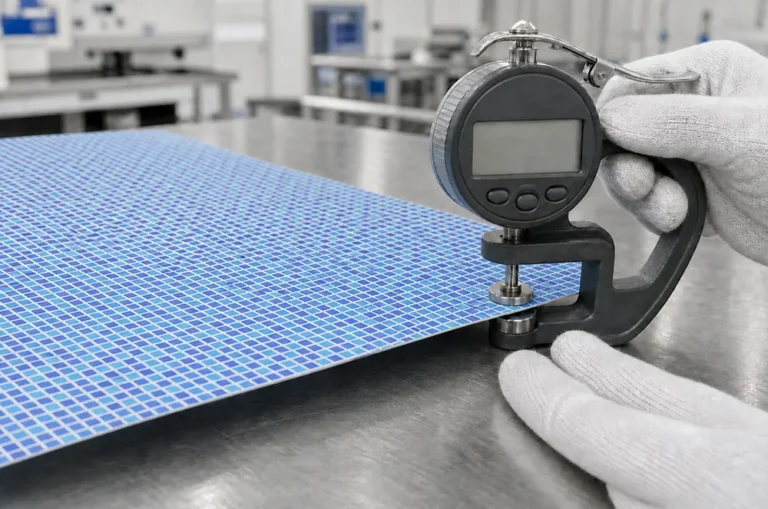
Use a suitable calibrated instrument and an agreed measurement procedure. For embossed or textured vinyl, raised peaks and lower areas can yield different readings. Record the measuring positions and whether the specification refers to the base material, a raised texture, or another defined surface location. Do not compare the highest embossed reading on one sample against the valley reading on another.
For bulk roll inspections, identify the approved sampling locations and acceptance criteria before production. A supplier’s average from several unrelated products is not a substitute for your order-specific acceptance standard.
4. Document a Comparison You Can Recheck
| Specification field | Record required for a valid comparison |
|---|---|
| Product identification | Manufacturer, specific model or approved grade; dated source |
| Label and physical unit | Exact gauge label and corresponding nominal mil/mm if supplied |
| Construction | Unreinforced PVC film or textile-reinforced PVC membrane |
| Material location | Wall, floor, or defined roll-material measurement point |
| Inspection | Instrument, method, measurement locations, readings and agreed tolerance |
| Approval | Technical sheet, approved physical sample, revision and acceptance criteria |
Two products can carry the same gauge number and still have different physical thicknesses. The reverse is also true: two materials can share a mil value while differing in structure and suitability. Use physical units and comparable evidence to make the decision.
LonaTarp supplies PVC pool liner materials in rolls, including unreinforced vinyl pool liner film and reinforced PVC membrane, for liner manufacturers, fabricators, importers, and bulk distributors. The material specification should identify construction, nominal thickness, tolerance and downstream fabrication requirements. Pool Liner Roll Materials — MOQ: 3,200 m². LonaTarp does not sell individual finished replacement liners or provide on-site installation.
The practical answer to a gauge question is not to assume a conversion: identify the exact product, find its physical thickness in mil or mm, and verify which part of the liner that measurement describes.