Rainwater tank sizing means balancing collectible roof runoff, the timing of rainfall, and the project’s non-potable water demand to find a workable storage volume. Multiplying annual rain by roof area only estimates supply; it does not show whether the tank will empty in a dry month or overflow through a wet season. Use the calculator below for a planning estimate, then verify the result against site rainfall records, demand data, available space, overflow, treatment, pipework and local requirements.
I. Size the System Around Supply, Demand, and Timing
Three numbers are often confused during early planning:

| Quantity | What it tells you | What it does not tell you |
|---|---|---|
| Annual collectible rainwater | The approximate volume the roof can deliver after collection losses | Whether the water arrives when the project needs it |
| Dry-period demand | The reserve needed for a selected number of rainless days | Whether earlier rainfall can refill that reserve |
| Modeled storage capacity | The tank volume that reaches a chosen demand-coverage target in a time-series model | Whether the tank, foundation, pipework or treatment system is ready to build |
Good rainwater harvesting tank sizing starts by calculating supply and demand over the same time steps. A warehouse may have more annual rainfall yield than annual washdown demand, yet still require supplemental water if most rainfall arrives in a few months. The opposite problem also occurs: a large tank can spend much of the year nearly empty when the roof catchment is too small.
For a first screening, collect:
- the roof plan area that actually drains to the proposed tank;
- monthly rainfall from a reliable local record;
- a collection-efficiency allowance for roof, first-flush, filter and conveyance losses;
- monthly non-potable demand for the uses connected to the system;
- the acceptable share of demand to be supplied by rainwater;
- a drier-year scenario if the project needs drought resilience;
- available footprint, filled height, overflow route and supplemental-water strategy.
This separates “how much rain falls” from “how much storage helps.” It also gives the project team a clear list of assumptions to verify before asking a tank supplier for a finished size.
II. Use the Calculator as a Planning Model, Not a Product Selector
The embedded rainwater tank size calculator accepts metric or US customary units. Enter the catchment area, collection efficiency, a rainfall scenario, daily demand for the dry-period benchmark, and monthly rainfall and demand. The model repeats the 12-month profile for three years and reports the third year, reducing the distortion caused by assuming an empty tank on the first day.
This is also a rainwater harvesting tank size calculator: it calculates collectible inflow for each month, limits storage to each candidate capacity, subtracts demand, and records overflow and supplemental-water requirements. It searches upward in rounded capacity steps until it finds the smallest modeled volume that reaches the selected demand-coverage target.
For a commercial site, do not enter residential assumptions out of convenience. A commercial rainwater harvesting tank size calculator should use the demand of the actual connected uses—such as irrigation, vehicle wash, process washdown or toilet flushing—by month. It should also reflect roof zones that genuinely drain to the tank, planned shutdowns, seasonal occupancy, drought scenarios and any permitted supplemental supply.
How to read the outputs
- Annual collectible rainwater shows the modeled roof supply after efficiency and rainfall-scenario adjustments.
- Annual modeled demand shows the total demand entered for rainwater-served uses.
- Dry-period storage benchmark equals typical daily demand multiplied by the selected dry-period days; it is a reference, not the final recommendation.
- Smallest modeled capacity is the first rounded capacity that reaches the selected coverage target in the repeated monthly model.
- Overflow shows water the selected tank cannot retain; frequent overflow may justify a larger tank only when later demand can use that extra stored water.
- Supplemental water exposes months when rainwater alone does not meet the entered demand.
Rainwater Tank Size Calculator
Estimate collectible roof runoff, a dry-period storage benchmark, and the smallest modeled capacity that reaches your selected demand-coverage target.
Start with site data. The prefilled monthly values are an illustration only. Replace them with local rainfall records and the project’s monthly non-potable demand before using the result for planning.
Monthly rainfall and demand
Enter rainfall depth for the roof and total project demand for each month. The calculator repeats the 12-month profile for three years and reports the third-year result to reduce start-empty distortion.
| Month | Rainfall (mm) | Demand (L) | Collectible yield | End storage | Overflow | Supplemental water |
|---|
Monthly demand should represent the uses served by rainwater, not the building’s total water consumption.
Planning limit: This calculator estimates storage from the entered rainfall and demand profile. It does not size gutters, pipework, overflow, pumps, treatment, foundations or structural support, and it does not confirm drinking-water compliance. A project designer should verify local rainfall records, design events, water quality, applicable codes and the final system layout.
III. Check the Yield Formula Before Trusting the Result
The basic rainwater harvesting tank capacity calculation begins with collectible yield.
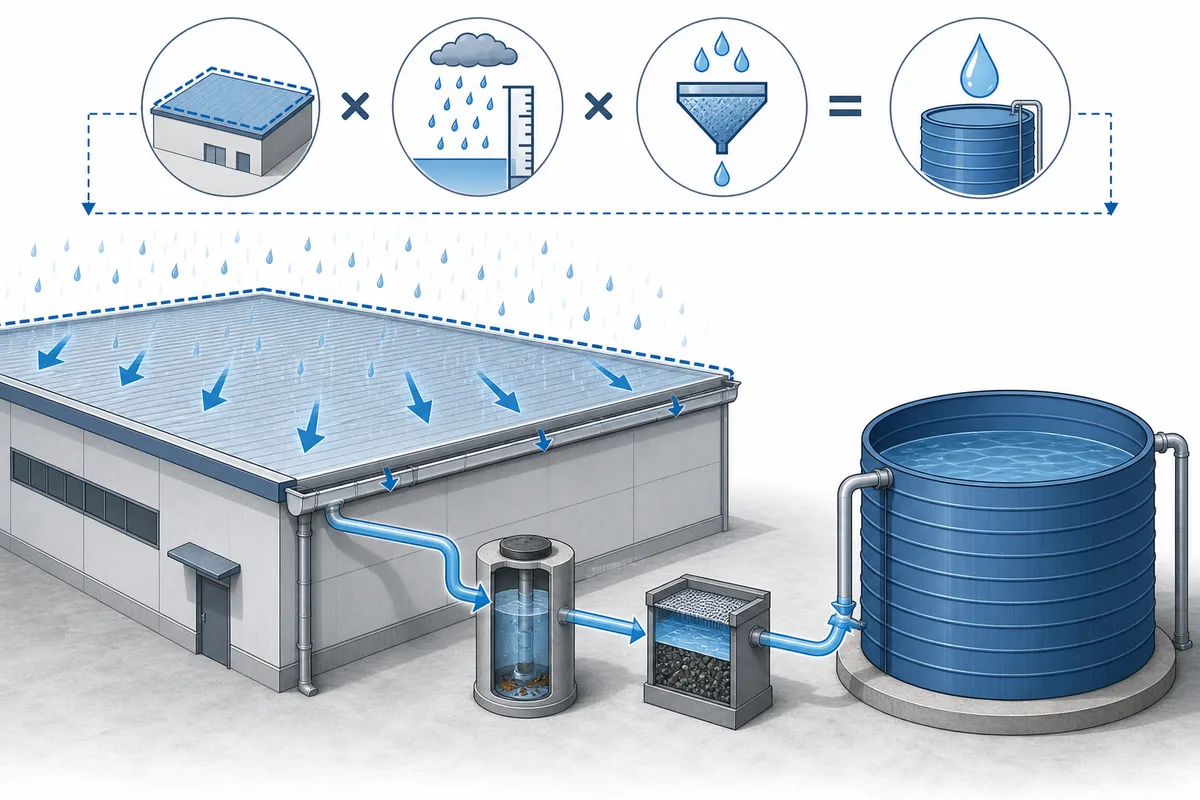
Metric
= roof catchment area (m²)
× monthly rainfall (mm)
× collection efficiency
One millimetre of rain over one square metre equals one litre before losses. For example, a 1,000 m² roof receiving 60 mm of rain at 85% collection efficiency produces:
US customary
= roof catchment area (ft²)
× monthly rainfall (in.)
× 0.623
× collection efficiency
The U.S. Department of Energy’s rainwater harvesting guidance uses the same roof-area, rainfall, conversion-factor and collection-factor structure. It notes a collection factor of roughly 75% to 90%, depending on system efficiency. The calculator starts at 85% only as an editable illustration; the project value should reflect the roof surface, gutters, first-flush diversion, filtration, leakage and conveyance arrangement.
Five checks prevent a neat formula from producing a misleading answer:
- Use the plan area that drains to this tank, not the building’s total floor area.
- Keep rainfall and area units consistent.
- Apply the efficiency factor once; do not reduce rainfall and then apply the same loss again.
- Use local monthly or finer rainfall data rather than an unrelated national average.
- Keep yield separate from peak inflow. Storage volume does not size gutters, downpipes, filters or overflow for a design storm.
IV. Use a Monthly Water Balance to Expose Shortage and Overflow
Annual supply can look generous while the tank still fails during the operating season. A useful rainwater harvesting tank capacity is therefore tested month by month:
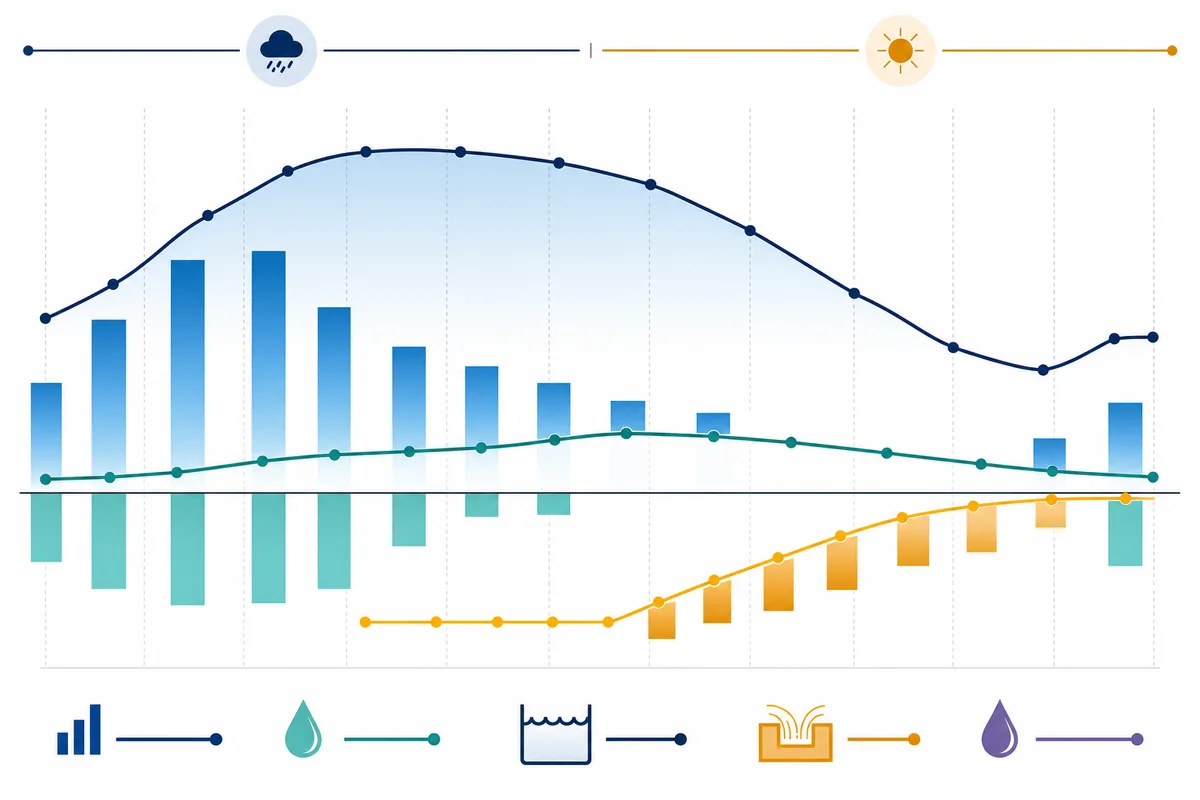
= previous end storage + monthly collectible yield
overflow
= max(0, water available before use – tank capacity)
water supplied from tank
= min(monthly demand, tank capacity after overflow)
end storage
= tank capacity after overflow – water supplied from tank
supplemental water
= max(0, monthly demand – water supplied from tank)
The calculator runs this balance repeatedly because storage carries from one month into the next. Texas A&M AgriLife Extension’s Rainwater Harvesting Supply Calculator similarly uses catchment area, collection efficiency, tank size, monthly rainfall and demand over a three-year period to show stored volume and supplemental water.
When choosing a water harvesting tank size, review more than the first capacity that passes:
- If annual yield is below annual demand, a larger tank cannot create water. Increase catchment, reduce the rainwater-served demand, accept a lower coverage target or plan supplemental supply.
- If overflow is high and shortages still occur later, extra storage may help, but only until the wet-season surplus has been retained.
- If overflow remains high while the tank rarely empties, the catchment may be oversized for the selected demand or the tank may already be larger than useful.
- If the result changes sharply when rainfall is reduced to 80% or 90%, the project is sensitive to dry years and needs a documented backup strategy.
- If the site has highly variable storms, short operational peaks or critical supply requirements, replace average monthly inputs with weekly or daily simulation.
The model’s “smallest” result is not automatically the purchase size. Select the next practical working capacity, then rerun the calculation with that exact value and check footprint, height, freeboard where applicable, overflow, access and maintenance. Never treat nominal tank volume as fully usable water without confirming the product and system definition.
V. Turn the Capacity Result into a Project Specification
Once the volume is defensible, the next question is physical: where will the water be stored, and how will the system connect to it? A rigid tank, sectional tank, underground cistern and flexible bladder can hold the same nominal volume but demand different footprints, foundations, access routes, fittings and inspection plans.
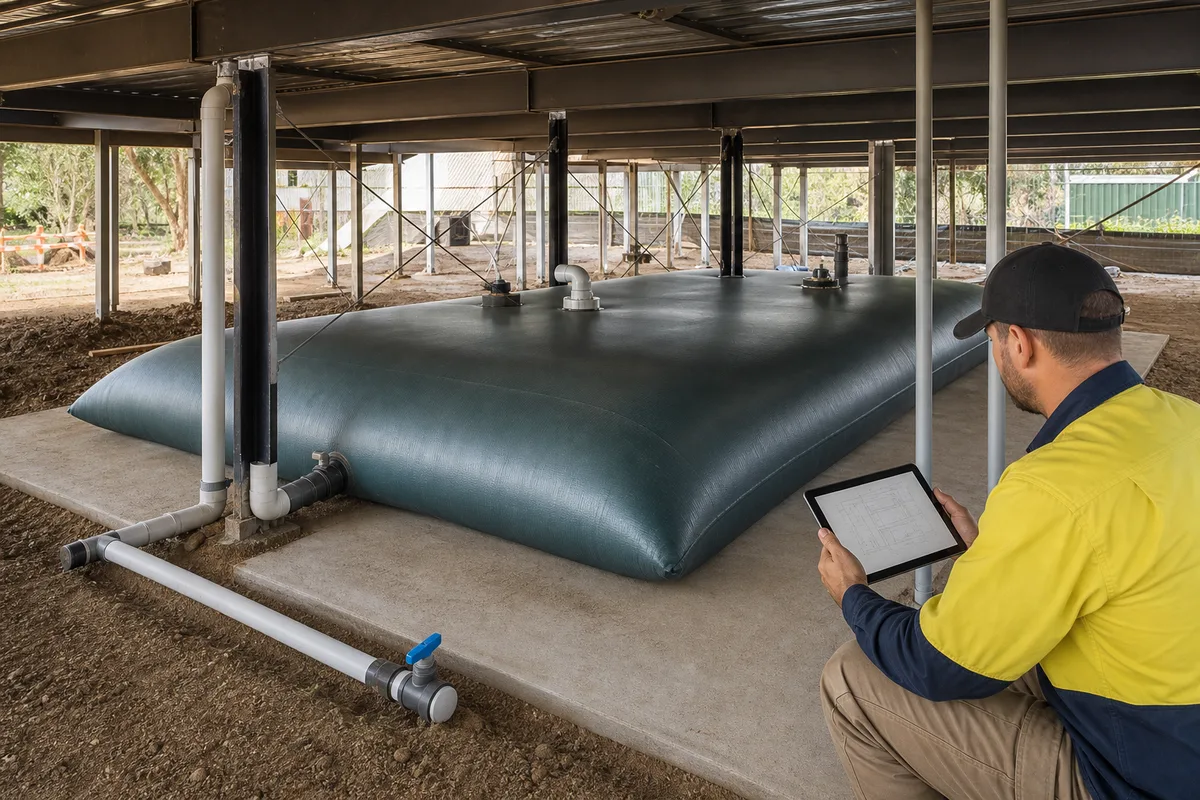
For a made-to-order flexible rainwater bladder tank, do not convert litres directly into an empty rectangular bag. Working volume depends on the allowed filled height, panel and seam layout, movement around posts or joists, the prepared base, protective layer, connection reinforcement and service clearance. The material and finished tank also need project-specific checks for liquid use, puncture risk, weld consistency and interface loads.
Send these details for a flexible-tank project review:
| Project input | Why the supplier needs it |
|---|---|
| Modeled working capacity and required quantity | Defines the volume target and whether the order is a single project or repeat program |
| Usable length, width and maximum filled height | Converts capacity into a feasible footprint without assuming a rigid rectangular shape |
| Roof catchment and monthly yield model | Shows the expected refill pattern and peak seasonal storage |
| Monthly non-potable demand and target coverage | Explains why the selected capacity is commercially useful |
| Inlet, outlet, overflow, vent and pump arrangement | Locates reinforced interfaces and protects the flexible connection from pipe loads |
| Base, access and puncture controls | Reduces damage risk and keeps fittings inspectable |
| Water use, target market and required verification | Sets the material, treatment and compliance boundary |
| Sample method, packing and batch requirements | Connects the calculation to finished-product approval and repeat procurement |
LonaTarp manufactures PVC-coated fabric and can fabricate made-to-order flexible tanks through cutting and welding. The production model is B2B, with a 5,000 m² material MOQ rather than one-piece retail stock. Final material, capacity, dimensions, fittings, liquid use and validation method remain subject to the project drawing, sample and agreed specification.
CTA: Send Your Capacity Model and Site Layout
Email: Lonatarp@gmail.com
WhatsApp: +86 13484130360