Is TPU waterproof fabric toxic? There is no responsible yes-or-no answer without the exact construction and intended use. TPU resin may be only one layer in a composite that also contains a textile, pigments, stabilizers, adhesives, surface treatments or printing inks. Safety depends on the formulation, exposure route, temperature, contact duration and rules for the finished product. A document for one resin grade—or a general statement that “TPU is non-toxic”—does not prove that a waterproof fabric is suitable for skin, children’s products, food, drinking water or medical use.
For a B2B buyer, the correct task is not to approve a polymer name. It is to verify the complete material against a defined use.
I. Why TPU Waterproof Fabric Is Not One Substance
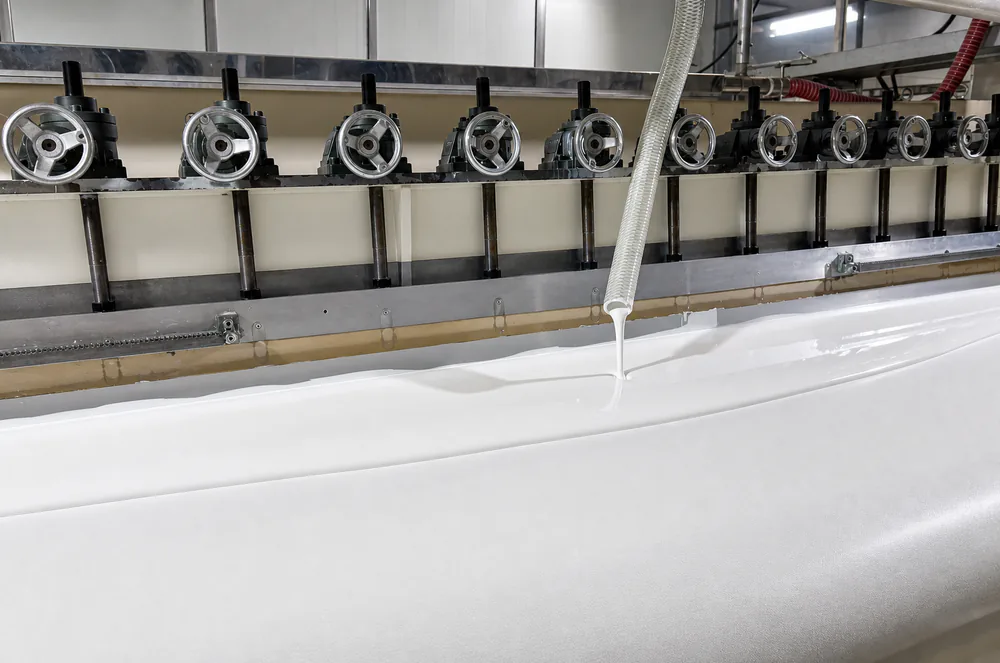
“TPU waterproof fabric” usually describes a multilayer textile material rather than a single pure chemical. The complete construction may include several sources of substances or exposure.
| Part of the construction | Its role | What the buyer should verify |
|---|---|---|
| TPU resin or formulated TPU layer | Flexible functional surface or barrier | Exact grade/formulation, color package, additives, current SDS/TDS and use-specific status |
| Textile substrate | Mechanical reinforcement and dimensional support | Fiber identity, finishes, dyes and any treatment applied before lamination or coating |
| Adhesive or tie layer | Bonds film to textile or joins different layers | Composition, cure/activation conditions, residuals and suitability for the intended contact |
| Pigments and stabilizers | Color and processing/service stability | Restricted-substance status and whether the declaration covers the exact color/formulation |
| Surface treatment or ink | Printing, bonding, appearance or handling function | Location in the product, transfer/contact possibility and relevant documentation |
| Welded seam, valve or accessory | Converts the roll material into a finished article | Added materials, processing conditions and finished-product test requirements |
This distinction matters because a compliant resin does not automatically make every composite compliant. The U.S. FDA’s food-contact terminology, for example, treats a food-contact substance, the material made from substances, and the finished article as related but distinct levels. It also states that the overall status depends on the components and their authorized conditions of use.
II. Hazard, Exposure and Compliance Are Different Questions
The word “toxic” compresses several decisions that a product team should keep separate.
Hazard concerns whether a substance can cause harm under some conditions. Exposure concerns how much of that substance can reach a person or the environment, by which route, and for how long. Risk combines the relevant hazard and expected exposure. Compliance asks whether the exact material and use meet the rules or customer requirements for a target market.
The same material can face very different evidence requirements in a rain cover, a skin-contact wearable, a child’s product, a food pouch, a drinking-water bladder or a medical device. Contact area, duration, temperature, repeated use, cleaning, abrasion and the type of contents can all change the assessment.
This is why a broad safety statement has little purchasing value. A buyer needs to know:
- which formulation and color were evaluated;
- whether the report covers raw resin, film, coated fabric or the finished article;
- which substances, migration endpoints or performance properties were tested;
- the method, laboratory, date and sample identity;
- the market, use conditions and limits to which the result applies.
III. Six Checks Before Approving a TPU Waterproof Fabric
1. Identify the exact material and every contact-facing layer
Record the TPU grade or formulated layer, substrate, adhesive, pigment, surface treatment, printing ink and accessory materials. Identify which side faces the user, liquid, food, air stream or other contact medium. A declaration for a hidden layer may not answer the question for the exposed surface.
2. Define the intended exposure before selecting a test
State the destination market, product category, contact route, temperature, duration, repeated-use cycle, cleaning method and expected wear. For food-contact reviews, the FDA explicitly organizes authorizations around food type and conditions of use; EU food-contact rules likewise address migration under representative time and temperature conditions.
3. Review current formulation-level documents
Request the safety data sheet and technical data for the exact material, not a generic TPU family brochure. Then request declarations or laboratory reports against the target regulation or customer restricted-substance list. Confirm the product code, color, date, test scope and whether the tested sample matches the proposed production construction.
An SDS is important for workplace handling and processing, but it is not a consumer-product approval and does not replace a migration, extractables or finished-article assessment when those are required.
4. Use application-specific compliance evidence
Skin contact, children’s products, food contact, drinking-water contact and medical use are different regulatory and testing tasks. A passing restricted-substance screen may support one part of supplier qualification, but it does not automatically establish biological compatibility, food migration compliance or potable-water suitability.
For EU food-contact applications, materials and articles must comply with the applicable food-contact framework, good manufacturing practice and any material-specific or national rules. For U.S. food-contact applications, the authorization and its conditions of use must cover the relevant components and intended use. The word “TPU” is not itself an authorization in either market.
5. Include processing and aging in the assessment
Heat, residence time, drying, welding, adhesives, printing, cleaning and repeated flexing can change the finished construction or create new exposure questions. Follow the exact supplier’s processing guidance and SDS, control ventilation and industrial hygiene as required, and assess the actual converted sample rather than relying only on the incoming roll.
If the product will be abraded, folded, heated, immersed or cleaned repeatedly, condition samples accordingly before the relevant safety or performance test. Initial compliance evidence does not predict every aging condition.
6. Link bulk production to the approved evidence
Use a controlled specification, approved sample and traceable document set. Define how color/formulation changes, supplier changes or process changes trigger re-evaluation. Incoming and batch controls should protect the identity that the test report actually covered.
IV. Why REACH or RoHS Does Not Mean “Food Grade”
REACH, RoHS and food-contact rules answer different questions.

The European Commission’s REACH Regulation overview describes it as the EU framework for registration, evaluation, authorization and restriction of chemicals. It can create obligations for substances and articles, including communication requirements for certain substances of very high concern. A REACH statement is useful, but its scope and substance list must be identified.
RoHS restricts specified hazardous substances in electrical and electronic equipment. The European Commission’s RoHS Directive overview describes its scope around products with electrical or electronic components. A RoHS report may be relevant to such an application, but it does not approve a fabric for food or drinking-water contact.
EU food-contact materials are governed by a separate framework. The European Commission’s food-contact materials overview states that food-contact materials must not release constituents at levels harmful to health or unacceptably change food, and that plastics have additional composition, restriction, migration and documentation requirements. The test conditions must represent the intended food and time/temperature use.
In the United States, FDA food-contact regulatory status guidance also ties status to the substance, manufacturer or applicable authorization, specifications and intended conditions of use. A result for one supplier, formulation or use cannot automatically be transferred to another.
Therefore, “REACH compliant,” “RoHS compliant” and “food-contact compliant” should never be used as interchangeable labels.
V. Claims That Require Product-Specific Evidence
The following statements are not safe shortcuts. Each needs a defined scope and supporting evidence for the exact construction:
- “Non-toxic” or “completely safe”: too broad unless the claim defines substances, exposure, users, test methods and limits.
- “Food grade” or “safe for drinking water”: requires the applicable jurisdiction, intended contact conditions and appropriate material/finished-product documentation or testing.
- “Medical grade”: requires a defined medical application and its regulatory and biological evaluation route; a generic polymer description is not enough.
- “BPA-free” or “phthalate-free”: identify which compounds, reporting limits, test method and formulation/color the result covers.
- “Heavy-metal-free” or “chlorine-free”: define the substances and analytical scope. A broad marketing phrase may omit pigments, inks, catalysts, contamination or other layers.
- “Eco-friendly” or “fully recyclable”: requires a defined environmental attribute, boundary and evidence. A multilayer textile may not follow the same recycling route as neat TPU resin.
- “Microplastic-free”: the material name cannot prove this. Particle release depends on the complete construction, abrasion, aging and use; where it matters, define an appropriate measurement or risk-assessment plan.
The purpose of this caution is not to imply that a TPU fabric is unsafe. It is to prevent a buyer from accepting a claim that does not answer the intended use.
VI. How to Read Supplier Documents Without Overreaching
| Document | What it can support | What it normally does not prove by itself |
|---|---|---|
| Technical Data Sheet (TDS) | Grade identity, selected material properties and recommended processing information | Finished-product safety or compliance in every application |
| Safety Data Sheet (SDS) | Hazard communication, handling, storage and processing precautions for the supplied material | Food-contact, skin-contact, potable-water or medical approval |
| REACH/SVHC declaration | Supplier statement against a stated REACH scope and list date | All restricted substances worldwide or use-specific consumer safety |
| RoHS test/declaration | Restricted substances within RoHS scope for EEE | Food-contact or drinking-water suitability |
| Laboratory test report | Results for the identified sample, methods and limits | Unlisted substances, other colors/formulations or future batches without identity control |
| Food-contact declaration / supporting evidence | Compliance for stated components and defined conditions under the applicable framework | Uses, temperatures, food types or markets outside the declared scope |
| Certificate or management-system record | Certain process or management controls | Automatic approval of every product produced by the organization |
Check whether the document is current, traceable to the quoted construction and issued by the appropriate party. A logo or certificate title without sample identity and scope is not enough for a technical approval.
VII. What Buyers Should Send to a Supplier
A useful safety inquiry contains more than “Is your TPU toxic?” Send:
- the finished product and whether you need resin, film or coated/laminated fabric;
- which surface contacts the user, food, water, fuel, air or another medium;
- destination country and product category;
- contact temperature, duration, repeat cycles and cleaning method;
- expected abrasion, folding, outdoor aging or sterilization/processing conditions;
- required regulation, standard, customer restricted-substance list and test method;
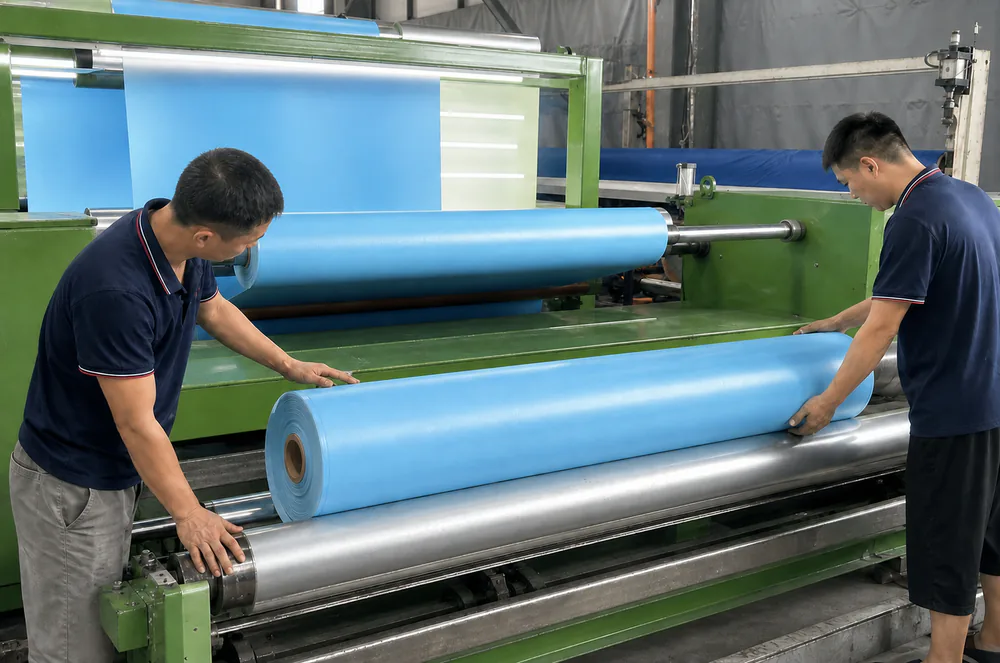
- proposed layer structure, thickness/GSM, width, color and joining process;
- estimated quantity, sample plan and production timing.
The supplier can then confirm which documents already exist, which claims remain unsupported and what sample or third-party testing is needed. If a required use cannot be supported, the correct outcome is to revise the material route—not to weaken the wording of the requirement.
VIII. Frequently Asked Questions
Is TPU waterproof fabric safe for skin contact?
It may be suitable in a qualified construction, but the word TPU does not establish skin-contact safety. Verify the exposed layer, additives, intended contact duration, user group, target-market requirements and appropriate test evidence for the finished product.
Does TPU contain harmful chemicals?
TPU is a material family with many formulations. Resin chemistry, residuals, additives, pigments, adhesives, finishes and processing can differ. Review the exact formulation and use-specific evidence rather than assuming every TPU fabric has the same substance profile.
Is TPU waterproof fabric safe for food or drinking water?
Do not make that conclusion from the polymer name or a general REACH/RoHS report. Confirm the applicable food- or drinking-water-contact requirements, complete construction, contact medium, temperature, time and required migration or product testing. LonaTarp must confirm documents for the exact product and project before any such claim is used.
Does TPU waterproof fabric release microplastics?
The phrase “TPU waterproof fabric” does not provide enough information for a quantified answer. Potential particle release depends on the material construction, surface, abrasion, aging and use. If this is a project concern, define the exposure scenario and an appropriate test or risk-assessment method instead of accepting a “microplastic-free” label.
Is TPU safe during heat welding or processing?
Processing safety depends on the exact material, temperature, residence time, equipment and workplace controls. Follow the current SDS and processing guidance from the material supplier, keep the process within the qualified window, and apply appropriate ventilation and industrial-hygiene controls. Consumer-use evidence does not replace workplace instructions.
Is TPU safer than PVC?
There is no responsible family-wide answer. Both TPU and PVC products vary by formulation, additives, construction and intended use. Compare exact materials against the same restricted-substance list, exposure conditions, product standard and test plan. Do not use polymer reputation as compliance evidence.
IX. Turn a Safety Question Into a Verifiable Specification
The defensible answer to “Is TPU waterproof fabric toxic?” is conditional: approve the exact construction only for the use, exposure and market covered by the evidence. Keep resin, film, textile composite and finished product documents connected, and re-evaluate changes that can affect that evidence.