The best PVC tarpaulin for outdoor use is not simply the heaviest or the most expensive one. It is a PVC-coated polyester construction whose formulation, weight, seams and fixing points are matched to the climate, exposure period and handling it will actually face. As for how long it lasts: for a commercial-grade PVC-coated polyester tarp, “several years” is the only responsible general answer. There is no single outdoor lifespan that applies to every material, finished cover and operating condition.
A stationary equipment cover that is properly supported, sloped and inspected may remain serviceable much longer than a truck tarp that is folded, tensioned, dragged and exposed to highway wind every day—even when both covers use the same roll material.
When a buyer asks me for a vinyl tarp that will “last five years,” I do not start with GSM or price. I first ask where it will be installed, how often it will be handled, what will rub against it, how water will drain, what temperatures it will face and what condition the buyer will accept at the end of the service period. This guide follows the same order.
I. Why PVC Tarpaulin Is a Top Choice for Outdoor and Long-Term Use
For covers that stay outdoors for long periods, or that must be reused season after season, PVC-coated polyester is widely chosen because it combines a woven reinforcing fabric with a continuous waterproof PVC surface. That combination gives buyers something lighter cover materials rarely offer: a material that can be specified, welded, reinforced and repaired around a defined duty cycle.
Why PVC-Coated Polyester Holds Up Outdoors
The polyester base fabric carries most of the tensile and tear load. The PVC layer seals that fabric against water and can be formulated with stabilizers, pigments and surface treatments for the intended exposure. High-frequency or hot-air welded panel seams may be appropriate for compatible PVC materials, so large outdoor covers can be built without stitching holes through the main surface.
These advantages are not automatic. Two tarps can have the same color and total weight but age differently because their polyester base fabrics, coating structures, additives, surface treatments, seams, reinforcement and installation conditions are different. The real strength of PVC tarpaulin for outdoor use is that each of these variables can be specified, sampled and controlled in production.
How PVC Compares with PE and Canvas for Outdoor Durability
PE (polyethylene) tarps and canvas tarps are the two materials buyers most often compare with PVC. Each can be the right choice under the right conditions:
Vinyl tarps are often better suited to repeated use and demanding outdoor conditions, but actual lifespan still depends on the specification and the application. A poorly specified PVC cover can fail sooner than a well-matched lighter cover on a short project. For a full side-by-side comparison of weight, handling and cost, see our guide to PVC vs PE tarpaulin.
II. How Long Does PVC Tarpaulin Last Outdoors?
In general, a correctly specified commercial vinyl tarp can remain serviceable for several years. That answer is intentionally conditional. The same logic applies to the broader question of what the lifespan of a tarp is: lighter tarps built for temporary covering are generally replaced sooner, while reinforced PVC covers specified for outdoor duty are built to last longer. In every case, the duty cycle sets the real limit.
A fixed outdoor cover with good slope, low abrasion and limited handling can have a very different service history from a transport tarp that is opened, folded, tightened and dragged every working day. A temporary construction enclosure may only need to survive one project, while an equipment manufacturer may need repeatable covers for a multi-year maintenance program.
Material Life vs Finished Cover Life
Many finished tarps reach the end of their useful life at a seam, edge or attachment point before the center of the fabric fails. For this reason, I separate five terms when discussing lifespan with a commercial buyer.
A projected service life should not be treated as a warranty unless the application, exposure, installation, maintenance, inspection method and failure criteria are defined in writing.
Service-Life Ranges by Exposure and Specification
Rather than publish fixed year figures that would not hold across climates and applications, it is more useful to rank outdoor PVC tarpaulin uses by the stress they place on the cover. The same roll material moves up or down this ranking depending on how it is used.
Specification then moves a cover within its profile. If you need PVC tarpaulin for long-term use, a UV formulation matched to the destination climate, reinforcement at known wear points and a drainage-friendly design matter more than weight alone. A heavier and more expensive tarp is not always the most economical answer. A better-fitted design, a replaceable wear patch or an improved drainage angle can sometimes add more useful life than simply increasing material weight.
Roof, Truck and Storage Covers: How Use Changes Service Life
Roof covers. How long a tarp will last on a roof depends first on whether it is an emergency cover or a planned long-term installation. Wind lifting the edges and water collecting in low areas are the main risks. A flexible tarp should not be treated as a permanent unsupported horizontal roof unless the complete structure has been designed for that condition. For planned installations, see our notes on long-term roof tarp covers.
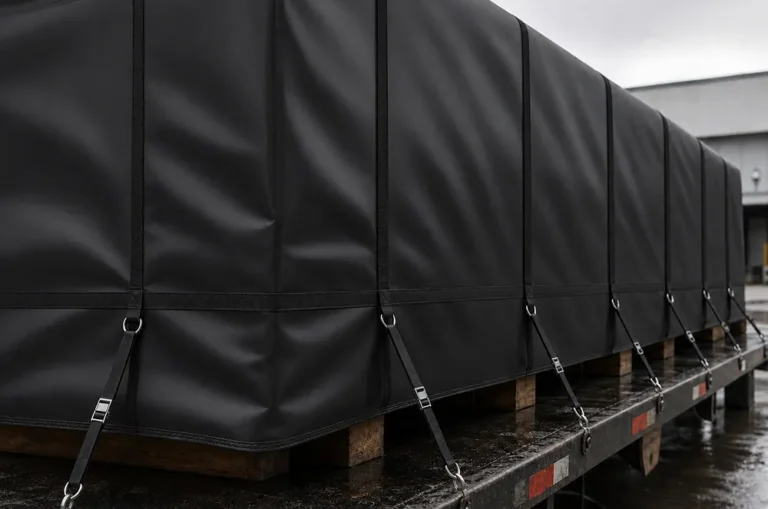
Truck and steel tarps. How long a steel tarp lasts is usually decided by abrasion and fixing points rather than by sunlight. A truck tarp may be folded hundreds of times, dragged across cargo and exposed to vibration, and steel loads add sharp edges and concentrated contact points. Wear patches, strong hems and correctly positioned D-rings protect the cover where it actually fails.

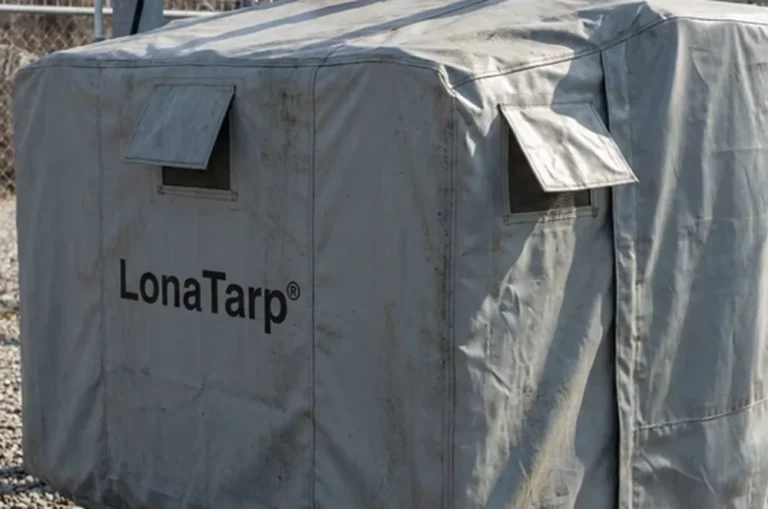
Storage covers. Industrial storage covers face long outdoor exposure, water collection, limited access and irregular stored shapes, so formulation, drainage and accessible inspection points carry more weight here.
III. Outdoor Conditions That Shorten PVC Tarp Life
Sun, Heat and UV Exposure

Sunlight is one of the main aging pressures for outdoor PVC-coated fabrics. Over time, an unsuitable formulation may show color change, loss of gloss, surface chalking, hardening, cracking or reduced flexibility. However, “UV resistant” is not one fixed performance level. The result depends on the complete formulation, pigment system, stabilizers, surface treatment, exposure direction, climate and duty cycle.
Dark and light colors may behave differently in heat absorption and appearance retention. High temperatures can increase softening, accelerate certain aging processes or affect a cover installed near hot equipment, while low temperatures can reduce flexibility and make repeated folding more demanding.
Wind, Flapping and Standing Water
A loose tarp can flap repeatedly in the wind. That movement creates flexing, noise, abrasion and shock loading at the fixing points. An excessively tensioned tarp can distort seams, pull hardware out of alignment and concentrate load around corners or grommets.
Ponding water adds another type of load. The PVC surface may remain waterproof, but accumulated water stretches the cover, deepens low points and increases force on seams, hardware and the supporting structure. I have seen buyers try to solve ponding by ordering a heavier fabric. In many cases, the correct solution is better slope, additional support, a revised panel layout or a planned drainage route.
Folding, Dragging and Edge Wear
An equipment cover may rub against one sharp bracket in the same location for months. A transport tarp wears along the same fold lines and cargo edges every working day. These wear mechanisms can end service life long before general UV aging becomes visible. Typical abrasion sources include:
- steel corners and rough cargo;
- concrete floors and loading platforms;
- cables, chains and hooks;
- repeated wind movement against equipment;
- folding along the same crease;
- dirty storage surfaces;
- incorrectly positioned buckles or fasteners.
For high-wear projects, I recommend identifying contact points on the drawing before sampling. Local wear patches, padding, replaceable panels or a different fastening route may be more effective than increasing the entire tarp weight.
IV. How to Choose the Best PVC Tarpaulin for Outdoor Use
Choosing PVC tarpaulin for outdoor use works best in a fixed order: define the exposure, specify the construction, design the fabrication, then verify the result before bulk production.
Match UV Protection to the Exposure Period
A cover for one short project and a cover expected to stay outdoors through several seasons should not carry the same UV requirement. The longer and more continuous the exposure, the more important it is to specify a UV-stabilized formulation and a defined weathering requirement rather than a general “UV resistant” label. From our manufacturing experience, a buyer should define:
- the destination climate and installation orientation;
- whether exposure is continuous or seasonal;
- the target color and surface finish;
- the required weathering method and exposure cycle;
- which properties must be checked after exposure;
- the acceptable change in appearance and mechanical performance.
Weight still matters, but GSM alone does not define durability. When a buyer asks only for “650 GSM” or “18 oz,” important design information is still missing. We also need to know the required tensile strength, tear resistance, flexibility, surface, service temperature, processing method and application. For long outdoor exposure, our UV resistant PVC tarpaulin can be specified as roll material for your own fabrication or for finished covers.
Reinforce Seams, Hems and Fixing Points
High-frequency or hot-air welded panel seams may be appropriate for compatible PVC materials. Sewn structures may be used for webbing, straps, hems and selected accessories. Each method creates a different stress path and should be positioned according to the cover drawing. Commercial buyers should control:
- panel direction and seam position;
- weld or overlap width;
- sewn and welded locations;
- folded, rope-reinforced or webbing-reinforced hems;
- corner patches and local wear patches;
- grommet and D-ring spacing;
- distance from hardware to the finished edge;
- expected pull direction and working load;
- zippers, flaps and frequently operated openings.
In our factory, we pay particular attention to transitions: where a seam meets an edge, where webbing ends, where a D-ring transfers force into the fabric and where an opening interrupts a reinforced panel. These locations often need more engineering than the large flat surface.
Check Weathering Results and Approve a Finished Sample
ISO 4892-3:2024 describes methods for exposing plastic specimens to fluorescent UV radiation, heat and water. ASTM G154-23 covers the operation of fluorescent ultraviolet lamp apparatus for exposing materials. These methods can help compare formulations, reveal changes and evaluate property retention under a defined laboratory cycle. They do not create a universal conversion between test hours and outdoor years.
Important purchasing rule: Do not write “1,000 hours of UV testing equals five outdoor years” into a specification unless a valid correlation has been established for the exact material, climate, orientation, duty cycle and failure mode.
A material can still look acceptable while losing flexibility, tear strength or coating adhesion, so check property retention, not only appearance. Relevant post-aging checks may include visual cracking, chalking or discoloration; tensile and tear performance; coating adhesion; low-temperature bend or flexibility; abrasion or puncture resistance; water resistance; and welded-seam or joint performance. ASTM D751-26 provides test methods for coated fabrics, including tarpaulins and similar products.
A roll-material report does not automatically validate hems, grommets, D-rings, zippers, sewn accessories or welded panel layouts. For repeat commercial orders, I recommend controlling four references: the approved material specification, the approved finished-cover drawing, an approved production-representative sample, and written inspection, packaging and change-control requirements.
V. How to Make PVC Tarps Last Longer Outdoors
Service life is influenced by the factory specification, but it is also influenced by what happens after delivery. A good cover can fail early when it is installed over sharp edges, left loose in the wind or stored wet and dirty.
Installation, Drainage and Tension
The cover should be supported and tensioned so that water can drain without overloading the fixing points. Avoid unsupported low areas and avoid pulling one or two grommets much harder than the others. For fitted equipment covers, confirm that the cover does not contact hot exhaust components or move repeatedly against sharp corners. Use padding, wear patches or replaceable panels where the tarp contacts cargo edges, frames, chains, handles or rough surfaces.
Cleaning, Storage and Inspection

Remove grit and debris before folding. Use cleaning agents that have been reviewed for the material and avoid aggressive solvents or tools that can damage the PVC surface. Where the operating process allows, dry the tarp before long-term folding or storage, store it away from sharp objects, excessive heat and contamination, and avoid repeatedly folding along one hard crease.
A fleet or project operator should define who inspects the cover, how often, what defects are recorded and what action is required. A daily transport tarp and a seasonal storage cover should not use the same schedule. Useful inspection points include:
- surface cuts, punctures and abrasion;
- hardening, cracking or delamination;
- welded and sewn seams;
- hems, webbing and corner patches;
- grommets, D-rings, buckles and zippers;
- water pockets and drainage paths;
- areas exposed to heat or chemicals;
- previous repairs and the material around them.
Signs It Is Time to Repair or Replace

For a B2B operator, the correct decision is not based only on the size of a hole. It should consider the remaining material condition, location of the defect, load path, value of the protected goods, safety risk, downtime and cost of repeated repairs.
A cover used over high-value cargo or near workers should use a stricter retirement criterion than a low-risk temporary cover. The end-of-life rule should be agreed by the buyer’s operations, safety and procurement teams rather than left to an operator’s visual judgment alone.
VI. Sourcing PVC Tarps for Long-Term Outdoor Projects
Haining Lona Coated Material Co., Ltd. is a B2B manufacturer. We work with importers, distributors, tarp fabricators, OEM brands, fleets, contractors, equipment manufacturers and industrial project buyers. We do not sell single retail tarps for camping, patios, backyards or household use.
Outdoor projects are usually supplied in one of two ways: as PVC tarpaulin roll material for your own cutting and welding, or as custom finished covers built to your drawing.
Our finished covers are made according to confirmed dimensions, drawings or approved samples. Available processing can include cutting, high-frequency or hot-air welding, industrial sewing, reinforced hems, grommets, D-rings, webbing, ropes, zippers, printing, labels and OEM packaging. For finished outdoor covers, explore our heavy duty vinyl tarps. Our typical production lead time is approximately 15 days after the material, drawing, sample and order details have been approved. If a project also needs PE covers, we can help supply PE options alongside our PVC products.
To review an outdoor PVC tarpaulin project, please include:
- company type and application;
- installation method, climate and daily or weekly duty cycle;
- finished dimensions or drawing, and quantity;
- target service period, and whether it is a design target, replacement interval or warranty request;
- material preference, seam and reinforcement requirements;
- weathering standard and inspection criteria;
- destination.
With this information, we can evaluate the material, panel layout, fabrication method, reinforcement and maintenance requirements as one complete service-life system. Send your outdoor tarp RFQ for factory review.
VII. Frequently Asked Questions
What Is the Best Tarp for Outdoor Use?
For commercial covers that stay outdoors for long periods or are reused often, a PVC-coated polyester tarp specified for the climate, exposure period and handling is usually the strongest choice. PE tarps can suit short-term covering and light handling, and canvas suits covers where breathability matters. The best choice depends on the duty cycle, not on the material name alone.
What Is the Lifespan of a Tarp?
A correctly specified commercial vinyl tarp can remain serviceable for several years, but there is no responsible universal lifespan. UV exposure, material construction, seams, hardware, wind, abrasion, handling, drainage, temperature and maintenance all affect the result.
How Long Does a PVC Tarp Last in Direct Sunlight?
There is no fixed figure. UV exposure can contribute to color change, chalking, hardening, cracking and loss of flexibility over time. The rate depends on the formulation, pigment, stabilizers, climate, orientation and exposure cycle.
Is PVC a Durable Material for Outdoor Covers?
Yes, when the construction is matched to the application. A reinforced polyester base and a continuous PVC surface make PVC tarpaulin well suited to outdoor covers, but durability still depends on the formulation, fabrication, installation and maintenance.
Does a Heavier PVC Tarp Always Last Longer Outdoors?
No. Higher GSM cannot correct poor drainage, incorrect tension, weak reinforcement, sharp contact points or a seam placed in a high-stress area. The complete construction should be selected for the application.
Can UV Test Hours Be Converted into Outdoor Years?
No universal conversion applies to every PVC formulation, climate and installation. Accelerated weathering is useful for comparing identified materials and evaluating property retention under a defined cycle, but the exposure hours should not automatically be presented as a fixed outdoor-year guarantee.
Is Service Life the Same as a Warranty Period?
No. Expected service life is a projection based on defined conditions. A warranty is the supplier’s written responsibility under agreed terms, exclusions and remedies. The two should not be treated as interchangeable.