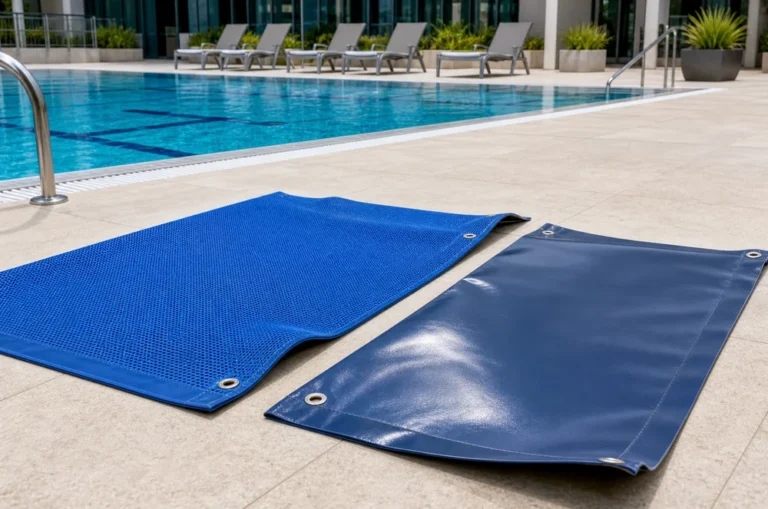
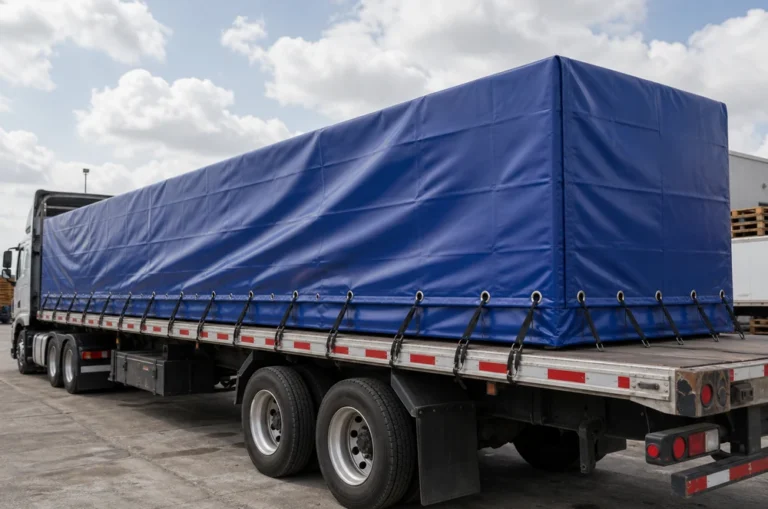
The thickness of PVC fabric depends on its reinforcement, PVC coating or lamination structure, formulation and surface texture. GSM and oz/yd² describe area weight, not thickness, so there is no universal conversion from either weight unit to millimeters. As a quick example, a 16 oz/yd² fabric is about 544 GSM; LonaTarp’s approximate factory rules give 0.418 mm for PVC coated fabric and 0.435 mm for PVC laminated fabric. These are estimates for initial comparison, not measured thickness specifications.
PVC fabric thickness and weight are different measurements. GSM and oz/yd² describe mass per area; mm and mil describe physical thickness. While GSM and oz/yd² can be converted directly, GSM-to-mm figures require assumptions about the material build. This calculator makes those assumptions visible so importers, fabricators and purchasing teams can estimate dimensions without mistaking the result for a measured property.
I. How Thick Is PVC Fabric?
For industrial reinforced PVC fabrics, total thickness is commonly a fraction of a millimeter, but different textile and PVC constructions do not have one fixed thickness at the same GSM. If a project specifies thickness, use the measured finished-material value and its tolerance rather than converting weight alone. You can review LonaTarp’s measured reference chart for actual example specifications.
How Thick Is 16 oz PVC Fabric?
In the industrial fabric trade, 16 oz usually means 16 ounces per square yard (oz/yd²), not 16 mil of thickness and not a 16 oz total roll weight. Under the quick factory approximation, 16 × 34 = 544 GSM. The thickness estimate then depends on how the reinforced PVC composite is made.
| Calculation | Approximate result | Interpretation |
|---|---|---|
| 16 oz/yd² × 34 | 544 GSM | Area weight (quick trade approximation) |
| 544 GSM ÷ 1300 | 0.418 mm | PVC coated thickness estimate |
| 544 GSM ÷ 1250 | 0.435 mm | PVC laminated thickness estimate |
For a purchase order, treat the estimated thickness as a question for the supplier, not a guaranteed property. Ask for the proposed grade’s measured thickness and allowed tolerance. A 16 oz fabric can vary considerably across different constructions.
II. PVC Fabric Thickness and Weight Calculator
Use the interactive estimator below to switch between GSM and oz/yd², then compare PVC coated and laminated estimates. The calculation is intentionally approximate, using LonaTarp’s supplied shop-floor coefficients rather than claiming a universal conversion.
PVC Fabric Weight & Estimated Thickness Calculator
Enter fabric weight and select the unit. Compare an estimated coated or laminated PVC fabric thickness. This is a factory rule of thumb, not a measured thickness or guaranteed specification.
Formula basis: oz/yd² ≈ GSM ÷ 34; PVC coated thickness (mm) ≈ GSM ÷ 1300; PVC laminated thickness (mm) ≈ GSM ÷ 1250. The thickness formulas are approximate in-house heuristics, not dimensional unit conversions. Embossing, expanded coating, reinforcement, formulation and measuring pressure can make the actual thickness different. Confirm with a measured sample.
JavaScript required: You can use the formulas shown above manually. Example: 16 oz/yd² ≈ 544 GSM, ≈0.418 mm coated or ≈0.435 mm laminated.
III. How to Convert GSM to oz/yd²
Factory quick conversion: GSM ÷ 34 ≈ oz/yd². To go the other way, multiply oz/yd² by 34. This applies to area weight regardless of whether the PVC fabric was coated or laminated.
For precision, 1 oz/yd² equals approximately 33.9057 g/m². The number 34 is a convenient rounding used for early comparisons. For example, a 550 GSM material is about 16.18 oz/yd² using the shortcut. In a formal specification, identify whether the weight refers to the entire finished coated fabric or only its base textile.
Do not confuse an ounce weight, such as 16 oz/yd², with 16 mil. A mil is one-thousandth of an inch; 16 mil is 0.4064 mm, whereas 16 oz/yd² is an area-weight designation. The apparent similarity of these numbers is coincidental.
IV. Coated vs Laminated PVC Fabric: How to Estimate Thickness
PVC coated fabric: GSM ÷ 1300 ≈ mm
For common reinforced PVC coated fabrics, LonaTarp’s stated factory shortcut is GSM ÷ 13, interpreted as hundredths of a millimeter. Expressed directly in millimeters, that is estimated thickness (mm) ≈ GSM ÷ 1300. For 650 GSM, the estimate is about 0.50 mm.
PVC laminated fabric: GSM ÷ 1250 ≈ mm
For common reinforced PVC laminated fabrics, the corresponding shortcut is GSM ÷ 12.5 in hundredths of a millimeter, or estimated thickness (mm) ≈ GSM ÷ 1250. For 650 GSM, this gives approximately 0.52 mm.
These coefficients reflect a practical estimation approach for familiar product constructions, not the density of PVC and not standardized formulas. Their accuracy depends on the reinforcement, PVC content, surface layers and formulation. They cannot be used to certify a grade or determine its thickness tolerance.
Quick Reference Chart: GSM, oz/yd² and Estimated Thickness
This chart applies the same factory estimation formulas as the calculator above. It illustrates likely order-of-magnitude thickness for common reinforced constructions; it is not a table of measured LonaTarp product specifications, universal material densities, or guaranteed tolerances.
| GSM (g/m²) | Approx. oz/yd² | PVC coated estimate (mm) | PVC laminated estimate (mm) |
|---|---|---|---|
| 400 | 11.76 | 0.308 | 0.320 |
| 500 | 14.71 | 0.385 | 0.400 |
| 550 | 16.18 | 0.423 | 0.440 |
| 650 | 19.12 | 0.500 | 0.520 |
| 750 | 22.06 | 0.577 | 0.600 |
| 900 | 26.47 | 0.692 | 0.720 |
How to read this chart: 550 GSM gives about 16.18 oz/yd², 0.423 mm under the coated estimate or 0.440 mm under the laminated estimate. A different reinforcement, heavy surface texture or special layer can produce a different measured thickness. For acceptance, request the actual grade’s data sheet or a representative sample.
V. Why GSM Cannot Guarantee an Exact Thickness
Two rolls with identical GSM can have different thicknesses. A heavier polyester scrim contributes mass without adding the same volume as PVC coating. Conversely, a change in formulation, fillers or coating distribution may change thickness without a comparable change in area weight. Laminated films and directly coated layers may also create different structures at the same mass.
Real Reference Example: Two 550 GSM Fabrics
LonaTarp’s published weight and thickness guide describes two 550 GSM reference materials that both have a reported thickness of 0.45 mm, but use different reinforcements: one has a 1000D × 1000D, 9×9 base fabric and the other an 840D × 840D, 18×18 Panama base fabric. Their stated warp tensile strengths are 1,390 N/5 cm and 2,040 N/5 cm, respectively.
This example shows that equal GSM and equal thickness do not prove identical strength or construction. The estimator gives approximately 0.423 mm for a conventional 550 GSM coated fabric; the 0.45 mm reference measurement illustrates why a rule-of-thumb result must not replace the actual product specification.
When Not to Rely on a GSM-to-mm Estimate
Special finishes can make estimation less reliable. 3D embossed PVC fabric has raised and recessed areas, so measured thickness depends on where and how pressure is applied. Expanded or foamed layers, unusual textile structures and engineered multi-layer products may not follow either rule of thumb.
Do not use the estimate as an acceptance limit where a product requires a tight dimensional tolerance, a known welding-machine clearance, a defined folding profile or a specific composite-layer construction. In these cases, obtain a representative sample, measure total thickness using an agreed method and record the applicable tolerance.
The estimator is useful for early purchasing comparisons only. It does not verify the final material’s quality, suitability or conformity with an order.
VI. How to Check Measured PVC Fabric Thickness
Ask the supplier to distinguish between nominal and measured thickness, specify the test method and supply the agreed tolerance. The relevant international reference is ISO 2286-3:2016, which describes the determination of coated-fabric thickness at a specified pressure. A controlled method matters because a flexible coated material may compress during measurement.
For mass per area, ISO 2286-2:2016 covers total mass and the contributions of the coating and substrate. A buyer comparing two proposed grades should verify which mass value is on each data sheet.
For a more complete explanation of weight, mil, measurement practice and supplier-quote comparisons, see our existing PVC Tarpaulin Thickness and Weight Guide. The estimator here does not replace those measurement instructions.
VII. Frequently Asked Questions
Is 16 oz PVC fabric the same as 16 mil?
No. A 16 oz/yd² fabric is specified by area weight; 16 mil is a physical thickness of 0.4064 mm. They are different quantities.
What is the difference between GSM and mm in PVC fabric?
GSM measures grams per square meter; mm measures thickness. There is no universal physical conversion between these quantities.
Can I use one GSM-to-mm formula for coated and laminated fabric?
Not reliably. As a preliminary estimation method, LonaTarp uses different empirical coefficients for coated and laminated structures. Neither one replaces measured thickness.
Does the calculator work for 3D embossed PVC tarpaulin?
It can show a preliminary number, but this is a special construction for which the shortcut may be inaccurate. Confirm thickness from a representative sample under an agreed measurement method.
Is heavier PVC fabric always thicker?
Not necessarily. Reinforcement weight, PVC formulation, coating thickness, lamination structure and surface design affect both properties differently.
How should I specify thickness in a bulk PVC fabric order?
State the target weight and thickness separately, identify the construction, and agree the thickness tolerance, test method and approved reference sample.
VIII. Final Recommendation
Use the GSM ↔ oz/yd² conversion for comparing area-weight labels, and use coated or laminated GSM-to-mm results only as approximate starting points. A finished PVC composite is not a single-density sheet. When thickness affects product fit, welding, durability or contract acceptance, measured thickness and construction details must control the purchase specification.
For a custom roll, share the proposed GSM, coated or laminated construction, intended application and any reference sample. See our PVC coated fabric roll range and PVC laminated tarpaulin rolls for the appropriate material path.