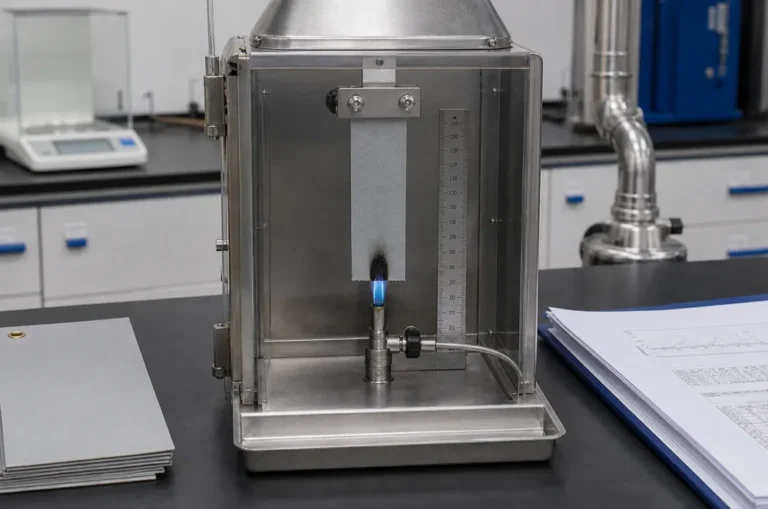
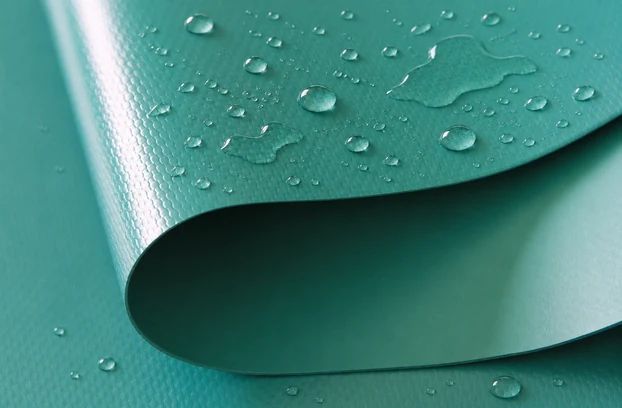
Is vinyl fabric flammable? For industrial vinyl fabric, meaning PVC-coated or PVC-laminated polyester, the answer is yes: a standard grade can burn. PVC resin itself resists burning, but the plasticizers that make the coating flexible and the polyester base fabric are combustible. A flame-retardant grade is hard to ignite or self-extinguishes once the flame is removed.
This guide explains why the fabric burns, what changes in a flame-retardant grade and how to read a fire rating. Upholstery and clothing vinyl follow their own flammability rules and are not covered here. For roll options, see our fire retardant vinyl fabric rolls.
I. Why Does Vinyl Fabric Burn If PVC Resists Fire?
Vinyl fabric burns because it is not pure PVC resin. The resin has some inherent flame resistance; the materials added to turn it into a flexible, reinforced fabric do not.
PVC resin has inherent flame resistance
PVC resin is 56.8% chlorine by weight, and that chlorine gives the polymer inherent flame resistance. Fire laboratories measure this as the limiting oxygen index (LOI), the oxygen concentration a material needs to keep burning. Air is about 21% oxygen; the Vinyl Institute’s review of PVC fire properties lists rigid PVC at an LOI of 47, which is why the resin typically stops burning once the heat source is removed. That resistance belongs to the resin, not to every product made from it. “Vinyl” and “PVC” name the same material family; our guide to what PVC/vinyl fabric is explains the terms.
Plasticizers and the polyester base are combustible
Three things added during production change the fire behavior of the finished fabric:
- Plasticizers and oils. They make the PVC flexible, and many of them are combustible. The same review notes that the fire properties of PVC typically deteriorate when it is plasticized, depending on the amount and kind of plasticizer.
- The polyester base fabric. It carries the load, and it can shrink, soften, melt and burn.
- Surface finishes and printing. Organic finishes can change how the surface responds to a flame.
A flexible, reinforced vinyl fabric therefore does not automatically meet a fire classification. The complete material has to be formulated and tested.
II. What Happens When Vinyl Fabric Meets Heat and Flame?
Heat softens vinyl fabric, and fire produces dense smoke from it. There is no single “melting point” to quote, because the fabric is a composite and each layer responds differently.
Softening, shrinking and melting
PVC is a thermoplastic, so the coating softens as it heats up. That is the property that makes the fabric weldable. With enough heat, the polyester base can shrink, soften and melt. Keep vinyl fabric away from exhaust components and other hot surfaces, even where no flame is present.
Burning, smoke and gases
A standard grade can ignite and burn. A flame-retardant grade is formulated to limit ignition and flame spread under the conditions of a specific test, but it is still not non-combustible. In both cases, PVC that burns gives off dense, toxic smoke, and its decomposition can release hydrogen chloride. PVC breaks down mainly by giving off hydrogen chloride and then forms a char, so part of its carbon stays behind as solid residue. Smoke suppressants can be added to the formulation to reduce the smoke.
III. Standard vs Flame-Retardant Vinyl Fabric
The difference between a standard and a flame-retardant vinyl fabric is the formulation, not the weight or the look. Two rolls with the same weight can give different flame-test results when the PVC compound or the construction changes.
| Standard vinyl fabric | Flame-retardant vinyl fabric | |
|---|---|---|
| PVC compound | Formulated without a fire requirement | Flame retardants added to the PVC for a target test |
| When a flame is applied | Can ignite and burn | Hard to ignite, or self-extinguishes once the flame is removed |
| Fire evidence | Not tested to a fire standard | Test report to a named standard for the tested construction |
| Typical use | Covers and products with no fire requirement | Tents, partitions, ducting and other uses with a fire requirement |
In a flame-retardant formula, the resin, the plasticizer system and the flame-retardant additives have to be balanced for the target test, so no single additive is a universal fix. Our functional additives guide lists the common standards and explains how flame retardants and smoke suppressants work.
IV. How Is Flame Retardancy Built Into PVC-Coated Fabric?
Flame retardancy is built into the PVC compound: flame retardants are mixed into the formula before the PVC is coated or laminated onto the base fabric. The Chemical Fabrics and Film Association’s overview of flame retardants in coated fabrics describes three ways they work: making the gases released by heat less combustible, forming a char layer that insulates the material, and releasing water that cools the flame.
The additives commonly used in vinyl-coated fabrics follow those routes:
- Antimony trioxide. It works in synergy with the chlorine in PVC to inhibit combustible gases, so a small amount goes a long way.
- Phosphorus flame retardants. They act in the gas phase and also form char. They are used with antimony or in place of it.
- Alumina trihydrate and magnesium hydroxide. They absorb heat and release water as the temperature rises.
- Zinc-based additives. They serve as flame retardants, smoke suppressants and char formers.
Which system is used, and how much, depends on the target test. Our own flame-retardant formulations use antimony trioxide or phosphorus-based systems. As a reference, a GB 8624 formula uses about 12–16 PHR of flame retardant and an NFPA 701 formula about 7–8 PHR, where PHR means parts per hundred parts of PVC resin. The package is then balanced against the plasticizer level, processing and cost, and confirmed on a tested trial sample.
V. How Do You Read a Flame-Retardant Rating?
A flame-retardant rating is a result for one tested construction under one test method. It is not a property of vinyl fabric in general, and one standard cannot stand in for another.
The rating names a test, not a material
Different markets use different tests. NFPA 701 is the common reference in the United States, DIN 4102-1 class B1 in Germany and EN 13501-1 in the European Union. Identify the destination market and the final use before the material is finalized.
A report covers the sample that was tested
We hold SGS test reports under NFPA 701, DIN 4102-1, EN 13501-1 and GB 8624 for specified constructions:
| Standard | Tested sample | Result |
|---|---|---|
| NFPA 701, Test Method 1 | PVC vinyl sample | Meets the requirements |
| DIN 4102-1 | PVC membrane, about 1,200 g/m² and about 1,000 g/m² | Class B1 |
| EN 13501-1 | PVC tarpaulin | B-s3,d0 |
| GB 8624 | Membrane material, about 1,200 g/m² | B1 (B-s3,d0) |
Each result applies to the sample and conditions described in its report. If your weight, surface finish or installation differs, the test scope has to be confirmed for your order.
Flame retardant does not mean fireproof
A flame-retardant grade resists ignition and limits flame spread; calling a flexible coated fabric “fireproof” is rarely accurate. If a buyer asks for fireproof material, the real requirement is usually a named test. See what a fireproof tarp really means.
VI. Which Applications Need Flame-Retardant Vinyl Fabric?
You need a flame-retardant grade when a building code, an event regulation or your customer’s specification requires one. The end use decides the standard, and the standard decides the formulation.
Typical examples are:
- Tent and marquee fabric, and membrane structures
- Warehouse dividers, workshop partitions and industrial curtains
- Ventilation ducting
- Construction scaffold covers and temporary shelters
- Truck side curtains and covers, where the customer specification requires it
The fire rating is one of several properties to weigh when you choose this material; our guide to the advantages and disadvantages of PVC fabric covers the others.
VII. How to Verify Flame Retardancy Before You Order
Verify flame retardancy from a test report and an approved sample, not from a label on a quote. Three checks catch most problems:
- The standard. Name the test method, its edition and the class you need.
- The tested construction. Compare the weight, base fabric, coating and surface finish in the report with the material you are buying. Top coats and printing can change the result.
- A trial sample. Have a sample of your construction made and tested before bulk production.
For a flame-retardant order, we treat the agreed fire classification as part of the product specification and confirm it on an approved sample first. Our fire-retardant tarpaulin specifications guide explains how to write the standard, test scope and acceptance terms into a purchase order.
VIII. FAQ
Is PVC combustible?
PVC resin has some inherent flame resistance because of its chlorine content, but it can still decompose and burn. Flexible PVC fabric also contains combustible plasticizers and a polyester base, so it burns more readily than the resin alone unless flame retardants are added.
Does vinyl fabric melt?
Yes. The PVC layer softens with heat and the polyester base can shrink and melt. The fabric has no single melting point.
Is flame-retardant vinyl fabric fireproof?
No. It resists ignition and limits flame spread under a defined test, but it is not non-combustible.
Can vinyl fabric be used outdoors?
Yes. PVC-coated fabric is widely used for outdoor covers, tents and curtains. For long sun exposure, ask for a UV-stabilized formulation; see our UV-resistant PVC tarpaulin options.
What is the most flame-retardant material?
There is no single answer, because fire performance is measured by test, not by material name. For coated fabrics, compare the classification each tested construction achieved under the standard your project requires.