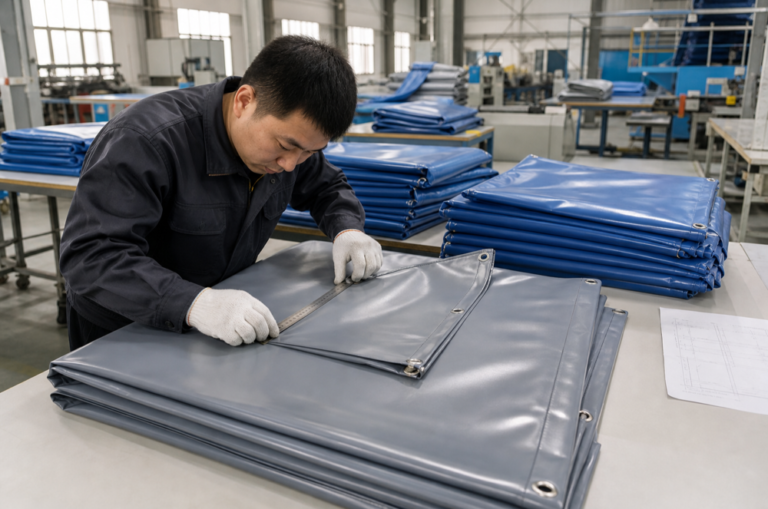
PVC fabric usually refers to a material that combines polyvinyl chloride with a textile backing. In short, the PVC material in fabric is polyvinyl chloride, a plastic that is coated or laminated onto a textile base, usually polyester, to make it waterproof and weldable. Often called vinyl fabric, it is supplied in rolls for fabrication into tarpaulins, curtains, protective covers and other finished products. For industrial buyers, LonaTarp supplies these materials as custom PVC fabric rolls.
The name alone does not describe the complete construction. PVC may cover one or both sides of a base fabric. Related materials include clear reinforced PVC, unsupported PVC film and coated mesh, each serving different requirements.
For industrial buyers, understanding these differences helps answer a practical question: which material construction will suit the application, working environment and fabrication method?
I. What Is PVC/Vinyl Fabric?
What do PVC, vinyl fabric and PVC cloth mean?
PVC stands for polyvinyl chloride, the plastic polymer used in the coating or film. In this material context, “vinyl” is a common commercial name for PVC, so PVC fabric and vinyl fabric often refer to the same family of products. For a closer look at how the two names are used in supplier quotes, see our guide to PVC vs vinyl fabric.
Is vinyl a fabric? Vinyl itself is a plastic, not a textile. “Vinyl fabric” usually means a textile that has been coated or laminated with PVC. A vinyl sheet with no textile backing is more accurately called PVC film.
“PVC cloth” is another term buyers may encounter. However, none of these names tells you whether the material has a textile backing, how many PVC layers it contains or which performance requirements it meets.
Vinyl fabric is also used to describe upholstery and decorative materials. Industrial covers require a more specific description, including the reinforcement, surface construction and intended service conditions.
A brief history of vinyl fabric
Vinyl fabric history is closely connected to the development of flexible PVC. Early PVC was difficult to process into useful flexible products. In 1926, Waldo Semon demonstrated how plasticizers could make it workable, including applying flexible vinyl to fabric. Commercial PVC resin and film followed, while wartime material shortages encouraged further development.
Later advances in coating, film production and surface finishing expanded the range of coated textiles available for different applications. The Chemical Fabrics & Film Association’s historical timeline documents these developments.
II. What Is PVC/Vinyl Fabric Made Of?
The PVC layer: resin, flexibility and formulation
PVC fabric combines a PVC coating or film with a textile backing. Flexible PVC formulations use ingredients selected to achieve the required processing and material characteristics.
Plasticizers help make PVC flexible. Other formulation components can influence color, stability and application-specific performance. The exact formulation varies between products, so two materials described as “PVC fabric” may behave differently in use.
Specify UV resistance, flame performance and cold flexibility for the intended application.
The textile backing: reinforcement and fabric construction
In reinforced PVC fabric, the base textile contributes to the material’s mechanical behavior. Polyester is commonly used in industrial PVC-coated fabric, where the yarn construction and fabric density help determine how the material responds to tension and tearing.
Is polyester the same as PVC fabric? No. Polyester is a fiber used to weave the base fabric; PVC is the plastic layer applied to it. PVC-coated polyester combines the two: the polyester carries the load, and the PVC provides the water barrier and surface.
A buyer comparing two reinforced materials should therefore examine the base fabric alongside the finished weight and thickness.
Supported vinyl versus unsupported PVC film
Supported vinyl fabric has a backing; unsupported vinyl has no backing. In the industrial materials discussed here, the support is typically a textile reinforcement. A backing-free PVC sheet is more precisely described as PVC film. These distinctions are reflected in Spradling’s terminology for vinyl-coated fabrics.
Is vinyl a knit fabric? The word “vinyl” does not identify a knitting method. Supported vinyl materials can use different textile constructions, including woven or knitted backings. Unsupported PVC film contains no textile structure.
For a film product, yarn denier and weave density are therefore not applicable specifications.
III. What Are the Main Types of PVC/Vinyl Materials?
Single-sided and double-sided PVC-coated fabric
PVC-coated fabric is produced by applying PVC to a base textile. A single-sided construction has PVC on one face; a double-sided construction has PVC on both faces of the base fabric.
These descriptions identify the position of the PVC relative to the reinforcement. When comparing materials, buyers should also confirm the finished weight, coating adhesion, surface requirements and performance on each side.
A double-sided coated fabric contains a base textile. It is a different construction from two PVC films bonded together without reinforcement.
PVC film constructions without a textile backing
Unsupported PVC materials include single-layer film and constructions made by bonding two PVC films together.
A single-layer film consists of one PVC layer without a base fabric. A double-layer film composite contains two PVC films combined without a textile reinforcement between them.
For textile-backed alternatives, see our laminated materials range. Unsupported film and reinforced laminated fabric have different layer structures.
When comparing PVC-coated and PVC-laminated materials, request the actual layer structure. A process label alone does not establish strength, durability or suitability.
Clear PVC with and without textile reinforcement
Clear PVC materials provide visibility through the sheet, but transparency does not tell you whether reinforcement is present.
The distinction between clear PVC constructions is whether transparent PVC is combined with a base fabric or supplied as film without a base fabric.
Balance visibility and reinforcement by checking a sample for the intended panel or cover, including the visible base-fabric structure where present, thickness, flexibility and handling requirements.
PVC mesh and Textilene: two different constructions
PVC mesh and Textilene are related mesh materials with different manufacturing sequences.
LonaTarp’s PVC mesh is made by coating a polyester mesh base with PVC. In Textilene construction, the yarn is PVC-coated before being woven into the mesh.
For either material, confirm the opening size and whether ventilation, visibility or screening is required. An open-mesh product allows passage through its openings, so it should be evaluated differently from a continuous waterproof sheet.
The following table summarizes the material structures discussed here.
| Material | Construction | Construction or process |
|---|---|---|
| Double-sided PVC-coated fabric | PVC on both sides of a base fabric | Coated |
| Single-sided PVC-coated fabric | PVC on one side of a base fabric | Coated |
| Double-layer PVC film composite | Two PVC films combined without a base fabric | Laminated |
| Single-layer PVC film | One PVC layer without a base fabric | Film without textile backing |
| Double-layer reinforced clear PVC | Two transparent PVC layers combined with a base fabric | Laminated |
| Single-layer reinforced clear PVC | One transparent PVC layer combined with a base fabric | Laminated |
| Clear PVC film | Transparent PVC without a base fabric | Film without textile backing |
| PVC mesh | Polyester mesh base with a PVC coating | Coated |
| Textilene | PVC-coated yarn woven into mesh | Yarn coating followed by weaving |
For a step-by-step comparison of the two processes, see knife coating vs lamination. To compare these constructions as supplied rolls, browse our PVC material fabric types.
Embossed, striped, matte and glossy finishes
LonaTarp offers embossed, striped, matte and glossy surface finishes.
An embossed surface has a textured pattern. Striped materials use bands of color, while matte and glossy describe the surface appearance.
These options help answer what vinyl fabric looks like, but appearance does not establish mechanical performance. A glossy surface and a matte surface may belong to different constructions or specifications. Choose the required structure first, then confirm the finish using a representative sample.
IV. What Are the Properties, Advantages and Limitations of PVC/Vinyl Fabric?
PVC fabric properties depend on the combination of structure, formulation and manufacturing quality. Its advantages and disadvantages become clearer when each characteristic is considered alongside the conditions of use.
Is PVC a good fabric? For covers, tarpaulins, curtains and other industrial products that must keep water out and withstand handling, PVC-coated fabric is one of the most widely used choices. Whether it is right for a specific product depends on the construction and formulation.
In short, PVC fabric is waterproof, durable, weldable and easy to clean, but it does not breathe, it is heavier than uncoated textiles, and its cold flexibility, UV resistance and flame performance depend on the formulation. For each point and how to write it into a specification, see our guide to the advantages and disadvantages of PVC fabric.
Waterproofness, breathability and finished-cover performance
A continuous PVC surface can provide a water barrier, making suitable materials useful for protective covers and tarpaulins. For roll materials selected specifically for water resistance, see our waterproof PVC tarpaulin rolls.
However, the waterproof performance of a finished cover also depends on seams, edges, fasteners, drainage and installation. A material sample does not demonstrate how the complete product will behave.
Continuous coverings also require attention to ventilation. Moisture can accumulate inside an enclosure even when rain is kept outside. Where airflow is the priority, an open mesh may serve the purpose better, provided water exclusion is not required.
Tensile strength, tear resistance and abrasion resistance
Tensile strength concerns resistance to being pulled apart. Tear resistance concerns how the material responds when a tear develops. Abrasion resistance concerns surface wear from rubbing against cargo, equipment or other contact points.
For reinforced materials, the base fabric and PVC construction both matter. Coating or layer adhesion is also relevant where separation could affect service performance.
These properties should be assessed separately. ASTM D751, for example, contains distinct methods for breaking strength, tearing, coating adhesion, hydrostatic resistance and seam strength.
Flexibility, hand feel and temperature limits
Vinyl fabric can feel supple or firm, smooth or textured, depending on its formulation, thickness, reinforcement and surface finish.
One material may feel supple and easy to fold, while another feels firm and holds its shape more readily. A textured surface also feels different from a smooth one.
For industrial use, evaluate flexibility under the conditions that matter. A curtain opened repeatedly, a cover folded for storage and a panel used in cold weather may require different behavior. Confirm operating conditions and relevant test results rather than judging a material only by its room-temperature hand feel.
UV, flame and chemical resistance
UV resistance, flame performance and chemical resistance depend on the formulation and must be specified individually.
For outdoor exposure, discuss weathering, color retention and the performance expected after exposure. For fire retardant vinyl fabric requirements, identify the required test and the report applicable to the selected material. For chemical contact, provide the substance, concentration, temperature and likely duration of exposure.
A general material name or a company certification does not establish that a particular product meets every requirement. The useful evidence is tied to the supplied specification and the intended application.
Cleaning, maintenance and end-of-life considerations
A wipeable surface can simplify routine cleaning. The cleaning method should still follow the material supplier’s instructions, particularly where solvents, disinfectants or repeated scrubbing are involved.
Maintenance also includes checking seams, attachment points and areas exposed to repeated friction.
Specialist recycling routes exist for certain coated fabrics and PVC films, as described by IVK Europe. Acceptance depends on the material and the available collection and processing route, so recyclability should be confirmed for the actual product.
V. What Is PVC/Vinyl Fabric Used For?
Covers, tarpaulins and industrial protection
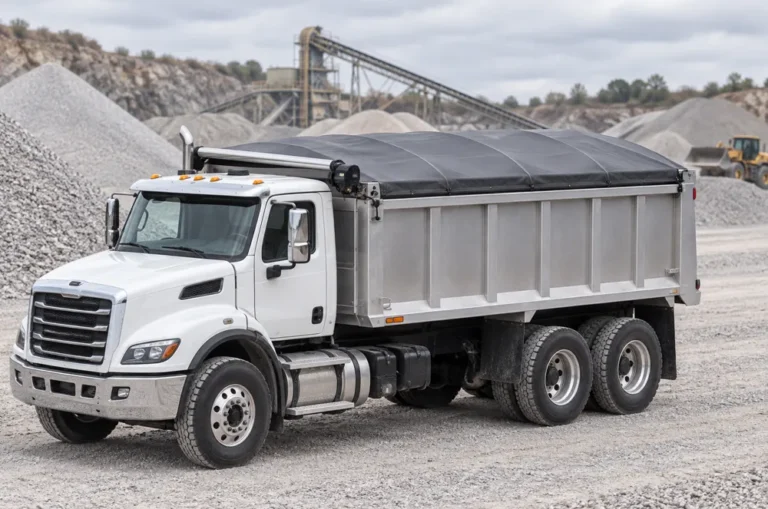
PVC-coated fabric is used in products such as transport covers, equipment covers, industrial curtains and protective tarpaulins.
Each application creates a different set of demands. A transport cover may face wind, cargo friction and frequent handling. A movable curtain may require repeated flexing and dependable attachment points. An equipment cover may need to balance protection with ease of removal.
The application name is therefore a starting point for selecting the structure and performance requirements.
Common industrial uses include:
- Truck side curtains and transport covers – see truck side curtains.
- Inflatable products and boats – see airtight PVC material.
- Swimming pool liners – see reinforced PVC pool liner.
- Clear windows and enclosures – see clear vinyl fabric.
- Ventilated screens and furniture slings – see Textilene fabric.
Clear panels, mesh products and other specialized uses
Clear PVC materials can be considered where visibility through a protective panel is important. Mesh materials can serve applications requiring airflow or screening, depending on their construction and opening size.
Other PVC materials are developed for uses such as inflatables, pool liners and membrane structures. These applications require their own specifications. A material selected for a general cover should not automatically be transferred to a pressure-retaining, water-retaining or structural application.
VI. What Do Vinyl Fabric Grades and Specifications Mean?
What does “grade” mean in different product markets?
“Marine grade,” “commercial grade” and supplier-specific numbered grades may describe different product ranges or requirements. Ask the supplier what the designation means and which measurable properties support it.
For industrial purchasing, a useful PVC fabric description identifies the construction, dimensions and relevant performance criteria. A grade label becomes useful when its meaning is written down and can be checked against the application.
This approach also makes quotations easier to compare when suppliers use different naming systems.
How do GSM, thickness and base-fabric specifications differ?
GSM means grams per square meter: the mass of a measured area of material. Thickness describes the distance through the material.
Denier describes yarn linear density. It expresses the weight in grams of 9,000 meters of yarn, as explained by CottonWorks. It applies to the yarn in a reinforced construction, rather than to unsupported film.
| Specification | What it describes | What to check |
|---|---|---|
| GSM | Material mass per unit area | Whether it refers to the finished material or one component |
| Thickness | Overall material thickness | Unit, measurement method and tolerance |
| Base fabric | The textile reinforcement | Fiber and fabric construction |
| Denier | Yarn linear density | Warp and weft specifications where applicable |
| Weave density | Yarn count over a stated distance | Direction and units used |
| Width and roll length | Supplied roll dimensions | Usable width and fabrication layout |
Our PVC tarpaulin material page lists the construction details buyers typically specify.
A heavier material is not automatically stronger or more suitable. Materials with the same GSM can have different reinforcement, PVC content and construction.
Compare finished weight alongside the base fabric and relevant test results. For unsupported PVC film, concentrate on film dimensions and performance rather than requesting textile specifications.
Which performance results should buyers compare?
Start with the failure modes that matter to the product. Depending on the application, these may include tearing, abrasion, seam failure, water penetration, loss of flexibility or weathering.
Then compare results obtained using the same test method, procedure, units and conditions. Where the material has directional properties, examine both directions.
A test name alone is incomplete. Ask for the reported result and the acceptance requirement. This gives the buyer and supplier a shared basis for evaluating the material.
VII. How Do You Choose the Right PVC/Vinyl Material?
Start with the application and service environment
Describe how the material will be used before choosing a weight or thickness.
Consider whether the product will be indoors or outdoors, fixed or frequently moved, and exposed to sunlight, cold, friction or chemicals. Explain whether the priority is continuous coverage, visibility, airflow or a combination of functions.
For example, an outdoor machine cover and a ventilated screen may both use PVC-based materials, but their construction requirements will differ substantially.
Match the construction to performance and fabrication requirements
Choose reinforced fabric for textile reinforcement, clear materials for visibility and open mesh for ventilation.
Where textile reinforcement is required, discuss the base fabric and mechanical performance. Where visibility matters, compare clear reinforced PVC with clear film. Where ventilation is required, confirm the mesh opening and screening characteristics.
Next, explain how the product will be made. Welding, sewing, cutting, printing and accessory installation place different demands on the material. Compatibility should be checked for the selected construction and production method.
Confirm the specification, sample and acceptance requirements
Before bulk production, bring the material description and sample together.
The written specification should identify the agreed construction, weight or thickness, dimensions, color, finish and required performance. The sample allows the buyer to assess appearance, hand feel and suitability for fabrication.
For demanding applications, confirm how the relevant properties will be verified and what constitutes acceptance. This helps ensure that the material approved during sampling is clearly defined for the production order.
If you are specifying a PVC fabric for a production order, send us the application, required construction and roll quantity, and we will recommend a material for sampling. Contact our team.
VIII. Frequently Asked Questions
Is PVC a good fabric?
For industrial covers, tarpaulins and curtains, yes: PVC-coated fabric is waterproof, durable, weldable and easy to clean. It is not breathable and is heavier than uncoated textiles, so it suits protective applications better than apparel.
What are the disadvantages of PVC fabric?
It does not breathe, it is heavier than uncoated fabric, and its cold flexibility, UV resistance and flame performance depend on the formulation. Recycling options also depend on local collection routes.
Is vinyl a fabric?
Vinyl is a plastic. “Vinyl fabric” refers to a textile coated or laminated with PVC; a vinyl sheet without a textile backing is PVC film.
Is polyester the same as PVC fabric?
No. Polyester is the fiber used for the base fabric; PVC is the plastic layer applied to it. PVC-coated polyester combines both.
Is PVC fabric waterproof?
The PVC layer itself blocks water. A finished product’s waterproofing also depends on its seams, edges and fittings; welded seams seal better than stitched ones. Open PVC mesh is not waterproof.