I. Can Vinyl Tarps Be Sewn?
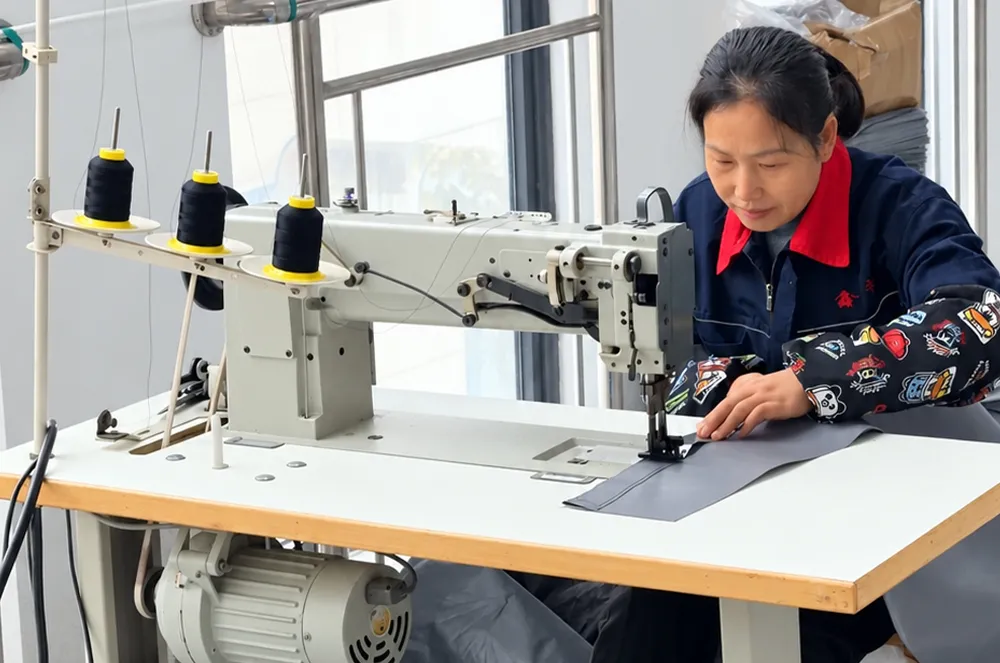
Yes. Sewing PVC tarpaulin is common in commercial fabrication, especially when a finished cover needs webbing, straps, reinforcement or hardware.
But sewing vinyl tarp material is not the same as sewing ordinary textile fabric. PVC-coated material is usually thicker, heavier and less flexible than many common fabrics. The sewing method must match the coating, base fabric, reinforcement, thread, hardware and finished product design.
Many PVC-coated polyester tarp fabrics can also be heat welded. This means the key question is not only:
Can this material be sewn?
The better question is:
Why should this part of the tarp be sewn?
In finished vinyl tarps, sewing is often used for reinforcement, webbing, straps, zippers, D-rings and flexible edge structures. Welding is more often considered for compatible PVC panel joints where a continuous sealed connection is needed.
For buyers, sewing should be reviewed as part of the finished product design, not as an isolated processing step. You can also review our Vinyl Tarps range to see how these fabrication methods are used in finished commercial covers.
II. Sewing PVC Tarpaulin: When Does It Make Sense?
Sewing makes sense when the finished tarp needs more than a flat panel connection. It is especially useful when the cover includes attached components, flexible parts or load-bearing details.
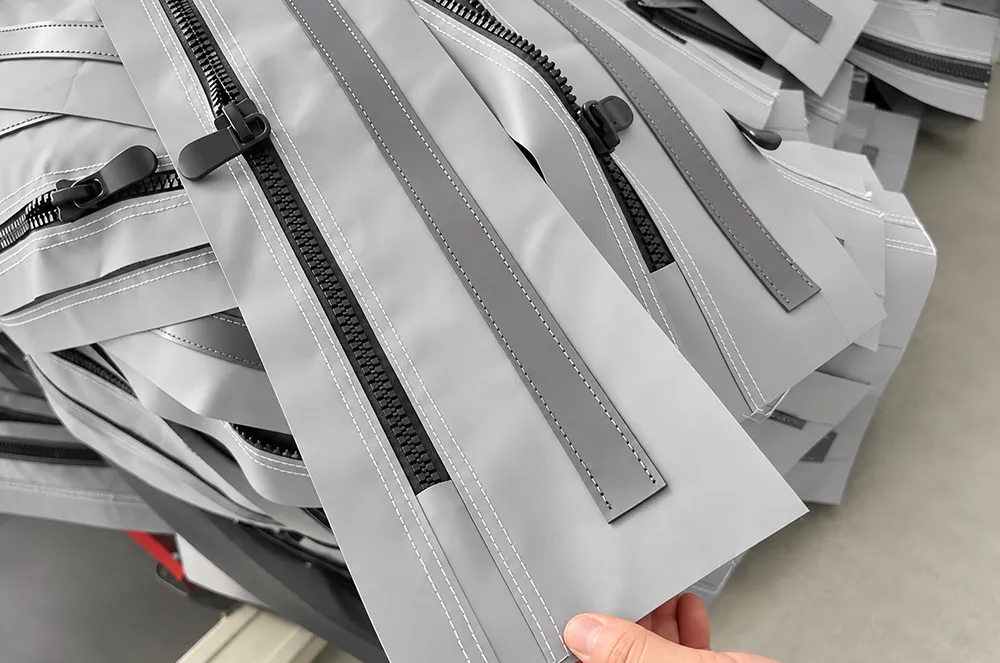
Attaching Webbing, Straps and Hardware
Many commercial vinyl tarps need accessories such as webbing, D-rings, straps, buckles, zippers or reinforced fixing points.
These details often carry concentrated loads. A D-ring, for example, does not work by itself. It needs the surrounding tarp material, reinforcement patch, webbing and stitch layout to work together.
The stitching secures the components, while the webbing and reinforcement help spread the load into a larger area of the tarp.
This is why buyers should not only ask whether the seam is “strong.” They should ask whether the sewn structure matches the way the cover will actually be pulled, tied, opened, folded or installed.
Complex Shapes and Flexible Assemblies
Sewing can also be useful when the tarp includes shaped or flexible sections.
Common examples include:
- Fitted equipment covers
- Industrial curtains
- Flaps and overlap sections
- Zippered openings
- Strap assemblies
- Reinforced edges with several material layers
These areas may involve different materials or small components that are difficult to handle with welding alone. In some designs, sewing is the practical way to attach flexible or non-PVC parts to the cover.
This does not mean every shaped tarp should be sewn. The final method still depends on the fabric, coating, design and performance requirement.
III. Sewing vs Welding Vinyl Tarps
When comparing sewing PVC tarpaulin with welding, the important question is not which method is better overall, but which one is more suitable for the specific joint and finished-cover requirement.
Welding joins compatible thermoplastic surfaces through heat and pressure. Sewing connects material layers with thread passing through the fabric. One method is not automatically stronger or better than the other.
A sewn seam can fail if the stitch line is too close to the edge, the reinforcement is too small, or the load is concentrated in one small area.
A welded seam can fail if the material is not compatible, or if the heat, pressure or seam width is not controlled properly.
In many commercial covers, both methods may appear in the same finished tarp. Large PVC panels may be welded to form the main cover surface, while webbing, straps or selected hardware are added by sewing where the design requires it.
The right question is not “sewn or welded?” The better question is which joining method suits each part of the cover.
IV. How Does Sewing Affect Waterproofing?
A standard sewn seam is not waterproof by itself.
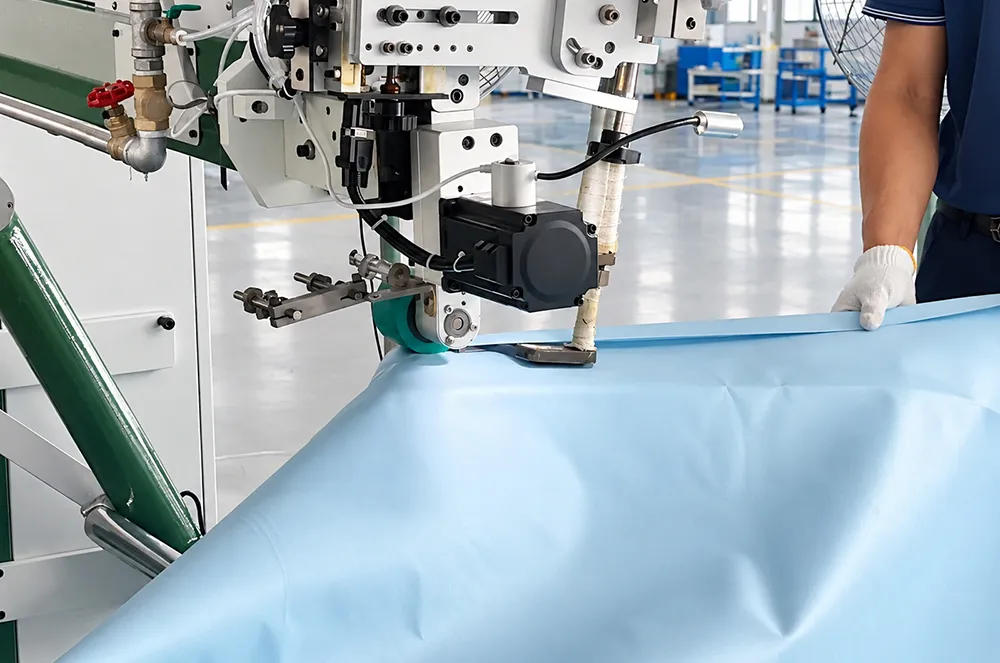
When sewing PVC tarpaulin, the needle passes through the PVC-coated fabric and leaves small holes along the stitch line. Even though the thread fills part of those holes, water can still pass through the sewn area, especially when the seam is exposed directly to rain or standing water.
This does not mean sewing should be avoided. Sewing is still useful for attaching webbing, reinforcement, straps, D-rings, zippers and other components that need a mechanical connection.
How We Improve the Waterproofing of Sewn Areas
When a sewn area also needs water protection, we can apply backside high-frequency sealing after sewing.
After the PVC tarpaulin is sewn, the back of the stitch line is treated with high-frequency equipment. The backside thread is pressed flatter against the PVC surface, and the process helps seal the small needle holes created during sewing.
This allows the finished tarp to keep the sewn reinforcement or hardware needed on the front side while improving water resistance around the stitched area.
A simple way to compare the three constructions is:
In practice, one finished vinyl tarp may use more than one joining method.
The main PVC panels may be welded, while webbing, straps or D-rings are sewn where mechanical reinforcement is needed. Selected sewn areas can then receive backside high-frequency sealing when those stitch lines also need better water protection.
V. What Makes a Good Sewn Vinyl Tarp Seam?
A good sewn vinyl tarp seam is not judged only by whether the stitch line looks straight.
Straight stitching matters, but commercial buyers should look at the full structure around the sewn area. A neat stitch line can still fail if the fabric is not reinforced properly or the load is placed in the wrong direction.
Important details include:
- Whether the seam has skipped stitches, loose thread or broken thread
- Whether the reinforcement patch is large enough for the load
- Whether the stitch line is too close to the fabric edge
- Whether webbing spreads force instead of concentrating it
- Whether corners and turns are smooth
- Whether high-stress areas have suitable reinforcement
The most important idea is the load path.
A metal D-ring sewn onto a small unreinforced patch does not automatically create a reliable fixing point. When the cover is pulled, the force must move from the D-ring into the webbing, then into the reinforcement and surrounding tarp material.
If the reinforcement is too small or the stitch pattern does not support the pulling direction, the fixing point may tear even when the D-ring itself is strong.
This is why sewn vinyl tarp quality should be reviewed as a finished structure, not as separate components.
VI. What Should Buyers Check Before Bulk Production?
Before approving a sewn vinyl tarp for bulk production, buyers should confirm whether the sample reflects the actual finished product.
The sample should not only show fabric color and general size. It should show how the sewn details, welded areas, edge finishing and hardware will be produced.
Check these points before approval:
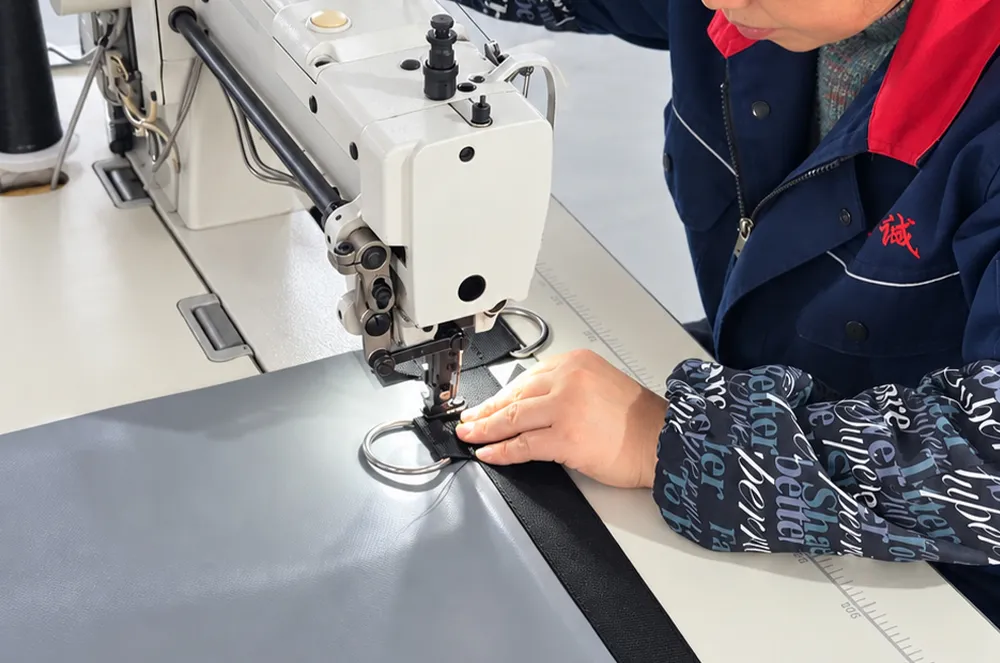
- The sample uses the final material and reinforcement
- The sewn structure matches the drawing or specification
- Webbing, straps, D-rings or zippers are fixed in the agreed way
- High-stress areas have enough reinforcement
- Sewn areas that need water resistance have a sealing or design solution
- The sample can represent repeat bulk production
Factory Experience: Why We Review Sewing and Welding Together
In our finished-tarp production, we often review sewn details and welded areas in the same sample instead of checking them separately.
For example, a custom PVC cover may use welded panels to form the main covering surface. The customer may also need webbing, straps or D-rings along the edges so the cover can be pulled tight or fixed in place. In this case, the welded panel controls the main surface connection, while the sewn reinforcement controls how the load is carried around the edge.
During sample review, we do not only check whether the stitch line is straight. We also look at whether the webbing is wide enough for the pulling direction, whether the reinforcement patch covers enough area, and whether the sewn hardware sits in the right position after the cover is installed.
This is why a production sample should be reviewed as one finished cover. A clean welded panel does not solve a weak fixing point, and a strong D-ring does not help if the surrounding sewn structure cannot spread the load.
Buyers who need a full custom structure can continue to your Custom Vinyl Tarps page. Buyers comparing overall tarp quality can also read your Best Vinyl Tarps guide.
Conclusion: Choose the Seam Method Around the Finished Cover
Sewing vinyl tarps makes sense when the finished product needs reinforcement, webbing, straps, hardware, flexible parts or complex assemblies. Welding is often more suitable for continuous PVC panel joints where material compatibility and water resistance are important.
For B2B buyers, the goal is not to choose sewing or welding as a label. The goal is to confirm that each seam, edge and attachment point matches the tarp’s real use.
If you are developing a custom vinyl tarp with sewn reinforcement, welded seams or mixed fabrication, share your application, finished dimensions and drawings with LonaTarp. Custom finished tarp orders have a 30-piece MOQ.
VIII. Frequently Asked Questions
Can You Sew a Vinyl Tarp Instead of Welding It?
Yes. Sewing is commonly used for reinforcement, webbing, straps and hardware, while welding is often used for continuous PVC panel joints. Many finished tarps use both methods.
Are Sewn Vinyl Tarp Seams Waterproof?
Not by themselves. Sewing creates small needle holes that can allow water through. Where better water protection is required, we can apply backside high-frequency sealing after sewing to help seal the needle holes and improve the water resistance of the stitched area.
Is Sewing Stronger Than Welding for Vinyl Tarps?
Neither method is automatically stronger. Performance depends on the material, seam design, reinforcement, load direction and production quality.