A pool liner is a flexible lining fitted against the inside walls and floor of a swimming pool. In a liner-based system, it holds the water and forms the surface people see and touch. Vinyl liners are commonly made from flexible PVC.
Not every pool needs a separate liner. The deciding factor is how the pool is built and waterproofed, rather than whether it sits above or below ground. Understanding that distinction helps pool manufacturers, distributors and project buyers identify the right component before discussing materials or specifications.
I. What Is a Pool Liner, and Where Does It Sit?
The Lining Inside the Pool Walls and Floor
The liner sits between the pool water and the supporting wall and floor surfaces. Depending on the design, it may also extend over steps, benches or other internal features.
Its role is different from that of the pool structure. Walls, supports and the prepared base establish and support the pool’s form. The liner provides the water-contact surface within that arrangement.
This matters when specifying a replacement or a new lining system. A membrane cannot be selected solely because it looks similar to the existing surface. It must suit the supporting construction, internal geometry and connection details.
What Is a Vinyl Pool Liner?
In this context, vinyl generally refers to flexible polyvinyl chloride, or PVC. A vinyl pool liner is a lining made from that material, formed and joined to suit its intended pool system.
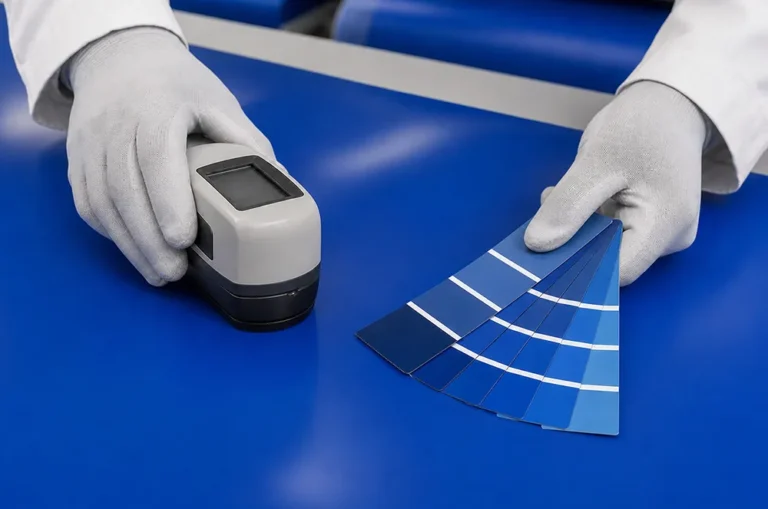
The term does not describe one universal construction. Unreinforced PVC film has no textile reinforcement, while reinforced PVC membrane incorporates a reinforcing layer. A printed surface or similar color does not tell you which structure is underneath.
There is also a difference between liner material and a finished liner. Rolls still require downstream fabrication or installation; a finished liner has already been prepared for a particular configuration. Buyers should establish which form they need before requesting a quotation.
How a Liner Differs from a Pool Cover or Underlay
These components occupy different positions and perform different jobs.
| Component | Position | Main function |
|---|---|---|
| Pool liner | Against the internal walls and floor | Forms the water-retaining lining in the intended system |
| Pool cover | Over the pool or water surface | Provides the covering functions specified for that cover |
| Underlay or protective layer | Beneath the liner, where required | Provides separation, cushioning or substrate protection according to the system design |
An underlay does not replace the liner’s water-retaining function. Equally, a pool cover does not waterproof the pool basin.
II. What Does a Pool Liner Do, and How Does It Work?
It Forms the Water-Retaining Lining
The main purpose of a pool liner is to contain water within the supported pool basin. The lining creates a continuous barrier across the areas it covers, separating the water from the surfaces behind it.
Water pressure helps press a correctly fitted liner against its supporting surfaces. It does not correct an unsuitable base, the wrong dimensions or poorly executed connections.
The useful distinction is between a waterproof sheet and a watertight lining system. The sheet is one component; its fit, joints, edges and penetrations determine how it performs after installation.
Seams, Edges and Fittings Complete the System
A pool interior includes more than uninterrupted wall and floor areas. It also has corners, transitions and openings for equipment such as skimmers, returns and drains.
Where sheets meet, the joints must provide continuity. Where the liner meets an opening or termination, the connection must be compatible with the lining system. A sound central panel cannot compensate for a leaking fitting.
Fabrication methods also differ. A factory-made liner and a membrane joined on site follow different production and installation routes. Material suitability and joining methods therefore need to be confirmed together.
For manufacturers sourcing rolls, this means identifying the intended fabrication route before choosing the material. For a renovation project, it means checking how the proposed lining will connect to the existing pool details.
It Creates the Visible Pool Interior
The liner also determines much of the pool’s internal appearance. Solid colors, printed designs and surface textures offer different visual effects.
Those choices need to be viewed in context. Water depth, lighting and surrounding finishes can change how a pattern or color appears after the pool is filled.
Surface feel is a separate consideration. A smooth finish and a textured finish are different options, and a visible texture alone does not establish slip resistance. Any required performance should be supported by the relevant product evidence.
The liner also provides the surface that must be cleaned during routine pool care. Ease of cleaning depends on the selected finish and the deposits or staining involved. Confirm which cleaning tools and products are compatible with that lining; an unsuitable method can damage its surface.
III. Which Pools Need a Liner? Above-Ground and Inground Explained
Above-Ground Pools Designed Around a Liner
An above-ground pool liner is the internal lining used in a pool installed above ground. In many rigid-wall designs, the wall system provides support while a separate flexible liner retains the water.
Where the pool has been designed around that arrangement, the liner is an essential component. The supporting wall is not a substitute for it.
However, “above-ground” describes the pool’s position, not a complete material specification. It does not establish whether the lining is reinforced, how thick it should be or how it attaches at the top.
Some flexible-wall products use fabric or membrane as part of the pool body itself. These should be assessed from their actual construction rather than treated as identical to a rigid-wall pool with a separate liner.
Inground Pools Can Use Different Interior Systems
Some inground pools have liners; others use a different interior finish and waterproofing arrangement. The CFFA industry association overview of pool types distinguishes vinyl liner, fiberglass and concrete construction.
A vinyl liner inground pool is designed to use a compatible liner as its water-retaining interior. Other pools may have a concrete shell with a specified finish system, or a prefabricated fiberglass shell with its own internal surface.
An intact fiberglass pool with its specified interior surface does not usually need an additional flexible liner simply because it is installed inground. Any proposed conversion to a membrane lining requires a separate assessment of the shell, compatibility and connection details.
Concrete pools can also be lined with suitable PVC membrane systems. This is one possible approach for new construction or renovation, subject to the condition of the shell, surface preparation and connection details.
The answer to whether an inground pool needs a liner therefore comes from its design. Being below ground does not make a separate flexible liner compulsory.
A Quick Way to Judge Whether a Liner Is Required
Start by identifying the existing or proposed water-retaining system.
| Pool situation | Initial conclusion | What to confirm |
|---|---|---|
| The original design relies on a flexible liner | A compatible liner is required | The original construction and lining requirements |
| An above-ground pool has an unclear construction | Location alone is insufficient | How its walls, floor and water-retaining layer work together |
| An inground vinyl liner pool | The liner is part of the specified system | Fit, attachment and fitting compatibility |
| A pool already has another complete interior system | A separate liner is not automatically necessary | The condition and requirements of that system |
| An existing pool is being considered for membrane relining | Relining may be an option | Substrate condition, compatibility and detail design |
| A pool is losing water | Diagnose the cause before choosing a remedy | Whether the issue concerns the lining, fittings, pipework or structure |
If the question is “Do I need a pool liner?”, the first useful document is the pool’s construction specification. If that is unavailable, a professional assessment should establish how the existing basin retains water.
A leak by itself is not enough evidence to prescribe a new liner.
IV. What Are the Benefits and Limitations of a Pool Liner?
The Practical Benefits of a Suitable Liner System
A suitable lining system combines a water-retaining surface with choices in appearance and fabrication.
Its practical advantages can include:
- A defined waterproof lining: the membrane provides a continuous lining when its seams and connections are correctly completed.
- A choice of interior finishes: colors and patterns allow different visual treatments without making the pool structure itself decorative.
- Adaptation to pool geometry: suitable material and fabrication can accommodate the intended walls, floor and internal details.
- A renovation option: some existing pools can be assessed for relining rather than simply reproducing their previous finish.
- A specified surface feel: different finishes can be considered for the intended use, cleaning regime and performance requirements.
These benefits depend on the selected product and system. No single liner construction is automatically suitable for every pool.
What a Liner Cannot Compensate For
A liner cannot provide the structural capacity that the pool design requires. Nor should it be used to conceal an unresolved structural defect.
Rough or sharp supporting surfaces, unsuitable detailing and incorrect installation can damage the lining. Water treatment and cleaning practices also need to follow the applicable material and system instructions.
Thickness alone does not resolve these issues. A thicker sheet may still perform poorly if its formulation, joining behavior or installation is unsuitable. Likewise, an attractive pattern says little about seam quality.
A liner also remains a component that needs inspection and care. Claims of permanent waterproofing, maintenance-free use or a fixed service life need evidence and conditions; they cannot be inferred from the word “vinyl.”
How It Differs from Other Pool Interior Finishes
The immediate choice concerns how the pool’s internal surface and waterproofing will be provided.
| Interior approach | What distinguishes it | What needs checking |
|---|---|---|
| Flexible liner or PVC membrane | Uses a separately formed and connected lining | Support, joints, terminations and fittings |
| Plaster or similar applied finish | Creates an applied interior surface over a compatible construction | The specified finish and underlying waterproofing arrangement |
| Tile finish | Provides a tiled wearing and decorative surface | The complete assembly behind the tile, including waterproofing and interfaces |
| Coating system | Uses a specified coating over a prepared substrate | Product compatibility, preparation and application conditions |
A tiled appearance does not reveal the waterproofing construction behind it. Similarly, choosing a membrane does not remove the need to assess the supporting surface.
The appropriate approach depends on the existing pool, the proposed work and the requirements of the complete system.
V. What to Confirm Before Taking the Next Step
Before choosing a product or requesting a quotation, answer four questions:
- Does the pool rely on a liner? Check the specified water-retaining system rather than judging from its above-ground or inground position.
- What are you sourcing? Distinguish material rolls, a fabricated liner and an installation service.
- Will the complete lining fit the pool? Confirm the supporting surfaces, pool geometry, fittings and edge connections.
- Which decision comes next? If the construction is still unclear, identify the liner type first. Once the material structure and fabrication route are established, review the required specifications.
For material buyers, those answers provide a useful basis for comparing quotations. Ask suppliers to address the same material construction, fabrication route and intended pool application before comparing individual specifications.
LonaTarp manufactures reinforced PVC pool liner membrane and unreinforced PVC pool liner film in roll form for business buyers. You can compare these constructions on our PVC pool liner materials and rolls page. When requesting a material review, include the intended pool system, downstream fabrication method, target specification and estimated roll quantity.
Fabrication and installation are handled by your liner fabricator or installation contractor.