Is PVC tarpaulin oil resistant? The honest answer I give buyers is: yes, for splashes of lubricant, grease and hydraulic oil, if the coating is formulated for it. It is not automatically oil resistant, and no PVC tarp is resistant to every oil or solvent. The reason is the plasticizer that keeps PVC flexible. Oils and fuels can slowly pull that plasticizer out, and the coating then stiffens, shrinks and cracks. How fast that happens depends on the oil, the temperature, how long it sits on the fabric, and how the material was made.
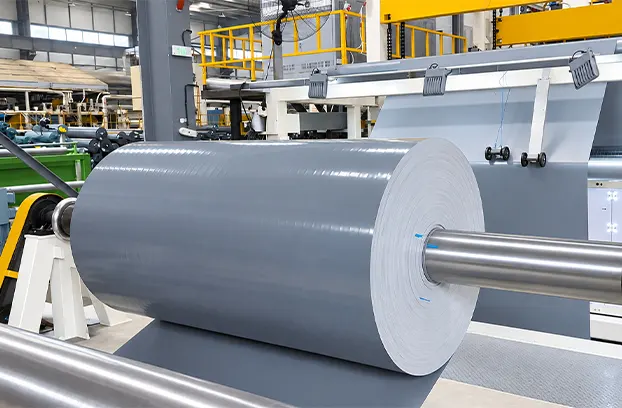
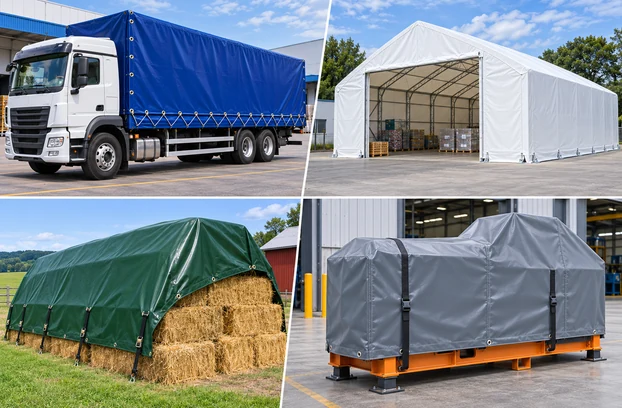
We produce PVC tarpaulin rolls for covers, curtains and liners, and oil contact is one of the questions I get most often from industrial buyers. This guide explains what oil does to the coating, what changes the result, and how to check a material before you place a bulk order.
I. The Short Answer: Oil Resistant, Within Limits
A quick way to think about it:
- Occasional splash, wiped off: a standard PVC coated polyester tarpaulin usually copes well.
- Repeated contact every day: possible, but the formulation, top coat and seams need to be chosen for it and checked.
- Oil that pools on the fabric or stays in contact for weeks: this is a containment job, not a cover job. The material has to be specified and tested for that fluid.
- Gasoline and strong solvents: treat these as a separate case. Do not assume a tarp that handles motor oil will handle fuel.
When a supplier simply writes “oil resistant” on a data sheet, ask which oil, at what temperature, for how long, and how it was tested. Without those four answers, the phrase tells you very little.
II. What Oil Actually Does to a PVC Coating
Rigid PVC is a hard plastic. To make a flexible coating, we add plasticizers, which are oily liquids blended into the PVC compound. They make up a large share of a flexible coating, and they do not lock permanently into the polymer.
When a hydrocarbon such as crude oil, diesel or lubricating oil sits on the surface, the plasticizer can migrate out of the PVC and into that liquid. This is called extraction. Over time you see:
- the coating feeling harder or less flexible than the unexposed area
- shrinkage, which can pull the fabric out of shape
- surface cracking, especially at folds and creases
- in some cases a sticky or oily surface while the plasticizer is moving
Heat speeds this up, because the plasticizer moves faster in a warm coating and a warm oil. A sticky surface can have several other causes, so we wrote a separate note on why PVC fabric turns sticky. Badly attacked coating can also start to lose its grip on the base fabric, which leads to delamination.
The polyester base fabric inside the tarp is not the weak point here. The coating is what keeps oil out, so the question is how long the coating keeps its properties.
III. What Decides Oil Resistance: Formulation, Top Coat, Thickness and Edges
Formulation
The plasticizer type and the rest of the compound decide how easily oil can extract it. This is the main difference between a general-purpose tarpaulin and one made for oil contact. For oil-contact orders we use an oil-resistant PVC formulation instead of our general-purpose compound. The two can look identical on the roll, so ask your supplier which one you are getting. You cannot tell by looking.
A PVDF top coat
On our coating line we can apply an acrylic, PVDF or PVDF/TiO₂ top coat in the same run. PVDF is chemically inert and resists weathering well, so a PVDF surface slows down the attack on the PVC underneath. If you want more on surface finishes, see our lacquered PVC tarpaulin with acrylic or PVDF top coats.
I always add one caution: the top coat is a thin layer on the face of the fabric. Cut edges, the back face, welded seams and areas that get scuffed are still plain PVC. A PVDF surface buys time. It does not make the whole tarp fuel-proof.
Coating weight and thickness
A heavier coating gives oil more material to work through before it reaches the base fabric. We make PVC coated fabrics from about 300 to 2,500 g/m², and for oil contact I would not pick the lightest grade that just meets the strength requirement.
Edges, seams and hardware
In real use, oil rarely gets in through the middle of the sheet. It gets in at the cut edge, a stitched hem, a grommet or a seam. For oil contact we recommend welded seams rather than stitched ones, because stitching leaves holes through the coating. Our notes on PVC fabric welding cover hot-air and high-frequency welding. We can also supply base fabric with anti-wicking treatment, which limits how far liquid travels along the yarns from an exposed edge.
IV. Choosing an Oil Resistant Tarp for the Type of Contact
When someone asks me for an oil resistant tarp, my first question is not about the tarp. It is about the contact.
| Type of contact | Typical example | What we usually suggest |
|---|---|---|
| Occasional splash | Machine covers, workshop curtains, truck covers near grease points | PVC coated polyester with a cleanable surface; PVDF top coat if it also sits outdoors |
| Repeated wetting | Daily oil or coolant spray, wash-down areas | Formulation chosen for oil contact, PVDF top coat, welded seams, sealed edges; sample test with your fluid |
| Pooling or temporary containment | Drip trays, ground protection under equipment, temporary liners | Laminated or impregnated construction (knife-coated fabric can contain micro-pores), fully welded, tested against the actual fluid before bulk order |
| Long immersion or fuel storage | Fuel bladders, reusable storage tanks | Often TPU or another engineered material; PVC only for defined, limited-time use |
For reusable fuel containment, many buyers specify TPU coated fabrics instead of PVC. TPU contains no plasticizer, so extraction is not the issue it is for PVC. TPU also has to be checked against the specific fuel, and it costs more. We make both, so I am happy to tell you when PVC is the better value and when it is not.
V. PVC Tarpaulin Chemical Resistance Beyond Oil
PVC tarpaulin chemical resistance varies by chemical, concentration and temperature. Water, many dilute acids and alkalis, and ordinary rain and dirt are generally not a problem. Strong solvents (ketones, chlorinated solvents, many aromatics) can swell or dissolve the coating, and some cleaning products can extract plasticizer just as oil does.
Because of this, we do not publish a general chemical resistance chart and say “pass” for everything on it. Send us the safety data sheet (SDS) of the chemical, its concentration, the temperature and how long it stays on the fabric, and we will tell you whether we think PVC suits it and how to test it.
Cleaning is part of chemical exposure too. Many covers are damaged by the degreaser rather than the oil. Our guide to cleaning PVC coated fabric explains which cleaners to check first.
VI. How Oil and Chemical Resistance Is Tested
These are the test methods I see most often in buyers’ specifications:
| Method | What it covers | What you get |
|---|---|---|
| ISO 175 | Plastic specimens fully immersed in a liquid chemical | Change in mass, dimensions, appearance and other properties after immersion |
| ASTM D543 | Resistance of plastics to chemical reagents | Immersion for containers and transfer lines; wet patch for splash and spill contact; changes in weight, dimensions, appearance and strength |
| ASTM F715 | Coated fabrics used in oil spill barriers and temporary storage devices | Laboratory performance tests for membranes in spill control and storage use |
Two points help when you read the results:
- Choose the method that matches the contact. ASTM D543 itself separates immersion (for anything that holds the liquid) from a wet patch (for splash or spill). A splash cover does not need an immersion test, and a liner should not be approved on a splash test.
- Short tests screen; they do not predict service life. ASTM notes that for continuous immersion, short-time test data mainly helps rule out unsuitable materials. Test with your own oil, at your working temperature, and compare tensile strength and flexibility before and after exposure. Our guide on how to read a PVC tarpaulin strength spec sheet explains those numbers.
We do not publish oil immersion results for our standard grades, because a result for one oil at one temperature would be misread as a general rating. For an oil-contact order, we send samples to a third-party laboratory for testing with your fluid, to the method you specify.
VII. A Real Example: Liners for Temporary Oil Storage
One project shows how we approach this in practice. A customer in a country neighboring Russia needed large circular liners for temporary storage of crude oil, refined fuel and oily waste, about 20 m to over 40 m in diameter. Each liner was for one-time use.
We supplied a PVC coated polyester with an oil-resistant, fuel-resistant formulation and a PVDF surface treatment:
| Item | Value |
|---|---|
| Base fabric | Polyester 1000D × 1000D, 20 × 20 |
| Weight | ≥ 680 g/m² |
| Tensile strength (warp / weft) | 2,730 / 1,900 N/5cm |
| Tear strength (warp / weft) | 270 / 240 N (trapezoid) |
| Peel strength | 90 N/5cm |
| Surface | PVDF treatment |
| Formulation range | -30 °C to +70 °C |
| Testing | Tested to GOST 29151-91 |
The liners were joined with three hot-air welded seams, each at least 90% of the parent material’s strength, with metal eyelets every 1.2 m. The full details are in our fuel containment liner project.
What I take from that project: the material was chosen for a defined job, a defined set of fluids and a one-time service period. That is the right way to use PVC with oil. Using the same fabric for years of permanent fuel storage would be a different question.
VIII. What to Send Us for an Oil-Resistant PVC Tarpaulin Quote
To recommend a material, I need:
- The fluid: product name, type (crude, diesel, gasoline, hydraulic oil, cutting fluid, etc.) and SDS if you have it.
- The contact: splash, repeated wetting, pooling or immersion; how long each contact lasts; how often.
- Temperature: of the fluid and of the site, including winter lows.
- The product: roll goods or finished covers/liners, sizes, seams, edges and hardware.
- Outdoor exposure: whether it also needs UV and weather resistance.
- Required tests: the method and the pass criteria, if your project already has them.
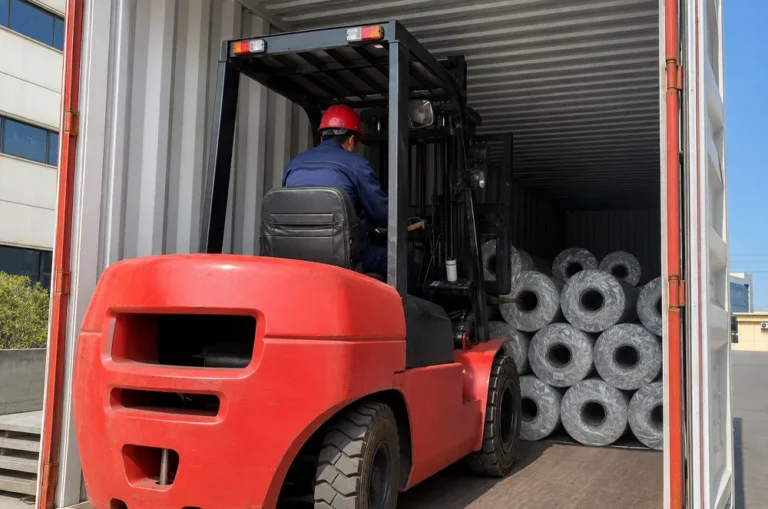
We supply PVC coated tarpaulin as rolls and as finished products. Minimum order: 5,000 m² per order for rolls; for finished products, 30 pieces per size with a total of at least 5,000 m². If you are comparing materials, our PVC coated tarpaulin page lists the weights and base fabrics we make.
IX. FAQ
Is PVC tarpaulin chemical resistant?
To many chemicals, yes, but not to all. Water, rain and many dilute acids and alkalis are usually fine. Strong solvents and some fuels can damage the coating. Give your supplier the SDS, concentration, temperature and contact time rather than relying on a general claim.
Can one tarp handle hydraulic oil, diesel and gasoline?
Do not assume so. Gasoline and other light fuels are much more aggressive to PVC than hydraulic oil or grease. If one tarp will see several fluids, test it against the most aggressive one.
Does a PVDF top coat make PVC tarpaulin fuel-proof?
No. PVDF slows the attack on the face of the fabric, but edges, seams and the back face are still PVC. It is an improvement, not a guarantee.
How long do PVC tarps last?
As a guide for typical outdoor cover use: about 3–7 years for 0.25–0.5 mm (270–610 g/m², 8–18 oz/yd²), 7–10 years for 0.5–1.0 mm (610–1,190 g/m², 18–35 oz/yd²), and 10–15 years above 1.0 mm (over 1,190 g/m², 35 oz/yd²). These are reference values, not a warranty. Actual life depends on the top coat, UV exposure, climate and handling, and regular oil contact will shorten it.
Which is better for oil, PE or PVC tarpaulin?
For anything beyond a short-term cover, PVC. PE tarps are light and cheap, but they are made for short-term weather cover, not for repeated oily contact. Our vinyl vs poly tarp comparison covers the other differences.
Is PVC tarpaulin completely waterproof?
The coated sheet itself is. Leaks usually come from seams, stitching, grommet holes and cut edges: the same weak points where oil gets in. See where water gets into PVC fabric.
Does oil resistance change in cold weather?
Oil extraction is slower in the cold, but a coating that has already lost plasticizer becomes stiffer and cracks more easily when it is folded in winter. Our standard formulations are designed for -30 °C to +70 °C. More on PVC fabric in cold weather.
If you have a cover, curtain or liner that will meet oil, send me the fluid and how it will be used. I would rather spend ten minutes on the right questions than ship 5,000 m² of the wrong material.