PVC tarpaulin delamination is when the PVC layer loses its bond with the polyester base fabric and starts to peel, bubble or lift. It usually begins at a cut edge, a sharp crease or beside a welded seam. The root cause is almost always a bond that was too weak for the job, and the number that predicts it is peel strength.
I have spent more than 20 years making PVC tarpaulin, and delamination is one of the first things serious buyers ask me about. It is also one of the most misunderstood. Many guides say “laminated tarps peel, coated tarps don’t.” Our production records say the answer depends far more on how the bond is built than on the label. This guide explains what we see in the factory, how to check a failed tarp, and how to write a specification that prevents it, whether you buy laminated PVC tarpaulin or knife-coated PVC tarpaulin.
I. What PVC Tarpaulin Delamination Is, and What It Is Not
A PVC tarpaulin has three parts: a PVC layer on each side and a polyester base fabric in the middle. The two PVC layers hold on to the fabric partly by gripping the yarns and partly by bonding to each other through the gaps between the yarns. Delamination means that bond has failed and the layers have separated.
Where Delamination Usually Starts
- Cut edges and hems. Moisture can enter the exposed yarns and work along them under the coating.
- Fold lines. A tarp that is folded along the same crease again and again stresses the bond at the same line.
- Next to welded seams. Too much heat or pressure at the weld can damage the bond just beside the seam.
- Bubbles in the middle of a panel. A soft blister that grows over time is usually a weak spot in the bond, not trapped air.
Damage That Looks Like Delamination but Is Not
Before blaming the bond, rule out these look-alikes:
| What you see | What it usually is | How to tell |
|---|---|---|
| Fine cracks across the surface after cold weather | Cold cracking of the PVC layer | The crack runs through the PVC; the coating is still stuck to the fabric |
| A thin film or print flaking off | Topcoat or ink failure | Only the surface finish lifts; the PVC underneath is intact |
| Yarn showing through a worn patch | Abrasion | The coating has worn away, not peeled away |
| Sticky or greasy surface | Plasticizer migration | The surface changes, but the layers have not separated |
Each of these has a different cause and a different fix. Our guide to PVC fabric in cold weather covers cold cracking in more detail.
II. Why PVC Tarpaulin Coating Peels: The Main Causes
A Bond That Was Too Weak From the Start
Most delamination I have investigated goes back to the production route not matching the end use. In our factory, we choose the process by working backwards from how the product will be used. When that step is skipped, these are the usual problems:
- The base fabric is too dense for lamination. In laminated fabric, peel strength falls as the base fabric gets denser, because a tight weave leaves fewer openings for the two PVC layers to bond through. We cover this in our lamination process notes.
- Not enough paste in the fabric. On dense or heavy fabrics, we impregnate the base fabric with paste before laminating. Skipping or thinning that step leaves the yarns poorly anchored.
- Wrong heat or pressure. If the PVC does not flow into the weave, it sits on the surface instead of gripping the yarns.
- A low-cost bonding method used for a demanding product. Cold lamination is fine for mattress covers and folders. It is not the right choice for a truck curtain that flexes all day.
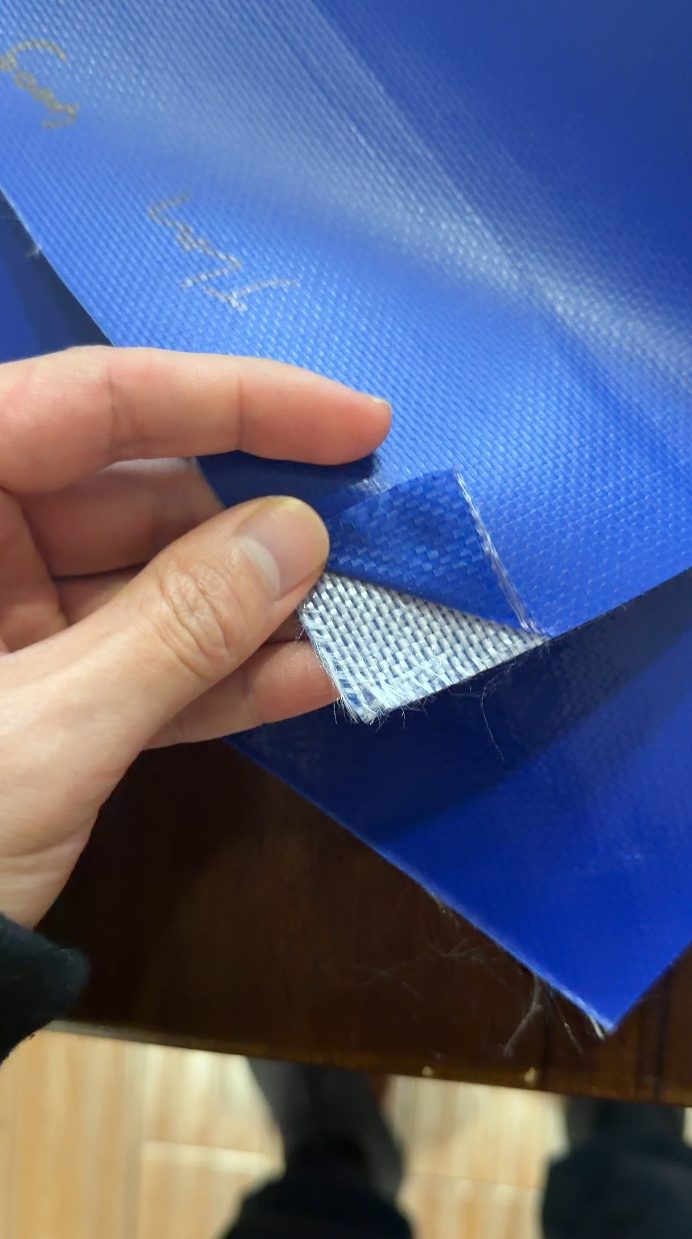
The photo below shows what low peel strength looks like on a laminated fabric. The PVC film lifts away from the base fabric as one clean sheet, and the white polyester yarns underneath are left almost bare. The film itself is undamaged; the bond between the film and the fabric was simply too weak.
Too Much Filler in the PVC Compound
The bond can also fail inside the PVC itself. A buyer once sent us the photo below. It is a knife-coated ripstop PVC tarpaulin made for truck covers. The order had been pushed to a very low price, and the factory that made it met that price by putting more calcium carbonate filler into the PVC compound. On the finished fabric, rubbing the surface with a thumb was enough to lift the coating off the yarns. Compare it with the laminated sample above: there the film came off as an intact sheet, while here the coating itself broke up under light rubbing.
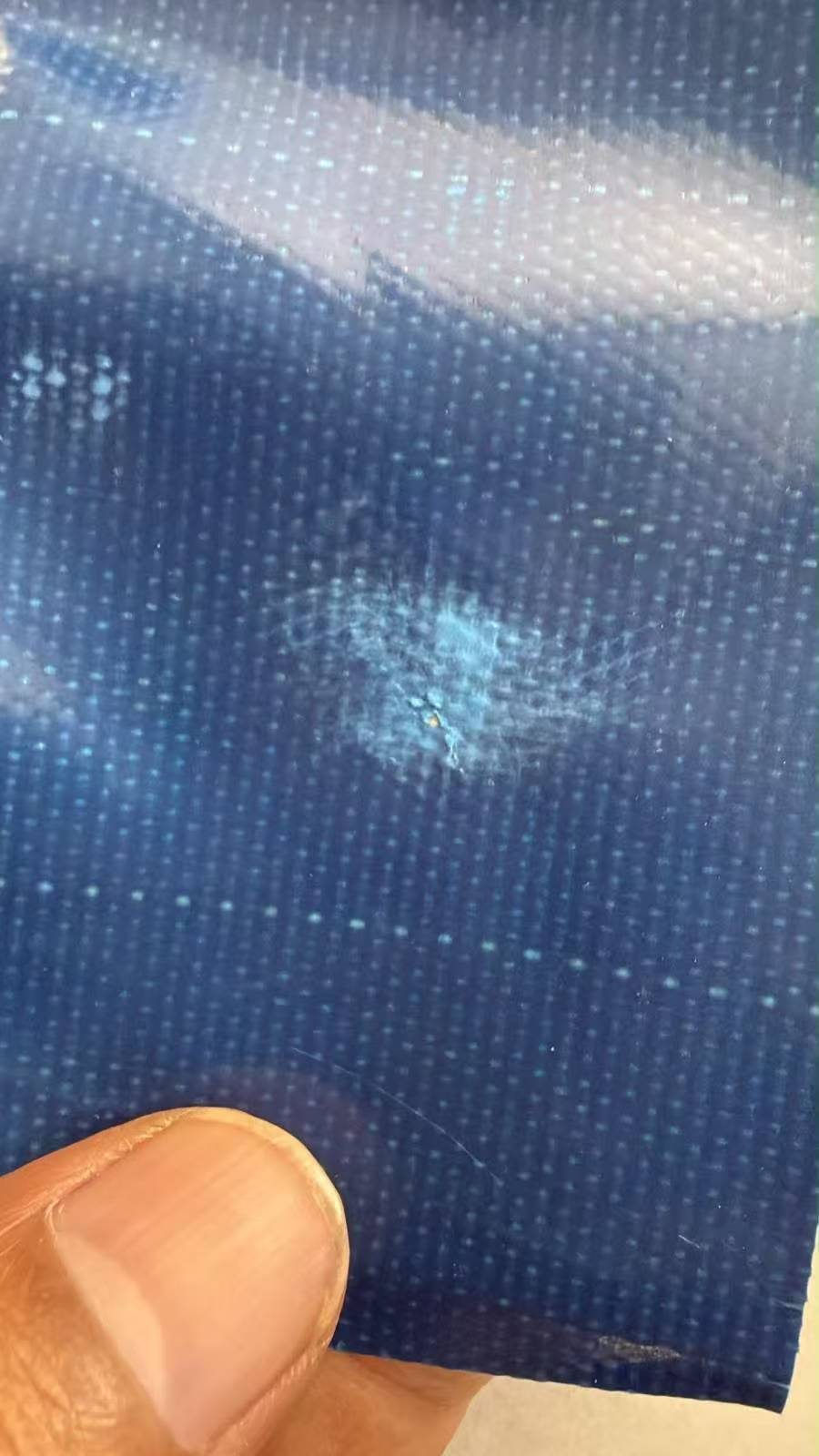
Filler is a normal ingredient in PVC compound. The problem is the amount. When filler replaces too much of the PVC resin and plasticizer, the coating loses the binder that holds it together and grips the yarns. Filler also adds weight, so the fabric can still meet the g/m² on the order. Weight alone will not show this problem; peel strength will. If a quote is far below the market for the same weight and construction, ask what has changed before you place the order.
Moisture Wicking In From the Cut Edges
Polyester yarns can act like a wick. Once water gets into the yarns at a cut edge, it can travel along them under the coating. That is why we offer anti-wicking yarn treatment. In a simple test we use, a sample is left in coloured water for 24 hours: treated yarns draw the water about ten-odd centimetres, and untreated yarns draw it roughly twice as far. Some lamination methods also leave the cut edge more open to wicking than others. If your product has exposed edges in wet service, ask for anti-wicking PVC fabric.
Folding, Flexing and Vibration
A truck curtain that flaps at highway speed or a cover that is folded tight every day puts the bond through millions of small bending cycles. A weak bond fails first at the crease or the most flexed area. This is where a fabric’s flexibility matters as much as its peel number.
Heat, Sunlight, Cold and Chemicals
PVC and polyester do not respond to heat in the same way, so repeated heating and cooling strains the bond. Long sun exposure ages the PVC. Oils, solvents and some chemicals can draw plasticizer out of the PVC, leaving it stiffer and less able to move with the fabric. Our standard formulations are designed for use from −30 °C to +70 °C; outside that range, the risk of cracking and bond damage rises.
Welding Damage Next to the Seam
If a seam is welded too hot or with too much pressure, the bond right beside the weld can be damaged even when the seam itself looks fine. Welding settings depend on the process: on our process charts, the hot-air welding temperature is about 550–650 °C for knife-coated rolls and about 350–450 °C for laminated rolls. A test weld on the actual roll is the only reliable check; see how to check tarpaulin welding quality.
III. Coated vs Laminated Tarpaulin: Which Delaminates Less?
You will often read that knife-coated tarpaulin “always” resists delamination better than laminated tarpaulin. Our production data does not support that as a general rule. Peel strength depends on the bonding method, and laminated fabric covers several very different methods, from cold lamination at the low end to impregnation followed by lamination at the top. In our own production, knife coating is typically from 60–70 N/5cm, and impregnation plus lamination reaches 100 N/5cm or more, up to about 200 N/5cm. The full peel level for each process is in the process table of our tensile, tear and peel strength guide.
So the strongest bond we make is a laminated one: impregnation followed by lamination. That is why we use it for airtight PVC fabrics, liquid storage bags and boat fabric. Knife coating gives a softer, more fold-resistant fabric that suits truck curtains, tarpaulins and tensile structures, but it is not our choice for liquid containers or inflatables, because the coated layer can contain micro-pores.
The right question is not “coated or laminated?” but “which bonding route, and what peel value, for this use?” For the full process comparison, read knife coating vs lamination.
IV. Peel Strength: The Number That Predicts Delamination
Peel strength (also called coating adhesion) is the force needed to pull the PVC layer away from the base fabric, usually reported in N/5cm. It is the most direct way to measure the bond before the tarp goes into service. Our guide to tensile, tear and peel strength explains the test methods and units in detail; here is what matters for delamination.
What to Ask For
- A peel value and its test method. For example, DIN 53357, FZ/T 80007 or ISO 2411. Values from different methods are not directly comparable.
- Face and back. The two sides of a fabric can bond differently, so ask for both.
- Minimum, not just typical. A typical value tells you about average production; a minimum value is what you can hold the supplier to.
- Conditioning, if your use is harsh. If the tarp will see heat, water or cold, ask whether peel is also checked after ageing, soaking or low-temperature exposure.
- A welded peel test for finished products. For fabricated tarps, the bond next to the weld matters as much as the bond in the roll.
What We Do on Every Order
We test peel strength on every production order on our own testing equipment, together with tensile and tear strength. For welded products, we also test peel on welded samples: 5 cm samples for high-frequency welds and 3 cm samples for hot-air welds. We keep the test record for every sample we test, which matters if a question about a shipment comes up later. You can see more about how testing fits into our production on our quality control page.
V. How to Check a Delaminated Tarp Before You Claim or Reorder
When a customer sends me photos of a peeling tarp, I go through the same five questions. They usually point to the cause within a few minutes.
- Where did it separate? Between the PVC and the fabric, inside the PVC layer, in the surface finish, or in the fabric itself? Only the first is true delamination. How it separates also helps: on laminated fabric, a film that peels off in one clean sheet points to low peel strength; on coated fabric, a coating that breaks up under a firm thumb rub points to a weak PVC compound.
- Where on the tarp? Edges point to wicking or hemming; fold lines point to flexing; weld edges point to welding settings; random bubbles point to a weak bond in the roll.
- How old is the tarp, and how was it used and stored? Folded wet, stored in heat, exposed to oil or chemicals?
- Is there a lot number and a retained sample? Comparing the failed tarp with an unused sample from the same roll separates a production problem from a service problem.
- What did the specification say? If no peel value, method or conditioning was agreed, write them into the next order.
Keep the failed piece. A small section cut from the damaged area and one from an undamaged area is far more useful to your supplier than photos alone.
VI. How to Prevent PVC Tarpaulin Delamination
In the Material Specification
- Tell your supplier the real end use: flexing, folding, welding, wet edges, heat, chemicals and temperature range.
- Agree the bonding route with the supplier, not just “PVC coated” or “PVC laminated.”
- Specify peel strength with method, face and back, minimum value and any conditioning.
- Ask for anti-wicking treatment if cut edges will be exposed in wet service.
- Confirm the route and the peel value on a trial sample before bulk production.
- Be careful with a price far below the market for the same weight. Extra filler can keep the weight on spec while weakening the coating.
In Fabrication
- Run a test weld on the actual roll and check the bond beside the seam, not only the seam strength. We do this as part of our custom PVC tarpaulin fabrication.
- Seal or hem exposed cut edges where moisture is likely.
- Avoid placing seams and grommets on the fold lines the product will be stored on.
In Use and Storage
- Clean off oils, fuel and chemicals rather than letting them sit on the surface; see how to clean PVC coated fabric.
- Dry the tarp before storing it, and store it out of direct heat.
- Roll rather than fold where you can, or change the fold lines from time to time.
Can a Delaminated Tarp Be Repaired?
A small, isolated area can sometimes be patched or re-welded. Once peeling appears in several places, the bond has generally failed across the material, and replacing the tarp with a correctly specified fabric is usually the better decision. If you are reordering, use the failure to sharpen the specification; that is often worth more than the repair.
VII. FAQ
Why does PVC coated fabric delaminate?
Usually because the bond between the PVC and the polyester base fabric was too weak for the way the fabric is used. A bonding route that does not suit the base fabric or the end use, too much filler in the PVC compound, moisture wicking in from cut edges, repeated folding and flexing, heat and chemicals, and welding damage are the most common causes.
Is knife-coated tarpaulin less likely to delaminate than laminated tarpaulin?
Not as a general rule. In our production, impregnation followed by lamination gives the highest peel strength, from 100 to about 200 N/5cm, while knife coating is typically from 60–70 N/5cm upward. Knife-coated fabric is softer and more fold-resistant, which helps in flexing uses. Compare the peel value and the bonding route, not the label.
What peel strength should a PVC tarpaulin have?
It depends on the use. Ask for a minimum value for face and back, the test method, and any conditioning that matches your service. As a reference from our own production, knife-coated fabric is typically from 60–70 N/5cm and impregnated laminated fabric 100 N/5cm or more. The strength guide linked above includes a real peel test record from our lab.
Is a delaminated PVC tarp still waterproof?
Not reliably. Once the PVC lifts, water can reach the polyester yarns and travel along them, which can lead to mildew and loss of strength over time. Small areas can be repaired; widespread delamination usually means replacement.